One of them is a very useful security feature.
With its latest crop of foldable devices in August comes Samsung’s One UI 9 update, the first version of the company’s interface for Galaxy devices to be built on Android 17. Along with a new version of the operating system, One UI 9 brings welcome updates and features. As of this writing, it is widely rolling out to recent flagships primed for the update.
By now, we’ve become accustomed to a slew of sloppy AI features accompanying new smartphones. So it’s a big relief to report that many of the new inclusions this time around seem like things that real people might actually enjoy. Even some of the AI features are a bit more grounded than the nifty photo generation features of the last couple of years.
After installing One UI 9 on a Galaxy S26 Ultra and S25 Ultra, we tested its coolest new features to see which ones are the most useful. While some features seemed great on paper, like the Now Nudge feature which is supposed to provide contextual information when you need it, they proved lackluster in practice. Now, Nudge still hasn’t shown me anything useful, even with a scary amount of my data being fed into it. On the other hand, some of the simpler additions to the software have proven to be very practical. Here are the five Samsung Galaxy features you should use after updating to One UI 9.
My FanCam allows you to transform a wide video into a tracking shot
Samsung has put a lot of effort into AI photo and video editing features that you’ve probably never touched, but now it seems to be focusing on things that people will find useful. One of the flagship features of One UI 9 is My FanCam, which lets you turn a wide shot into a tight follow-up of a single person. A Samsung marketing clip shows a video of a rock band, and when My FanCam is invoked, each of the band members is highlighted on the screen. Once the user chooses the guitarist, the video crops around him in close-up.
Besides concerts, this feature is perfect for filming dance videos for social media. Rather than being forced to stay in the frame of a vertically shot video, you can dance in widescreen, then later crop to vertical framing. This also seems like a promising way to get highlights from your kids’ sports games. My FanCam will simply follow a subject over an entire video, and you don’t need to shoot video in a specialized mode for it to work. The magic happens when you open a video you’ve already saved in Samsung Gallery and tap the Galaxy AI button, which is an icon that looks like sparkles.
AI-powered video editing apps like CapCut have offered similar features for years, so the fact that you can now produce the same thing natively within Samsung’s Android software is a welcome addition. Performing this type of tracking shot in a manual editing program like Adobe Premiere Pro can require hours of tedious work, so it’s remarkable to see this automatic feature working on a smartphone. Fortunately, the feature works on the device without sending data to the cloud. In Engadget testing, My FanCam was available and worked when the phone was in airplane mode. You will, however, need a Samsung account login. Engadget tested the feature on a Galaxy S26 Ultra and S25 Ultra, but One UI 9 is still rolling out to older models. External reports show that the Galaxy S24 series phones are the oldest models to have My FanCam in the One UI 9 beta.
Even more quick panel customization
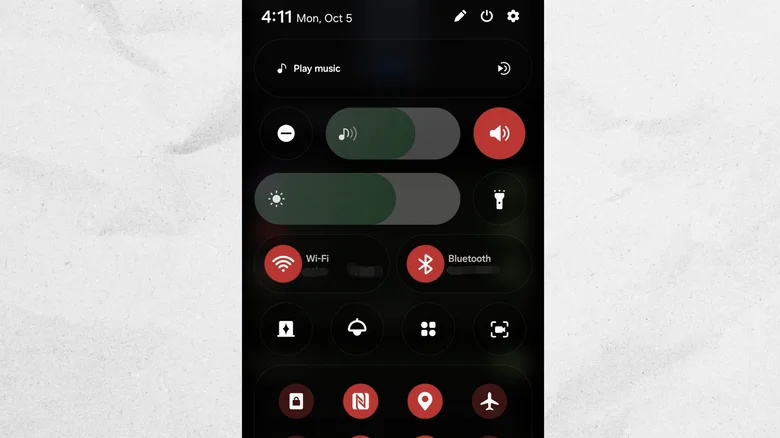
Customizing your phone is easier in One UI 9. With One UI 7 in 2024, Samsung visually overhauled One UI, and among the biggest changes was the decision to split Quick Settings and Notifications into two different panels. One UI 8 and 8.5 went even further by allowing users to customize the Quick Panel, as it is called. Settings can be placed anywhere and they can even be resized. Now in One UI 9, Samsung offers even more control to users.
The biggest change this time around is the volume and brightness sliders. Yes, you could reorient them vertically before, but the volume slider still had the ringer mute shortcut stuck to one end. The same goes for the brightness slider and dark mode toggle. Now you can ditch those buttons and turn the sliders into solo operators. Sliders in general are now also more minimal, doing away with the large UI buffers around their borders in previous software versions. Borders around tiles have also been removed.
The most subtle change is to the music player widget found in the quick panel (although it also appears above the notifications panel and in the live notification chip at the top left of the screen). The small waveform that appears on the scrollbar during playback now corresponds to the current album art.
Better document scanning helps flatten the curve
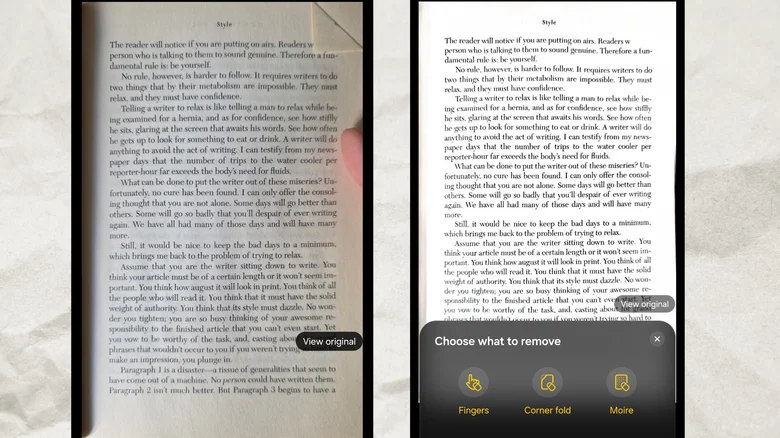
For many years, Samsung has offered a document scanning feature in its native One UI camera app. It’s one of the most convenient ways to quickly scan paper documents, signs and more. But it struggles with curved surfaces, making it difficult to scan the pages of a book or anything else that doesn’t lie completely flat.
In One UI 9, Samsung has given the document scanner a major upgrade that should help it more accurately scan books and other bound documents, as well as documents with bent corners. Previously, if a document looked distorted after scanning it with the camera, you could make a few edits after the fact to help smooth it out, but the chances of success weren’t great. Ditto for folded paper, in which case dog ears and other creases appeared as hard lines in the scanned photo. In One UI 9, the scanner will automatically compensate for both scenarios, meaning you can scan two pages of a book and it will look like a flat digital rendering of the pages rather than a reading packet handed out by your high school English teacher.
This update brings some additional benefits to the scanner. An updated eraser automatically removes your thumb from photos you’ve taken of documents while holding them. The tool can also compensate for moiré and glare, and there’s even a new home screen shortcut so you can launch the scanning tool directly when you need it – no fiddling in the camera app required. In tests we performed (shown above) scanning book pages, the scanner did a decent job of removing my thumb and removing a dog ear, although a full layout of a two-page book seemed to prevent it.
Generative Now Brief cards show the information you actually want
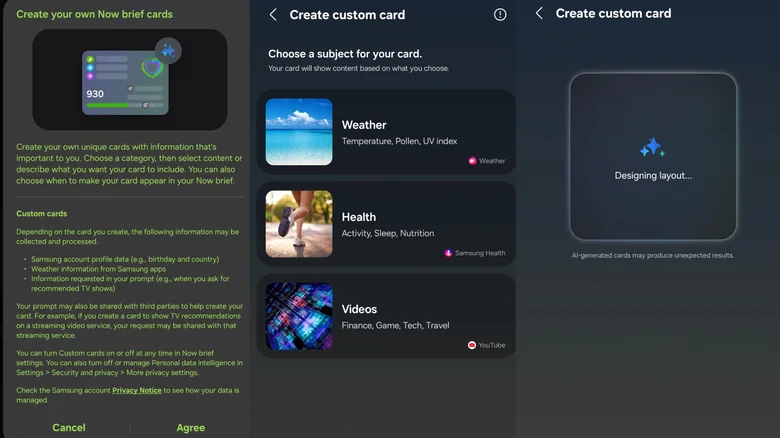
First introduced in One UI 7 with the Galaxy S25 series, the Now Brief on the lock screen’s Now Bar never lived up to its promises. Samsung claimed it would use AI to display “the most important real-time updates directly on the lock screen”, but this was mostly unnecessary. “The day is progressing” is useful information if you’re not used to linear time, but what else? Not so much.
In One UI 9, Samsung put some effort into figuring out what the Now Brief should tell you, and that’s a good thing. Instead, you can create custom maps that will update at a set time with whatever information you want from a handful of apps, including Samsung Health, Samsung Weather, and YouTube. For example, you can ask Samsung Health to notify you at 9 p.m. of the number of steps and calories burned for the day.
You create Now Brief cards with a Mad Libs-style generative prompt. Oddly enough, and perhaps to save on cloud processing costs, there is a daily limit to the number of times you can generate or edit Now Brief cards. This is somewhat reminiscent of the new Generative Create My Widget feature that Google introduced for Android 17, and which Samsung would emulate for One UI 9.5.
There’s no denying that this feature requires a lot of your personal data and processes it off-device. For all new Now Brief features, each generated card will only be served once per day. The rest of the time, he tells me things like I’ve been ignoring my parents and that I should catch up with them – even though I talked to them both last night. Is this the “super intelligence” I’ve heard so much about?
Real-time Security Brief alerts
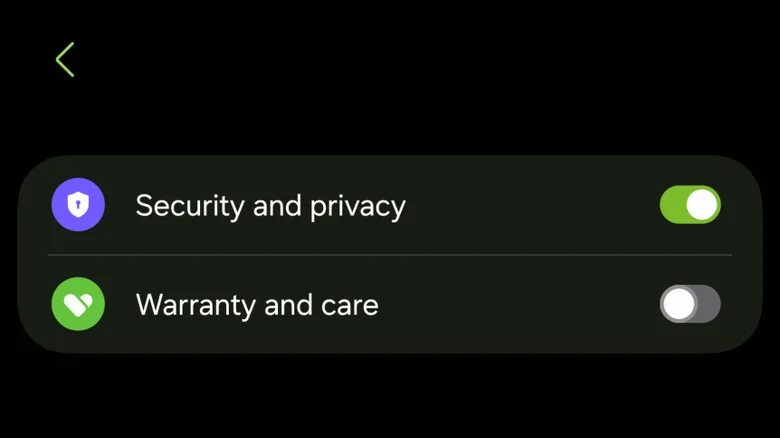
Another Now Bar feature is coming to One UI 9, and many people will find it more useful than the ability to generate a weather or health widget. After enabling the “Security & Privacy” button in the Now Brief settings, you will receive an alert on the Now Bar whenever your phone detects an app that may be malware or behaving strangely. Hopefully you’ll never see such an alert, but the more proactive your device can be in detecting threats, the easier it is to deal with them if they ever show up. Samsung calls the feature Security Brief.
Apps from the Play Store generally shouldn’t trigger a Security Brief alert unless they abuse their permissions by frequently asking for your location in the background or acting suspiciously. If you determine the threat is legitimate, you can follow the alert to take action.
If you are the type of person who installs software on your Android phone outside of the Play Store, Security Brief may bother you with false positives. Internet application packages are often unsigned by their developers, especially if they are created by amateurs, and SammyGuru reported that an application it regularly uses for Galaxy tutorials was flagged by Security Brief. In testing Engadget, we couldn’t get an alert to pop up during normal use, and I was reluctant to install unsigned APKs in the hopes of triggering one. Samsung lists support for Security Brief starting with the Galaxy S23 series.
When Now Bar launched in 2025, many saw it as an answer to the iPhone’s Dynamic Island for live news. But while this feature has enjoyed robust support from third-party developers, Now Bar has stagnated for years without much support, even from first parties. Very few apps work with it even now, and it would have made sense for Samsung to throw in the towel. So it’s encouraging to see new features added several years later.
Gn tech