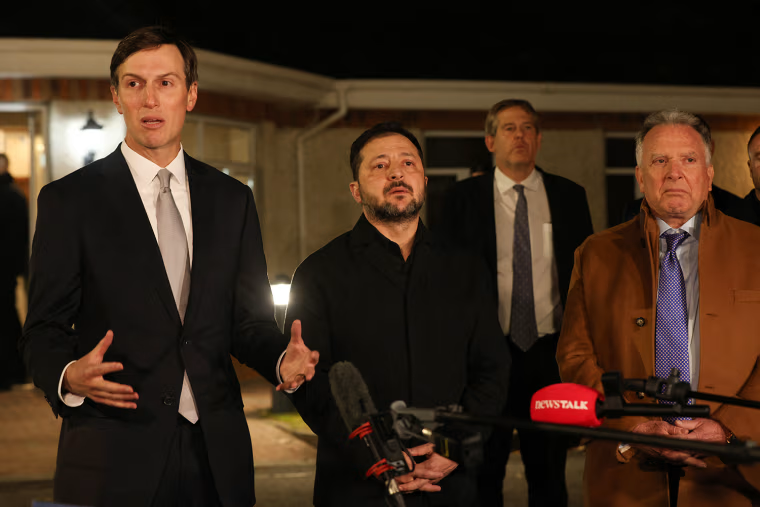
A Kremlin trap? Europe sees danger in Vladimir Putin’s security demands during negotiations with Trump

LONDON — When European countries said they wanted greater involvement in Ukraine peace talks, that was certainly not what they had in mind.
Europe has long demanded more say in negotiations to end Russia’s war, fearing being excluded by Washington and Moscow. They fear a deal favorable to President Vladimir Putin – who will meet President Donald Trump and Chinese leader Xi Jinping on Wednesday in a historic tripartite meeting in Shenzhen, China.
The good news for them is that the United States says it is now pushing to include Europe in future diplomatic rounds. The bad news, governments, officials and foreign policy analysts say, is the Trump team’s alarming new suggestion: that the entire future of European security should also be discussed — the same demand that Putin has been pushing for years.
For the Russian leader, redrawing the security map of Europe means reducing NATO’s presence and redressing what he sees as injustices imposed on Moscow after the collapse of the Soviet Union. A succession of senior European officials have blasted the idea, warning that Washington risks “falling into Moscow’s trap,” as Kaja Kallas, the European Union’s foreign policy chief, put it.
“This is all pretty weird,” former Estonian President Toomas Hendrik Ilves said Monday, summarizing the sentiment in an interview with NBC News.
It is unclear how or why the United States came to issue a maximalist demand that Putin first made in 2021, one that was widely rejected by Western governments months before Russia launched its full-scale invasion of Ukraine. But in recent days, as Washington has increased pressure for a breakthrough in peace talks, Russia and the United States have both revived the idea.
Jared Kushner, the president’s son-in-law and envoy, wrote Friday that the talks should address “broader postwar European security arrangements.”
Earlier this month, he lamented “decades of mistrust” and “competing security concerns” between Russia and Europe, pledging to address them by building a “sustainable framework for long-term European security and stability.” Kushner also stressed that NATO would remain central to European defense and that no country should have a veto over another’s alliances.

Trump himself has also hinted that he is seeking a final deal encompassing the entire continent. “This will be an important deal and it will involve much more than just Ukraine,” he told reporters in the Oval Office earlier this month. “I could even say that it could involve all of Europe. It will be a big, beautiful agreement, and everyone will be delighted.”
Instead, the idea sparked unease and dismay, seen by many in Europe as echoing Putin’s hardline war aims.
While Kushner portrays Europe and Russia as neighbors incapable of resolving their differences, history shows that aggression has been mostly one way. Russia seized Ukraine’s Crimean peninsula in 2014, then launched a full-scale invasion in 2022, while carrying out sabotage, cyberattacks and disinformation against the West.
Kushner’s suggestion also touches on a central European fear: that Washington will reach a deal at all costs, even if it emboldens Putin to expand his aggression.
“Why are two real estate agents pushing this idea?” Ilves said, referring to Kushner and Steve Witkoff, another Trump envoy, who both made their fortunes in real estate before moving into diplomacy.
“These people are not even diplomats,” said Ilves, who led his former Soviet republic from 2006 to 2016. “I’m not sure they have a clear idea of the long history of the development of the security architecture in Europe compared to Russia.”
Asked about the criticism, White House deputy press secretary Olivia Wales said the U.S. proposal aimed to “strengthen existing European security arrangements, with NATO at their center, while developing practical mechanisms to prevent future conflicts.”
Security guarantees for Ukraine “cannot be designed without understanding the broader security framework within which they will operate,” she said in an email, adding that any final deal must respect the sovereignty of Europe and Ukraine “and be accepted by the parties involved.”
European officials are nonetheless baffled by Kushner’s remarks.
Kallas, the EU foreign policy chief, called Russia’s maximalist war demands “truly absurd”, while German Foreign Minister Johann Wadephul stressed that “Europe has a security architecture – we don’t need a new one”.
Meanwhile, Lithuanian Foreign Minister Kęstutis Budrys said the rules were not the problem: “The problem is that Russia is breaking them. ” And even Canadian Prime Minister Mark Carney was adamant that “the security architecture for a free Europe will be determined by free Europe and NATO, not by Russia.”
Ukrainian President Volodymyr Zelenskyy called the idea “dangerous,” saying European security “should not be the main agenda.”
Ukraine believes that Russia is not in a position to make such demands, given that it has spent more than four years failing to win the war.
“At this point, all Putin can negotiate is a fair ceasefire along the current line of contact,” Ukrainian Foreign Minister Andriy Sybiha said. And “frankly, Europe does not need a new security order; it already exists and Russia constantly violates it.”
kyiv and its European backers also say a ceasefire must precede any peace talks, accusing Russia of procrastinating so it can continue bombing civilian infrastructure before the freezing winter.
If Europe accepts Russia’s demands for broader continental security before a ceasefire occurs, Moscow “will try to create the impression that it is our fault if the war continues, because we do not want to accept all their demands,” according to Sven Biscop, director of the Egmont Institute, a Belgian think tank.
He said he believed dialogue with Russia was a good thing, a view shared by influential Finnish President Alexander Stubb, who in a Financial Times interview published Tuesday said it had been “irresponsible” to hand negotiations with Putin to the United States, which he said could tend to divide Europe into spheres of influence.
Back in Washington, Sen. Jeanne Shaheen, D-N.H., the top Democrat on the Senate Foreign Relations Committee, urged Trump’s team to refuse Putin’s demands.
The Russian leader not only wanted to control Ukraine, but “he wants to rethink NATO to meet his revisionist ambitions,” Shaheen said, adding that any discussion of European security infrastructure should be a “failure” for the United States which “has benefited from the Alliance.”
Amid all this, any substantial progress toward ending the war remains elusive.
The latest round of negotiations between the United States, Russia and Ukraine in Abu Dhabi, United Arab Emirates, last week produced no major breakthroughs. Kushner said Washington was working on what could be the largest prisoner exchange of the war, while reporting that Russia had agreed to give Europe a seat at the table in the next round.

Russia hasn’t quite confirmed that, instead saying it needs to “understand from the Europeans themselves” what they can “contribute to the peace process” before allowing them to join, as Putin’s spokesman Dmitry Peskov told reporters on Monday.
There were internal disputes between European nations over who could represent them. Leaders agreed on a team made up of the UK (which left the EU in 2020), France, Germany, Italy and Poland, as well as representatives from the European Commission and the European Council. Kallas herself was left off the team.
“I don’t know which of the current leaders could be a sensible interlocutor in the dialogue,” Russian Foreign Minister Sergei Lavrov told the official Tass news agency on Monday.
He compared the chosen group of European countries to “Quartet,” a satirical poem by Russian author Ivan Krylov. In it, a monkey, a donkey, a goat, and a bear attribute their failure to form a string quartet to the seating arrangement rather than their lack of musical ability.
This meant at least agreeing on a seating arrangement.
Gn headline