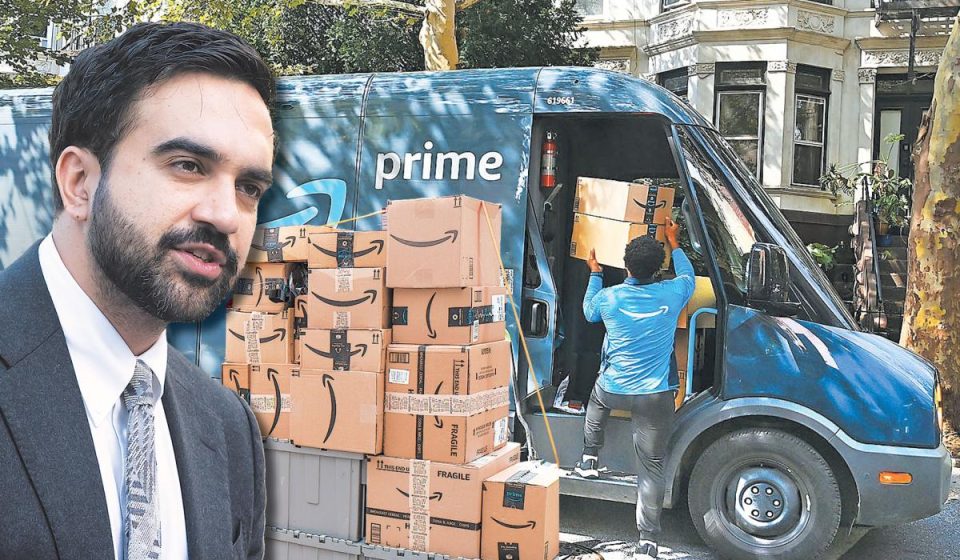
Amazon said it could move thousands of workers out of New York due to Mamdani’s labor bill — something experts say is likely to happen

Amazon said it could close more than a dozen warehouses and move thousands of workers out of New York City because of a labor bill pushed by Mayor Zohran Mamdani — and the e-commerce giant will likely make good on its threat if the controversial legislation passes, industry experts told The Post.
The Delivery Protection Act would require Amazon to directly hire more than 5,000 delivery workers across the city who are currently employed by third-party contractors. Supporters say the legislation will raise workers’ wages and improve safety conditions at Amazon and other delivery companies, including FedEx and DoorDash.
But Amazon doesn’t directly employ delivery workers anywhere else in the country — and has historically fiercely resisted efforts to change its policies in the United States and abroad. The result, experts say, could be not only that those 5,000 delivery jobs leave the city, but also that Amazon closes its 15 last-mile warehouses in the Big Apple and lays off the additional 2,000 workers who employ them.
Early last year, Amazon closed seven warehouses in Quebec, near Montreal, as part of a union fight involving one of its last-mile facilities. The union, the Confédération des syndicats nationaux (CSN), had organized the 300 workers at a warehouse in the city of Laval.
By March 2025, some 1,900 Canadians across seven warehouses and 2,800 delivery contractors at those facilities had lost their jobs.
“Amazon will fight back, because it needs to send a strong message to the rest of the country: ‘If you bother us, this is what will happen,'” said Marc Wulfraat, president and founder of Montreal-based logistics consulting firm MWPVL International.
“When you look at Amazon’s global operations, they are closing buildings left, right and center when there is union activity.”
According to real estate listings, the Montreal facility is now vacant, with Amazon still paying rent on more than 1.6 million square feet of space it spent hundreds of millions of dollars to build, according to Wulfraat. At least two facilities are offered for sublease.
The Delivery Protection Act – first introduced a year ago by Queen’s Council member Tiffany Cabán and reintroduced in 2026 – has strong support on the city council with some 34 co-signers. But several, including President Julie Menin, are “uncomfortable” about possible job losses, said a source close to the negotiations.
“This bill will have to pass in some form,” especially since the mayor supports it, the source told the Post, adding that the end result could make “both parties unhappy.”
Compromises that were discussed include allowing independent contractors to continue making deliveries while requiring Amazon to provide more safety guarantees for workers, the source said. No vote is planned.
Industry experts say the parallels between Quebec and New York cannot be ignored, even though Amazon directly or indirectly employs more than 12,000 hourly workers in New York, more than twice as many as in Quebec.
These include the 2,000 workers who work in last-mile warehouses and another 5,000 to deliver goods. The Delivery Protection Act would not affect the 5,500 workers at Amazon’s giant JFK8 fulfillment center in Staten Island, who voted to unionize in 2022 — a first at an Amazon facility in the United States — but who still do not have a collective bargaining agreement.
Although Amazon employs unionized workers in Europe, it has been making headlines since the pandemic undermined unions in the United States. He is now engaged in litigation over the allegedly harsh tactics he used to combat union organizing in Bessemer, Alabama, and Staten Island.
In April, the National Labor Relations Board ordered Amazon to the negotiating table with the Staten Island Teamsters, but Amazon filed lawsuits questioning the legitimacy of the NLRB.
“Amazon will say or do whatever it takes to deny workers stronger rights and wages and abdicate its responsibilities to its own employees,” the Teamsters said in a statement.
The risks posed by the Delivery Protection Act are not lost on the 40 independent companies that employ New York City’s 5,000 delivery workers.
“Look what happened in Quebec”, Kris Basmagy, owner of DashWave Delivery, which handles Amazon deliveries on Manhattan’s Upper East Side, told the Post. “There was pressure on the Amazon model, and it pulled out.”
Basmagy, which employs 150 delivery workers, added that nothing stops Amazon from replacing its New York facilities with some of the “warehouses being built along the New Jersey Turnpike.”
Amazon is still battling litigation in Quebec, where it denies closing its warehouses due to CSN union activity. The union has filed a complaint with the Quebec Labor Court, but even if it proves that Amazon violated labor laws, the most Amazon faces is a fine and potential negative consumer backlash, according to a CBC News report.
A class action lawsuit filed by an Amazon Prime customer in Quebec in February 2025 claims that warehouse closures have slowed Amazon’s delivery times beyond the one- and two-day guarantee for the Prime service – with some deliveries taking four to six days instead.
In May, a Quebec court ruled that the case could move forward. Yet the plaintiffs seeking refunds admit that the disruptions only lasted about two months, according to the complaint. Amazon says service has not suffered since a large Canadian logistics company, IntelCom, resumed deliveries to Quebec.
“Then they got their act together and stopped the delays,” said Saro Turner, a partner at the law firm Slater Vecchio, which filed the suit.
In New York, Amazon says delivery times and prices for customers would increase if it closed its warehouses. New York is “fundamentally different” from Quebec, where Amazon operated “far fewer sites,” according to Amazon spokesperson Steve Kelly.
The company funded an AKFR study showing that the Delivery Protection Act would cost New Yorkers $664 more per year, or about $5.20 per package. This figure covers deliveries made by other companies, including FedEx and Doordash.
“New York City is one of the largest and most complex delivery regions in the country,” Kelly said in a statement. “It is best served by a network of small, local businesses that are deeply rooted in their communities and leverage our operational infrastructure. »
Amazon’s deliveries in New York would slow permanently if the company closed its last-mile facilities in the city, according to a source with knowledge of Amazon’s operations. Same-day deliveries and those made within hours of placing an order would be hit hardest. The number of items falling under the prime minister’s promise would also decrease, the source said.
“There are a lot of same-day and morning deliveries in the city” that could arrive the next day, the source said.
Amazon’s last-mile facilities in Brooklyn and Queens include one in Red Hook at 270 Richards St. and another in Maspeth at 55-15 Grand Ave. Last-mile warehouses in Manhattan include an 87,000-square-foot facility at 706 11th Ave., according to a report on security concerns from New York City Comptroller Mark Levine.
“Amazon would not hesitate to close its 15 New York facilities if it felt the legislation posed a threat to its business model,” said Brittain Ladd, a logistics and retail consultant and former Amazon executive. “This is a model that could be copied in other cities.”
Delivery companies claim to be collateral damage in this fight.
“The focus is on punishing Amazon, whatever the repercussions, what it does to us as business owners and fathers and husbands,” Basmagy said. “It’s like we no longer exist.”
WGA Transit, which has actively recruited formerly incarcerated and homeless workers to deliver Amazon packages in Harlem, will be forced to cease operations if the Delivery Protection Act is enacted in its current form, owner Joe Artus told the Post.
“I have a 21-month-old daughter,” Artus told the Post. “If this thing passes, my company will have no way of existing or keeping my 189 employees.”
Gn bussni