

Introduction

The Ryzen AI Max+ 395 is not new. AMD’s best “Strix Halo” APU has been shipping in mini-PCs for about a year and is almost always rated as a small gaming PC. This misses the point: it was designed to run large AI models locally, on your own desktop and without a cloud account, and it’s very good at it. So that’s what we’ll focus on in this review.
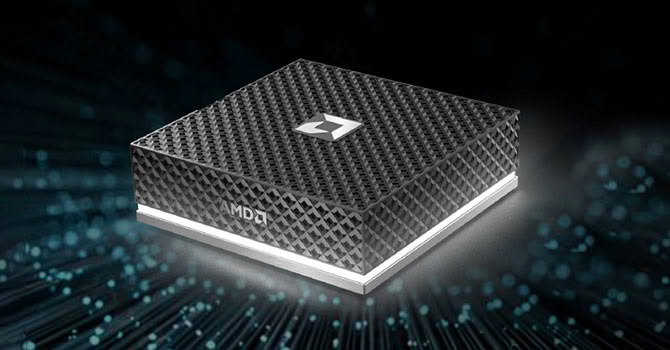
The AMD Ryzen AI Halo is a complete 150mm square, ~1kg machine with 16 Zen 5 cores, a Radeon 8060S RDNA 3.5 GPU, and an XDNA 2 NPU, but the number that really matters is the 128GB of LPDDR5X-8000 unified memory. That’s the core story of this product: you’ll be able to run huge AI models that no other consumer hardware can touch. A GeForce RTX 5090, the fastest consumer GPU you can buy, has “only” 32GB of GDDR7 VRAM, so as soon as one model no longer fits, it’s the small AMD box that keeps working while the powerful 5090 fails. AMD calls this specific model the Ryzen AI Halo development platform, priced at $4,000, compared to $7,000 for NVIDIA’s 128GB DGX Spark. The same concept is available from many other mini-PC vendors; search for “Ryzen AI 395”.
Gorgon Halo, the Ryzen AI 495 successor to the Strix Halo, was also recently announced and will be available in the coming weeks and months, with support for up to 192GB of faster LPDDR5X-8533 memory. It appears to be the exact same design, just with more memory and an improved CPU, which is actually clocked 100MHz higher on both the CPU and GPU (it’s the same silicon chip).
So this isn’t your typical review of a mini PC. The usual stuff is here (photos, teardown, games, power), but I’ll look at what 128GB of unified memory makes possible: local LLMs, image and text generation, text-to-speech, a coding assistant, and a few experiments we haven’t seen anyone else try.
| Features | |
|---|---|
| APU | AMD Ryzen AI Max+ 395 “Strix Halo” 16 cores / 32 threads, Zen 5 Up to 5.1 GHz boost TSMC N4P process |
| GPU | Integrated GPU AMD Radeon 8060S ARND 3.5 40 compute units (2,560 shaders) |
| NPU | AMD XDNA2 up to 50 HIGH |
| Memory | 128 GB Unified LPDDR5X-8000 ~256 GB/s bandwidth Up to 96 GB for the GPU |
| Storage | 2TB M.2 NVMe SSD PCIe generation 4 x4 |
| Show outputs | 1x HDMI 2.1b DisplayPort over USB-C |
| I/O Ports | 3x USB-C (USB4) 1x USB-C (power input only) 1x 10 Gbps Ethernet (RJ-45) |
| Networking | Wi-Fi 7 Bluetooth 5.4 10 GbE wired |
| Operating system | Windows 11 or Linux |
| TDP | 120W |
| Dimensions / Weight | 150 x 150 x 45.4 mm (5.9 x 5.9 x 1.79 in) 1016g (AMD claims <1.2kg, which seems wrong, we measured it) |
| Price | $4,000 |
Gn tech