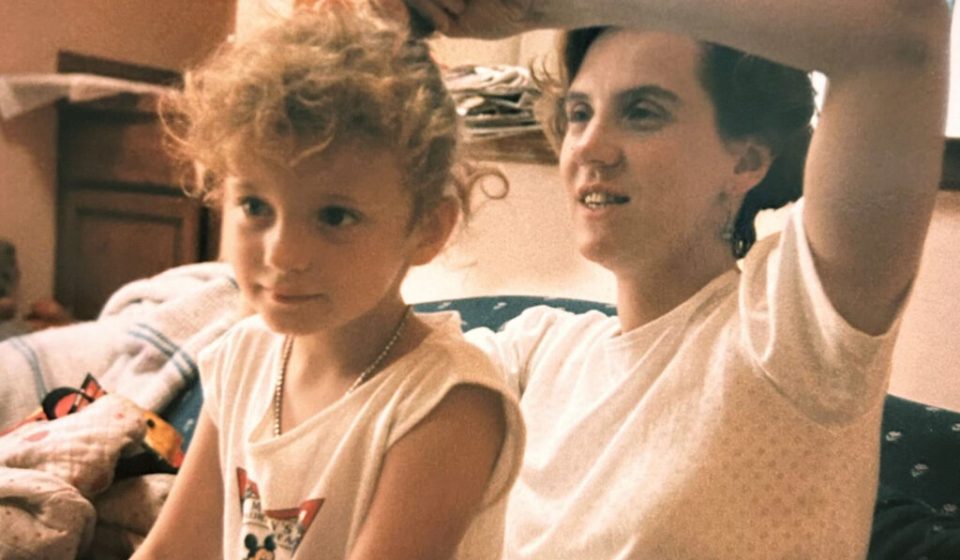

I can’t count how many times my mother attempted suicide.
This first happened when I was 15, in 1999. The last time – when she actually died – happened when I was 32, in 2016.
In between that were the other attempts. Two dozen, maybe? They all run together: the dawning feeling that something was wrong, the panic, the grim focus on the logistics of hospitalization and follow-up, the hard work of accepting his excuses and trying to move on, and worrying about what would come next – when it would happen again. It kept happening again. Sometimes she would go a year without doing it, but then she would try three times in as many months.
On this day in 2016, my husband and I were driving from Northern Virginia to Pennsylvania to meet my 1-month-old niece when my brother called. He was worried: he had no news from our mother, who lived half an hour from him. Can I stop by her house on the way to see if she’s okay?
I thought he was overreacting, but then I checked my mother’s surveillance system: her Netflix viewing history. Spying on her on Netflix often gave me insight into her mindset – why was she watching that Columbine documentary Again? More importantly, as long as she was watching Netflix, I knew she was alive.
While my husband drove, I checked the account. It was Saturday. She hadn’t watched anything since Thursday.
My brother was right. She was dead.
She died alone, her house a mess, leaving behind a rather cruel message. I don’t know if she really expected to die this time, or if she thought that, like every time before, she would wake up in the hospital. She lay dead for two days before anyone found her. I hate thinking about that time. While I was making pasta salad to bring to the family gathering, my mother was dying or dead, her cats unfed.
In the decade since, I have thought a lot about the loneliness of that death and how we could have avoided it. She received massive medical and psychiatric care, not to mention family support, but none of it worked.
I wish medical assistance in dying was an option for her. At the very least, it would have given him a more comfortable death – and my brothers and me a less complicated grief. And maybe, just maybe, it could have saved her.
Medical assistance in dying (MAiD) for psychiatric illnesses is only available in a few countries: Belgium, the Netherlands, Switzerland and Luxembourg. Canada was supposed to join this list in March 2027, after years of delay, but on October 7 it announced that plans for its MAiD program for mental illness were on indefinite hold. Justice Minister Simon Fraser highlighted “very real concerns about people living in communities where access to mental health services is inadequate”, as well as a recent report questioning whether mental illness can be classified as incurable.
I understand the objections to mental illness as a justification for MAID. People with mental illness may experience pressure from exhausted and frustrated families. There are concerns about equity and access to care, as Fraser indicated. If a person is very ill, they may not have the mental capacity to make the decision – perhaps because their depression makes them believe there is no hope.
And some of that…feels wrong. We’re supposed to save the mentally ill, not abandon them, right?
But sometimes mental illness is terminal.
At her best, my mother was tough, funny, warm, and bright, having earned her MBA from Wharton in the 1970s. She liked to say that when she was a student, there was only one women’s bathroom in the building where most of Wharton’s graduate classes were held, and they were in the basement. (“They didn’t even have a tampon dispenser!” she once told me in an email.) She had a successful career in consulting before becoming a stay-at-home mother of three in the early ’80s.
After my father died—also by suicide, related to his gambling addiction—in 1995, she stayed the course for a while, even starting a master’s program at Penn in higher education administration. She had smartly realized that working in higher education could mean reduced tuition for her children. But this plan wouldn’t work.
She had an unexplained seizure a few months after my father’s death, then a second one in 1996, this time while she was driving. She hit a school bus and suffered head trauma. They even gave her the last rites, she boasts.

After recovering—as much as she would—she earned her master’s degree and began becoming a professional counselor at universities. But it never really worked for her. She spent the rest of her life going from one emergency to another and eventually was unable to work at all. It was a relief for everyone when she began receiving Social Security disability insurance, although she still faced severe financial difficulties. I often gave him gift cards to grocery stores.
Her many neurologists, psychiatrists, therapists, and other providers wondered if she was suffering from some kind of reactive depression to my father’s death, or if it was a head injury, or a bipolar disorder that she had suffered from since adolescence, or a personality disorder, or perhaps what had caused these two attacks in the first place. (One suggested encephalitis.) It was probably a combination of everything, which complicated his treatment. For example, she sincerely wanted to try electroconvulsive therapy, but was told she was not a candidate due to her history of seizures. (Was that true? I don’t know. She might be an unreliable narrator for both me and her medical providers.)
She would stay stable for a while, then suddenly hear the voice of my father or grandmother telling her that she was worthless, that she should die. Sometimes the stairs would move when she went up them. Sometimes she saw flashes of light or pulsing walls. She speeded down the highways at 3 a.m. in her dirty Saturn Ion and couldn’t explain why. She could be paranoid, cruel, weepy, or overwhelmed with love for my brothers and me.
I have recorded several of his voicemails and sometimes select a random one to listen to. It’s a bit of a game of roulette: will it be a happy message about an article she read? Will she yell at me for a perceived slight? Will she cry about how she’s going to lose her house? She was always on the verge of losing her home.
She was on more medications than I remember, but the most effective was the antipsychotic Seroquel – really high doses of Seroquel. She hated it – how logical it made her feel, how much it clouded her thinking, how much weight she had gained (she had always been proud of her tall, slender figure). It also carried serious risks of metabolic and cardiovascular side effects, and his cholesterol levels began to rise. Periodically, she would work with her psychiatrist to get rid of them, only to have to start again when the voices returned and the mania took over. (One option no one ever discussed with her: palliative psychiatry, a concept I discovered while editing a fascinating early 2024 review on the subject by Anand Kumar of the University of Illinois.)
Of course she wanted to die. She was in constant pain. Much of it was physical: among other things, his right knee had been shattered in a suicide attempt in 2006 and it was difficult for him to walk on. While hospitalized on Thanksgiving Day 2014 (or maybe 2013? It was hard to follow) after a suicide attempt, she suffered an apparent serotonin storm and had a tooth knocked out of her jaw by hand. She contracted a nasty infection because of this, and despite regular visits to the dentist, it plagued her until her death.
And of course there was the psychological pain. She was bursting into rage, hurling wild insults with no basis in reality. After it subsided – which could be minutes, hours, days, weeks later – she was practically overwhelmed by a swirling vortex of regret: about how she had hurt my brothers and me, the bad choices she had made, how angry she was at God, how afraid she was that God would be angry with her, how much she missed my father even though she insulted him, as if it hadn’t been 20 years since his death. In addition to so many therapy methods and, of course, all the medications, she often sought the comfort of faith: she was born a Catholic and returned and left the church many times. Shortly before her death, she renounced the Catholic Church once again because of its sexual abuse scandals and joined a local Bahá’í group. (They were very kind to her. After she died, I found the Bahá’í children’s books that she had been given to learn about the religion.)
My brothers and I tried as hard as we could to help him without breaking down. We went to therapy with her, gave her money, helped her around the house, answered crazy phone calls. Sometimes she would ask me to write her emails or letters about wonderful times we had together, so she could look back on them when she was feeling sad. But the memory of picking raspberries together in the sun when I was little could not cure what ailed her.
She gritted her teeth every moment of the day. She didn’t smile and couldn’t stand it. She sobbed and took it until she couldn’t take it anymore, and then she tried to kill herself, and then we started again.
And through it all, I kept telling him: everything will be okay.
It was a lie. We both knew it would never go well. She It was never going to be okay. It must have been maddening – so many things in his life were literally maddening – to constantly be told, “It’s okay, you’re okay.”
She was always going to die this way.
If she were to kill herself – a phrase I hate because it takes away the most from her free will…
Gn Health