At the end of the G20 Finance, ministers plead for freedom of navigation in the Strait of Hormuz

The G20 Finance Ministers pleaded on Tuesday 1er September for safe and cost-free navigation in the Strait of Hormuz blocked by Iran at war with Washington, following two days of meetings organized by the United States.
The ministers “emphasize that freedom, security and predictability of navigation in the Strait of Hormuz and throughout the world, as well as the resolution of ongoing wars and conflicts, are essential to ensuring sustainable growth,” according to a final communiqué sent by the American organizers.
Also readHas Iran adapted rocket launchers to mine the Strait of Hormuz?
It is specified that the paragraph mentioning Hormuz was “approved by all G20 members except China”.
During his press conference, the American Secretary of the Treasury, Scott Bessent, assured that he had hoped to present a “unanimous” press release: “Unfortunately, we were able to reach a consensus for all participants except for one”, without directly citing China.
According to the published press release, China rejected several paragraphs, in addition to that linked to the Strait of Hormuz, in particular concerning global imbalances, which indirectly refer to Beijing’s very largely profitable trade balance, but also concerning the common framework for settling the sovereign debt of countries in a debt crisis.
“It is obvious that the country with the largest and unsustainable current account surplus, China was the dissenting opinion,” pointed out Scott Bessent, responding to a question.
The United States assumes Russia’s presence to the end
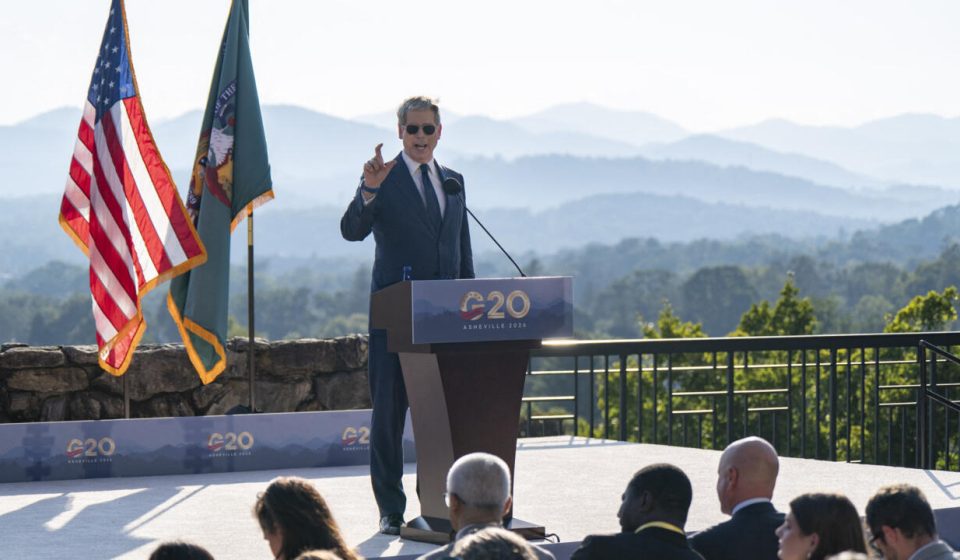
The summit was marked by the presence of the Russian Minister of Finance. “There was no impact” on the discussions in Asheville (North Carolina), said American Finance Minister Scott Bessent at a press conference. “I know that some Europeans left a bitter taste, but I think it is very important to discuss “with everyone” to put an end to this horrible conflict between Russia and Ukraine.”
The participation of Russian Finance Minister Anton Silouanov “created unease, without a doubt”, his Canadian counterpart François-Philippe Champagne had described to AFP a little earlier.
Usually persona non grata in the eyes of Western countries, Vladimir Putin’s minister sat, at the invitation of Washington, around the large table bringing together dozens of delegates in a majestic hotel complex at the foot of the Appalachians.
He was also able to speak personally with Scott Bessent, a key figure in Donald Trump’s government, who is better disposed than his Democratic predecessor Joe Biden towards Moscow.
Also readDrone incursions, sabotage, cyberattacks, espionage: is Moscow pushing Europe to the limit?
Europeans were upset as Russia relentlessly bombed their Ukrainian ally.
In Asheville, the European Union (EU) ensured that Minister Silouanov was excluded from the traditional family photo. Unusual fact: the media were kept away when this one was taken on Monday.
During a G20 summit on innovation which was held in parallel elsewhere in North Carolina, the problem was circumvented by taking two family photos: one where the Russian minister is present without the Europeans and the Canadian, the other with the Europeans and the Canadian without the Russian.
“This is not the time to normalize Russia or the presence of Russia at this type of meeting,” said the European Commissioner for the Economy, Valdis Dombrovskis, from Asheville.
With AFP