
Pike does not dispute his role in this grisly murder. But details of her upbringing, marked by years of sexual and physical abuse and neglect, were not shared with the jury that sentenced her to death. His lawyers say that if such evidence of abuse were presented now in a trial, a death sentence would not be guaranteed.
They asked the Supreme Court to stop Pike’s execution, saying she suffered from post-traumatic stress disorder stemming from assault and rape committed when she was a child. Being held down and strapped to a gurney, they wrote, will likely create “severe mental suffering and additional psychological terror under Tennessee’s lethal injection protocol.”
The state did not deny that Pike was the victim of abuse. But in a response filed Monday, the attorney general’s office said a judge already concluded last month that it was “speculative whether Pike would suffer” greater mental harm because of how the lethal injection protocol is applied.
The Supreme Court is Pike’s last chance to get a reprieve after Lee said he was upholding his death sentence “after careful consideration.”
Pike’s lawyers said Monday they were “saddened and heartbroken.”
Another woman, Gaile Owens, was on death row with Pike until 2010, when Gov. Phil Bredesen changed her sentence to life in prison.

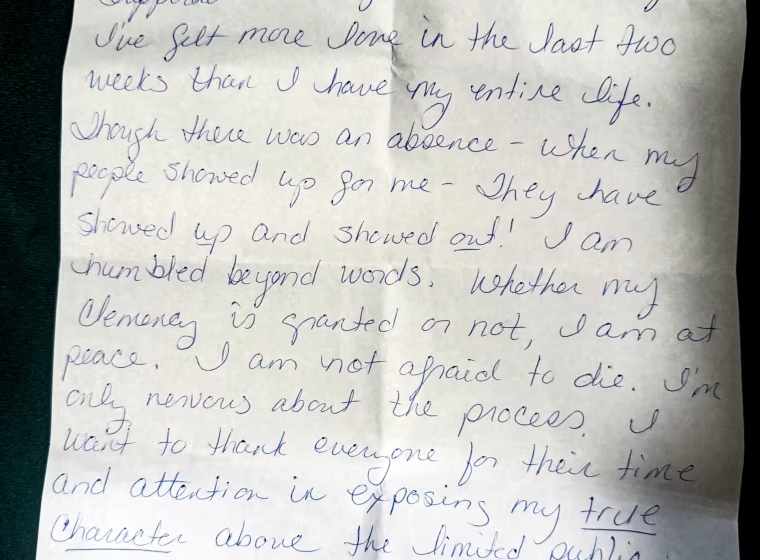
In his letter, Pike wrote that people saw a “limited public persona that was the only narrative” about him. Her lawyers had tried to convince Lee that she was the product of a tumultuous childhood.
“Entering into the chaos of Christa’s life that led her to this moment will not justify her actions that night,” one of her attorneys, Randall Spivey, said of the moment she committed her crime. “But the chaos will show you that Christa was broken and not evil.”
Different sentences
Pike’s lawyers also point out his age and how that led to such a different outcome in his case.
While she faced the death penalty for her first-degree murder and conspiracy to commit Slemmer’s murder, another conspirator was spared: Pike’s boyfriend, who was 17 at the time. Tadaryl Shipp was sentenced to life in prison because he was a minor and remains eligible for parole. Shipp testified at his post-conviction hearing that he was the one who carved a pentagram into Slemmer’s chest.
The third accomplice – Shadolla Peterson, then 18 years old – served as a lookout in the crime and was placed on probation in exchange for her cooperation.

Pike told police she “wasn’t even thinking” when she attacked Slemmer and was jealous believing the victim was trying to distract Shipp. Pike’s lawyers say his age would have been a more important factor today, given the evolution of scientific research that has led to the understanding that young people’s brains are still developing well beyond adolescence.
Additionally, his lawyers say his legal representatives at the time could have accepted a deal from prosecutors that offered a sentence of life in prison without the possibility of parole in exchange for a guilty plea.
Pike sobbed when the judge told her she would die by electrocution, then the only form of execution in Tennessee before the state switched to lethal injection as its primary method.

She begged in tears, “Can I please kiss my mother?”
Pike entered prison, where she was placed in solitary confinement for up to 23 hours a day and prescribed Prozac to treat her obsessive-compulsive disorder. At first, she found it difficult to express her remorse.
“It took me many years to realize the gravity of what I had done,” Pike said in his clemency request.
Persistent trauma
Three years ago, Pike’s lawyers asked Bethany Brand, a trauma psychologist, to evaluate whether she suffered from psychological disorders and determine whether any of them contributed to the crime.
She sat down with Pike in his Nashville jail and reviewed police reports, past medical exams and other records from his case detailing physical and sexual abuse. Brand learned that Pike’s parents were not stable figures in his life. Her mother’s boyfriends and other men had molested her from a young age, records show. She performed poorly in school and lived with other family members in West Virginia and North Carolina. At age 17 – a year before she participated in Slemmer’s murder – Pike reported to North Carolina police that she was walking to the store when a man threw her to the ground and raped her. No one has ever been arrested.

In his final report, Brand wrote that the adults in Pike’s life had failed him. Doctors didn’t diagnose him with bipolar disorder until a few years after he was incarcerated.
The level of trauma Pike was subjected to “is almost impossible to understand because it is so severe,” Brand wrote.
She told NBC News that medication in prison helped Pike immensely and that she now has “empathy and great regret” for what she did. But, she added, Pike’s case is a lesson in the need for greater awareness of women’s mental health and recognition of trauma and untreated mental illness.
“In Christa’s case, no one was trying to get her help,” Brand said.
May Martinez isn’t convinced the person responsible for mutilating her daughter’s body and keeping her naked from the waist down can change.
Martinez recalled that after the investigation ended, she did not realize that not all of her daughter’s body parts were buried with her remains, as some had been kept as evidence at trial. She had to collect Slemmer’s skull from the courthouse and remembers the medical examiner’s office sending her the other parts later. (The office said it rarely preserves human remains like it did 30 years ago because of better technology, improved photographs and laboratory work.)
Gn usa