
President Donald Trump’s ban on Canadian alcohol took effect Tuesday, an unprecedented move that underscores the breakdown of one of the world’s closest trade relationships.
The ban, which affects $800 million worth of Canadian alcoholic beverages imported by the United States last year, marks the latest salvo in a tit-for-tat trade war that already includes exorbitant tariffs and a ban on American alcohol in Ontario and other Canadian provinces.
However, experts say it’s unlikely that most U.S. shoppers will immediately notice the ban, in part because of workarounds, exemptions and the fact that distributors had time to stock up on imported Canadian alcohol before the ban took effect.
At the same time, given the rapidly evolving commercial environment with Canada, anything can change at any time. Hours before the ban took effect, Trump said he was confident the United States would emerge victorious and that he expected Canada to reach a deal with the United States soon.
“They want to have a deal with us, they call us all the time. The problem is they’ve treated the United States very unfairly,” Trump told reporters Monday.
“Over the next three or four weeks, they will come to us and say, ‘We’re going to remove all tariffs,'” Trump said. Canadian Prime Minister Mark Carney, however, said nothing to this effect.
Whiskey and liqueurs, two of the main alcoholic beverages exported from Canada to the United States, are exempt from the ban when sold in containers larger than four liters. In these cases, they will not face customs duties either.
But making this change requires having the right containers on hand or purchasing them from scratch and then re-bottling in smaller sizes, more commonly sold in liquor stores. All of this could increase costs for businesses – and potentially impact the prices consumers pay.
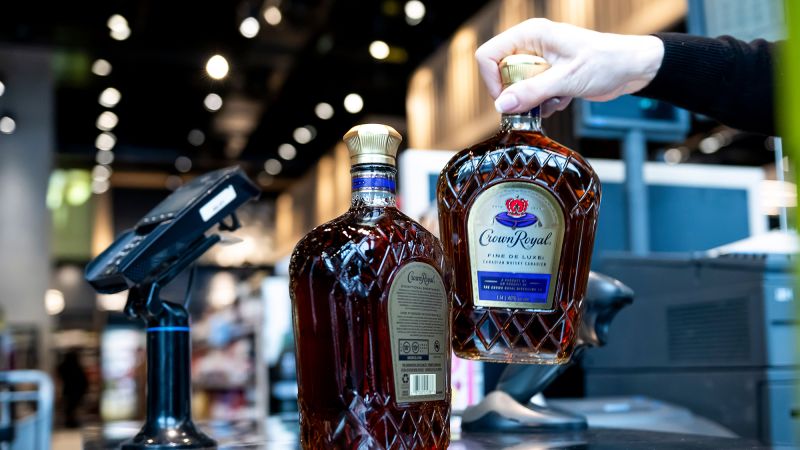
Crown Royal appears particularly well positioned since the company already sends bulk shipments of whiskey to the United States, where it bottles all products sold in the country.
Beyond the bulk exemptions, very few alcoholic beverages shipped from Canada were spared.
“The use of import bans against an ally is unprecedented and a major departure from U.S. trade policy,” said Inu Manak, a senior trade policy fellow at the Peterson Institute for International Economics. “It’s a very symbolic thing to target. It sends a message and is another form of escalation aimed at bringing Canadian negotiators back to the table. But Prime Minister Carney is in no rush to reach an agreement before the (U.S.) midterms.”
Some alcohol industry employees and executives have expressed dismay over the escalating trade war.
“It’s truly unfortunate that our industry has found itself drawn into this situation,” said Chris Swonger, president and CEO of the Distilled Spirits Council of the United States (DISCUS), an industry trade group. “We American distillers export all over the world. We don’t want tariffs placed on our products and we don’t want tariffs placed on our imports. We like to compete by sip and by taste, not by tariffs.”
Swonger described the banning of American alcohol by some Canadian provinces as an “unforced error” and expressed hope that the American ban will force a policy change.
“We are working hard to bring both governments to the table to resolve this issue,” he said.
Manak pointed out that Canadian provinces have banned American alcohol only in response to threats of American tariffs.
“In playground parlance, it was the United States that started it. It was Canada that responded,” she said.
And now U.S. officials are reacting to that response, demonstrating how a cycle of tit-for-tat escalation is spiraling out of control.
A liquor store manager in Niagara Falls, New York, located less than five miles from the Canadian border, told CNN he was confused and concerned about the U.S. ban on Canadian alcohol.
“We have a lot of Canadian customers and a lot of Canadian alcohol. It’s not good for business,” said the manager, who spoke on condition of anonymity. “People have the freedom to drink, right?
An employee at a liquor store in Port Huron, Michigan, near the Ontario border, also told CNN that many of his customers buy Canadian whiskey, including Crown Royal, Black Velvet and Rich and Rare.
But the Michigan liquor store employee added that store traffic from Canadians has declined significantly over the past year.
“We have a lot fewer Canadian customers than before,” he said.
To impose Canada’s alcohol ban, Trump relies on Section 338 of the Smoot-Hawley Tariff Act of 1930, the infamous trade law that exacerbated the Great Depression (and was hilariously featured in the movie “Ferris Bueller’s Day Off”).
The law allows the President of the United States to impose tariffs of up to 50 percent, or even ban certain imports when another country discriminates against “trade of the United States,” according to the law. But because no president before Trump has used the law in this way, courts have not weighed in on what the administration must prove to satisfy its demands.
Besides alcohol, Canadian dairy products, such as whey, and motorcycles are also subject to bans, with the Trump administration also alleging unfair treatment of American companies. In total, the bans cover nearly $1 billion in goods imported from Canada by the United States last year, according to federal trade data.
Canada’s partial ban on American alcohol has been painful for the American industry.
Exports of U.S. spirits to Canada fell 70% after Canadian provinces began removing U.S. wines and spirits from store shelves in March 2025, according to DISCUS.
But the Canadian alcohol industry is particularly dependent on American consumers.
About 93% of Canadian spirits went to the United States in 2025, according to DISCUS.
“This is going to be absolutely devastating for Canada and Canadian distillers,” Swonger said.
Gn headline