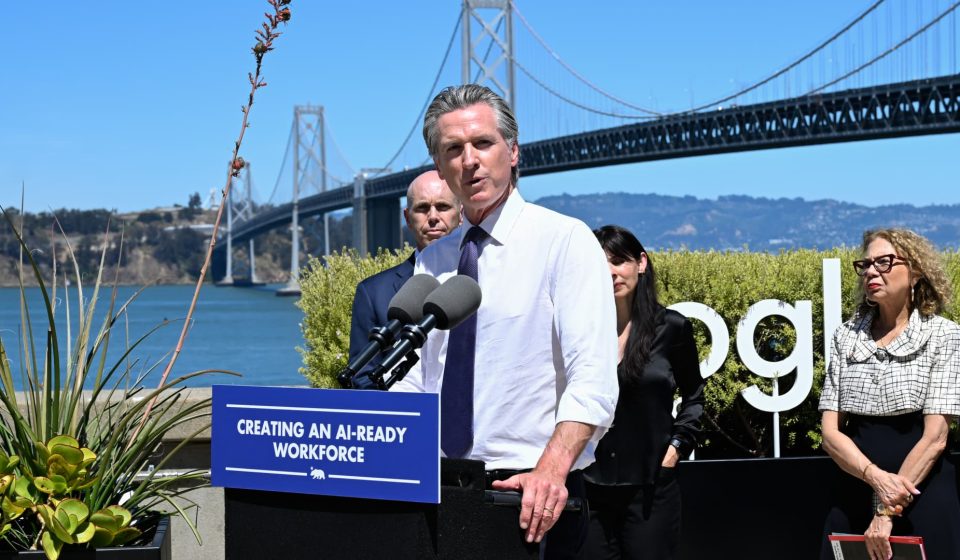

California Governor Gavin Newsom signed a landmark AI law prohibiting employers in the Golden State from relying solely on artificial intelligence to fire or discipline workers.
SB 947, dubbed the No Robo Bosses Act, prevents businesses statewide from exclusively using “automated decision-making systems” when it comes to disciplining and terminating employees. This also restricts their ability to use AI as a primary tool in such decisions.
Under the bill, employers who “primarily” rely on AI results to make termination or disciplinary decisions must now have a human evaluator corroborate those decisions using additional information, such as management evaluations, peer reviews, and personnel records. Additionally, affected employees must receive written notice that AI was “primarily used” in their termination or disciplinary decision, a description of the employee data used by the system, and a human point of contact who can further explain the decision.
“No worker should ever be fired or disciplined by a machine, AI or not. Artificial intelligence systems have the potential to increase productivity, but they have also made mistakes and misjudgments and demonstrated bias,” California State Senator Jerry McNerney, the bill’s author, told CNBC. “AI must remain a tool controlled by humans, not the other way around.”
McNerney, a Democrat, first introduced the law in 2025, following a concerted push by the state’s unions to build guardrails around management’s ability to use AI to take negative action against workers.
“When workers organize, we get results. Workers across California have demanded that our state lead the way in regulating AI in our workplaces. And today we see that starting to happen,” Lorena Gonzalez, president of the California Federation of Labor Unions, AFL-CIO and lead sponsor of the No Robo Bosses Act, said in a statement after Newsom signed it. “Today, California workers and our unions have changed the national conversation about how Americans can fight and win against AI taking over our jobs and workplaces.”
Newsom has recently taken a series of steps regarding AI, including signing a broader executive order earlier this month addressing potential existential risks posed by AI models “before it is too late,” and a measure to provide a state framework for the independent evaluation and auditing of AI models. Newsom said of the sweeping EO that the federal government was abdicating “its responsibility to protect Americans.”
The United States leads the world in the adoption of software and automated management systems, according to the results of an OECD survey released late last year. The study finds that algorithmic management software is widely adopted in every country, but nowhere as widely as in the United States, where 90% of executives say their company has adopted at least one tool to “train, monitor or evaluate workers.”
Meta faces a lawsuit, filed in July, in which former employees allege that AI-assisted systems were used to rank and select workers for termination, disproportionately affecting employees who had taken medical or family leave. Meta has denied the allegations.
Workers at Walmart and Amazon are increasingly concerned about the automation of human resources decisions, according to a survey released in May by the nonprofit United for Respect, which has roots in the labor movement and specifically the retail industry. Last summer, the nonprofit failed to convince Walmart shareholders to approve a measure requiring the company’s management to disclose more information about the use of AI among staff.
California’s No Robo Bosses law saw its momentum hit a wall in October when Newsom vetoed it despite clearing both state legislative chambers with overwhelming majority support. Among his concerns, Newsom cited a requirement that would have required companies to alert workers in advance whenever an AI system in use could affect working conditions.
“I share the author’s concern that, in some cases, unregulated use of ADS (automated decision-making software) by employers can be detrimental to workers,” the governor noted in his explanation, anticipating a future willingness to accept similar legislation. “However,” he continued, “rather than addressing the specific ways in which employers are misusing this technology, the bill imposes unclear reporting requirements on any company using even the most innocuous tools.”
After reintroducing the bill in February after resistance from Newsom, McNerney removed the prior notification requirement and removed language that would have extended the law’s protections to gig workers, which had drawn sharp criticism from ride-hailing giants such as Uber and Lyft. Although these changes somewhat blunted the strenuous lobbying efforts of technology and business groups that played a role in condemning the 2025 law’s equivalent, California business leaders nevertheless mobilized against SB 947 in the weeks leading up to its enactment.
“The bill’s requirements generally apply when an employer ‘primarily relies’ on an automated decision system, but this critical term is never defined. Employers have no objective standard for determining when a technology has moved from merely informing a decision to being the primary basis for it,” wrote Robert Singleton, senior director of policy and public affairs for the Progressive Chamber of California and the Western United States, in a letter to Newsom earlier this month, urging the governor to veto the bill. “Uncertainty over whether ordinary tools qualify as regulated automated decision systems could discourage employers from using technologies that improve consistency, identify safety risks, or help managers make more informed decisions,” he added.
First law of its kind in a country as public uses AI ahead of elections
While the aforementioned changes were made specifically to gain Newsom’s approval, No Robo Bosses proponents also benefited from the fact that, this time around, the bill was brought to the governor’s desk amid unprecedented public distrust of the introduction and continued presence of AI in the workplace. A July Gallup poll found that 39% of Americans think AI does more harm than good, an 8% increase from the 31% who thought the same in 2025. Pew Research, in a study released last August, also found that 71% of Americans think AI will “take jobs,” an increase of about 7% from about two years ago.
This trend has solidified as Newsom considers a run for president in 2028, an election in which AI policy is expected to be a hot topic, particularly among Democratic candidates. But Democrats are not alone on the issue. Earlier this month, Steve Hilton, Republican candidate for governor of California, came out in support of the No Robo Bosses Act.
“The California Chamber…says that rules requiring human review and fundamental accountability are too burdensome for employers. What a ridiculous thing for them to do,” Hilton wrote in an open letter to Gonzalez. “In some ways, I don’t think SB 947 goes far enough,” he wrote. “Employers should not be allowed to use AI to decide whether someone is fired, demoted, loses regular hours, or is kicked out of the program they rely on to make money.”
California businesses will be the first to adapt to its distinct regulatory framework, which establishes a largely unprecedented level of oversight over the use of AI in the workplace. Some local regulations over the past five years have placed restrictions on how AI can be used in employment decisions, including Illinois Public Law 103-0804, which also requires employers to notify workers when they use AI for a set of specified employment purposes. However, these restrictions have never been as extensive as those provided by California law. Even the Illinois law, which took effect last January, does not outright prohibit the deployment of digital agent systems for employment decisions.
While the No Robo Bosses Act is the first of its kind to become law, numerous other bills currently remain in limbo across the country, designed to accomplish the exact same goal. Last June, U.S. Senators Ed Markey (D-Mass.) and Brian Schatz (D-Hawaii), both Democrats, introduced federal legislation of the same name, which would prohibit employers from “relying on automated decision systems to make work-related decisions.” Markey’s bill, introduced to a Congress that has been slow to develop any legislation regulating AI, was effectively dead on arrival. A number of states, including New York, Louisiana and New Jersey, have seen similar legislation proposed but have yet to act on their own.
Earlier this year, New York became the first state in the country to ban the construction of new AI data centers.
California’s action may have just provided the push other states need to pass legislation on AI in the workplace.
The Electronic Frontier Foundation, a left-leaning civil liberties nonprofit, said in a statement to CNBC that signing the law is “an important step toward giving workers the protections they need in workplaces that use automated decision-making systems” and that it plans to continue its work with labor groups to “advance policies that protect human dignity in the workplace.”
Gn headline