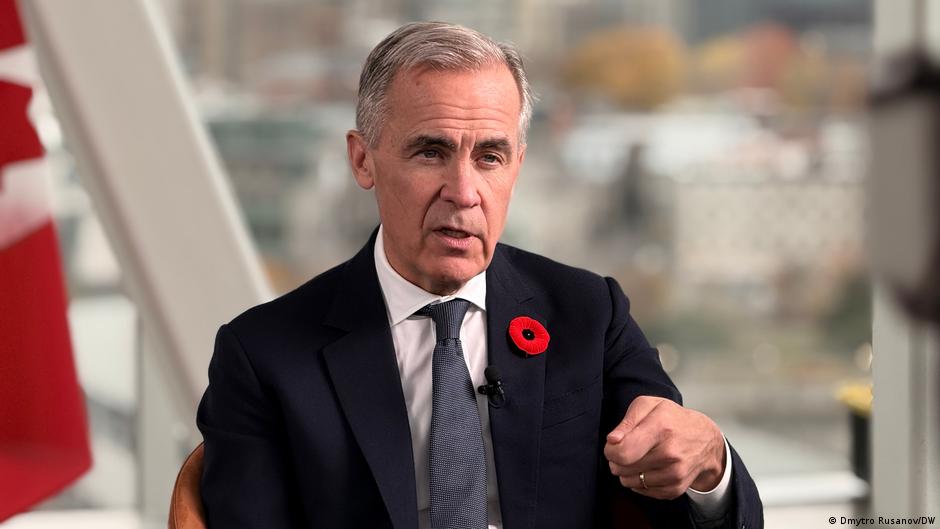
Canadian Prime Minister Mark Carney spoke to DW on Friday after talks in Montreal with European Union leaders aimed at hammering out the details of a new, closer partnership between Canada and the EU.
Amid difficult negotiations with U.S. President Donald Trump, who represents Canada’s largest trading partner, Carney said he and his compatriots realized the country was too dependent on the economic powerhouse of the south.
“The lesson that we have learned, Canadians as a whole, is that we are too dependent on the United States. We are too closely tied to the United States. And we need to build our strength here at home and diversify and deepen our partnerships with like-minded countries internationally,” Carney said.
What did Carney say about negotiations with the EU and closer ties with the bloc?
An EU delegation led by European Commission President Ursula von der Leyen and European Council President Antonio Costa spoke with Carney and other Canadian officials in Montreal on Friday.
They discuss plans launched by Commission President Ursula von der Leyen to create what she called an “associate member” – a status that does not yet exist for any other country – even as German Chancellor Friedrich Merz’s government resists the creation of the label. Carney seemed to speak in his favor.
“Well, I think the advantage of what we’re doing is that some things are absolutely clear, regardless of the exact terminology used. President von der Leyen uses associate membership. We use associate membership,” he told DW’s Katharina Kroll at the Montreal Port Tower.
“What does that mean? It means the closest possible partnership without being a full member of the European Union, because Canada is not geographically in Europe and therefore cannot join.” » said Carney.
What scope for EU-Canada cooperation does Carney see?
Asked if he was seeking to create a “new transatlantic bloc without the United States,” Carney said it was more about diversifying and deepening Canada’s other partnerships than excluding by far its largest trading partner.
“We are both partners of the United States, obviously close partners, alliance partners within NATO. And there are many, many opportunities for cooperation with the United States,” he said. “But in many cases there will be much deeper cooperation between Canada and Europe than between Canada and the United States.”
He mentioned the two existing areas of cooperation, such as the Comprehensive Economic and Trade Agreement (CETA), calling it “one of the most successful free trade agreements in the world”, and also highlighted research cooperation and programs like Horizon Europe and Erasmus+ enabling student exchanges.
But Carney also highlighted areas where the two sides could seek to expand cooperation, including space technologies, artificial intelligence and critical minerals.
Is Canada concerned that the negotiations could alienate the United States or Trump?
Despite his well-documented difficulties with Donald Trump — illustrated perhaps most crudely by Trump’s attempts to unilaterally rename Lake Ontario, or by his release of AI videos imagining him as an ice hockey player beating Carney in a fight — Carney said U.S.-Canadian ties run too deep to be derailed by any government, prime minister or president.
“The ties between Canadians and Americans are long-standing. They are very strong. And important elements of that connection will be maintained regardless of the government of Canada, that of the United States, or a combination of the two,” he said.
Asked how best to deal with Trump, Carney said it was “to be direct, to be clear, to be absolutely clear about your goals.” He said it was important to show respect but also to continue to bring “the negotiations back to the fundamental issues.”
But he said tensions with Trump demonstrated the need to diversify and seek Canada’s other, more natural partners around the world.
He acknowledged that whatever the nature of the negotiations with the EU, the “scale of the relationship with the United States” would be “very difficult to replace”.
Asked if he was concerned that the negotiations could expose him to new tariffs or other punitive measures from the Trump administration, Carney said, “We’ve been living with that for a while.”
“The United States has cited numerous justifications to justify trade action against Canada,” he said. “We believe that all these measures are unjustified under our trade agreement.”
Carney said the crucial message, also for the Trump White House, was that negotiations with Brussels were about “positive association” and partnership “to help solve global problems” and address global challenges.
“It’s not against anyone. It’s for. It’s a positive act,” he said.
DW’s Katharina Kroll conducted the interview in Montreal.
If you rely on our team for reliable reporting, please take a moment to select us as your preferred source on Google.
Gn usa