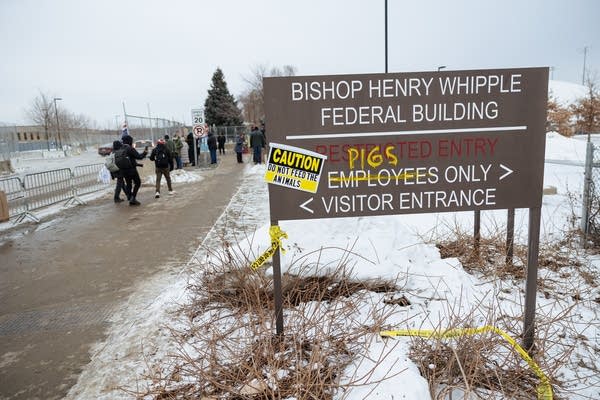

On Thursday morning, Ivan, 27, signed papers to be released from immigration detention at the Bishop Henry Whipple Federal Building. A judge granted his habeas petition and ordered his release. He headed toward the gates, intending to visit a church, thank God for his release, and see his wife.
“I couldn’t even see the sun,” Ivan said in Spanish during a call from the Freeborn County Jail Saturday. “Five federal agents were waiting for me.”
The agents handcuffed Ivan and took him to Albert Lea Prison, which contracts with Immigration and Customs Enforcement to hold detained immigrants. Ivan asked to use only his first name for fear of reprisals.
John Barham, one of Ivan’s lawyers, was baffled. At worst, he thought the officers would try to arrest Ivan later that day, after he returned home. “But we certainly didn’t expect this kind of prank of sending him to Whipple, giving him back his belongings, and then putting him back in the hands of other ICE agents before he could even leave the building,” Barham said.
MPR News helps you cut through the noise and build common understanding. Raise your support for this public resource and keep trusted journalism available to all.
Operation Metro Surge has officially ended in Minnesota, but advocates say federal agents have simply adapted and changed tactics since last winter. They fear that pushing the boundaries of the legal definition of “release” is just the latest strategy used by federal agents in Minnesota to meet arrest and deportation quotas.

The Bishop Henry Whipple Federal Building, pictured here in January with barricades erected to keep protesters out, became a physical symbol of ICE’s presence in Minnesota when hundreds of immigrants and protesters were arrested there during Operation Metro Surge. Now, detained immigrants are held in county jails but processed at Whipple.
Carly Danek for MPR News
Steven Appelget, the attorney who filed the habeas petition against Ivan to challenge his detention, called the move “more nonsense” from the federal government.
In Ivan’s petition, Appelget argued that the government did not have probable cause or a warrant to arrest Ivan in the first place.
Ivan is originally from Guatemala and has lived in the United States since 2019. Besides minor traffic violations, he has no criminal record in Minnesota.
Ivan works in construction to support his family. Early on the morning of September 11 in Columbia Heights, ICE agents spotted Ivan in his work vehicle at a gas station. Agents said in court records that they ran Ivan’s plates and found he did not have legal immigration status.
They followed him to a Menards parking lot and arrested him. Then they took him to the Crow Wing County Jail, which contracts with ICE.
Appelget normally works in the field of consumer protection. But last winter, he joined hundreds of Minnesota attorneys who volunteered to file a series of habeas petitions on behalf of ICE detainees who hadn’t gotten a bond hearing.
“In each of these habeas petitions, something strange happened,” Appelget said.
“ICE and DHS continue to find new and improved ways to violate Minnesota District Court orders,” he added.

A man is pushed to the ground as federal immigration agents confront protesters outside the Bishop Henry Whipple Federal Building on Jan. 15, a week after the death of Renee Good.
John Locher | P.A.
ICE and DHS did not respond to a request for comment on the practice of immediately rearresting immigrants whose habeas petitions have been granted.
A petition for habeas corpus, often translated from Latin as “you should have the body,” requires government officials to present a person they are detaining and justify to a judge why that person is imprisoned. The number of habeas petitions filed on behalf of people detained for immigration reasons has skyrocketed over the past year as the federal government has changed its interpretation of immigration law.
Previously, immigrants without status or with pending cases could not be arrested at all and showed up regularly in immigration court. If arrested, they could be released on bail.
Today, the federal government says it can automatically detain immigrants — even those without criminal records — without a bond hearing until they are deported.
During Operation Metro Surge, most federal judges in Minnesota disagreed with the federal government’s reinterpretation of immigration law and quickly approved habeas petitions if the detainee was not entitled to a bond hearing. But since the Eighth Circuit Court of Appeals sided with Republican President Donald Trump’s administration, habeas appeals have become more difficult in Minnesota.
The Supreme Court agreed to take up the matter.
Ivan isn’t the only person this has happened to. MPR News spoke with four attorneys who said several people have recently fallen victim to this bait-and-switch.
“I’ve heard of a handful, but it’s one of those things where it’s like if you see a cockroach, you don’t have a single cockroach,” said Daniel Suitor, a tenants’ rights attorney who has become a prolific habeas filer.

Feb. 7, Native and religious leaders march in the “Not on Native Land” rally in front of the Bishop Henry Whipple Federal Building. Several tribe members, U.S. citizens, were arrested by ICE during Operation Metro Surge.
Kerem Yucel | MPR News
The suitor said two customers had experienced this so far. One of them was eventually expelled. The other is being held in the Freeborn County Jail with Ivan.
Alejandro, 33, is originally from Mexico and works in Minnesota to support his family back home. Alejandro also asked to use only his first name for fear of reprisals. His case is more complicated than Ivan’s.
Alejandro was arrested for drunk driving and is facing deportation proceedings, but he does not have a final deportation order. Alejandro also requested asylum. His request was rejected, but he appealed.
However, Claimant said Alejandro’s habeas petition was simple.
“The warrant was not legally valid, and there was no reason to believe that Alejandro could not be apprehended once a legally valid warrant was obtained,” Suitor said.
Alejandro has been detained since May, first by local law enforcement before being transferred to ICE. On September 22, a judge recognized that Alejandro had been illegally arrested and that his detention was not justified. The judge ordered his release “immediate”.
On the morning of September 25, Alejandro was brought to the Whipple Building, given his belongings and told he was released.
Alejandro took a few steps further than Ivan. He reached the front doors of the building.
That’s where plainclothes immigration officers were waiting to handcuff him.
“One of the agents translated for me, saying that just as they could release me, they could arrest me again,” Alejandro said in Spanish.
“That’s bullshit,” Suitor said. “We won the case.”

Clergy protest at Minneapolis-St. Paul in January, where some ICE detainees were quickly removed from the state before a habeas petition could be filed in Minnesota.
Kerem Yucel | MPR News
The suitor said he plans to argue that what happened to Alejandro does not meet the legal definition of “release” ordered by a judge.
“I think we have a line of attack to say, letting someone walk out the door and walk maybe three feet away from the front door doesn’t mean they’re free from custody,” Suitor said.
The attorneys said what happened to their clients is part of a broader pattern of ICE’s change strategies to ultimately arrest and deport even more people without public confrontations like those seen during Operation Metro Surge.
“ICE never left. Things have become less public, less dramatic, but immigrants are still targeted and persecuted,” Barham said.
“And from the rumors that I’m hearing, the things that I’ve seen, I suspect that they’re about to escalate again.”
Gn world