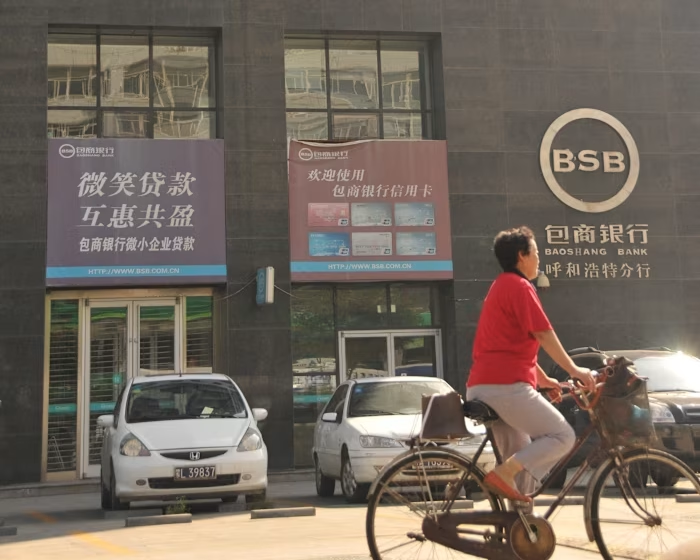

China has reduced the total number of banks by almost a quarter as part of a drive to step up oversight of smaller lenders in a period of economic slowdown.
Regional consolidation within China’s vast state-controlled banking system, with around $64 trillion in overall assets, comes amid signs of weak credit demand in the world’s second-largest economy.
There were more than 670 banking entity closures last year – a record – according to official data from the National Financial Regulatory Administration. Almost all lived in rural areas.
The closures mean the number of entities fell to 3,139, a 23 percent decline in the four years to 2025, ratings agency Fitch said in a report based on NFRA data.
Low rates and deflation in China have also put pressure on bank profits, amid a prolonged housing downturn.
Bank consolidation was about “simplifying regulation” and “eliminating the risk of liquidity events among smaller institutions”, said Jason Bedford, a senior visiting fellow at the East Asia Institute at the National University of Singapore. “We’ve never seen consolidations on this scale before.”
Fitch said that small banks in China, mainly at the rural and urban level, “remain the weakest part of the system, with poor asset quality, weak capitalization and governance gaps, particularly in less developed regions.”
The increase in mergers and dissolutions – when liabilities are also taken over by another lender – should “enhance monitoring”, the ratings agency said.
The NFRA did not respond to a request for comment.
Rural and regional city banks, which are often defined by the level of administrative government they fall under, collectively account for more than a quarter of China’s banking assets. While rural lenders are responsible for almost all of the recent bank closures, urban banks have also come under scrutiny.
In July, authorities in the central Chinese city of Wuhan took over the struggling Z-Bank – the first such takeover since the 2019 takeover of Baoshang Bank in Inner Mongolia.
Z-Bank, which had RMB124 billion in assets at the end of 2024 according to Moody’s, was absorbed by Hankou Bank, another Wuhan lender.

Moody’s said the move “illustrates the challenge facing weaker regional institutions.” The ratings agency added that it expects consolidation to continue as regulators “seek to manage risks associated with smaller and weaker regional institutions.”
Net interest margins – the difference between interest on savings and loans – at China’s biggest banks have come under pressure in recent years. Authorities unveiled in September a $54 billion capital increase for insurers as well as ICBC and the Agricultural Bank of China, two of its largest banks.
That follows a decision last year to inject nearly $70 billion into four other of the country’s largest public banks through stock sales.
Karen Wu, an analyst at credit consultancy CreditSights, part of Fitch, is optimistic about the outlook for China’s big banks, but said smaller lenders were more vulnerable given their lower net interest margins.
“For these smaller banks, you have to do that consolidation,” she said. “You must either ask big banks to consolidate small banks or guide the local government to inject capital into these small players. You must avoid any disruption to the financial market and depositor confidence.”
The overhaul of rural banks has been accompanied by a change in China’s overall economic conditions, clearly marked by the reversal of the real estate boom since 2021.
The People’s Bank of China releases data on what it calls “total social financing” that shows continued growth in overall credit – including government bonds – at a slower pace than in previous years. The indicator also showed rare outright declines in new yuan loans in April and July this year.

“Given household deleveraging in China, primarily in mortgage lending, banks are now lending more to businesses,” said Nicholas Zhu, vice president at Moody’s. He added that the change in lending was a “concern” for Moody’s but, according to the rating agency, “does not constitute a systemic concern for the banking system as a whole.”
Regional concerns were clearly embodied in the race for Baoshang Bank in 2019, backed by now-imprisoned billionaire Xiao Jianhua. Bedford said the incident was a “Rubicon event” in China’s banking sector.
He added that rural consolidation has often excluded the worst banks. Inner Mongolia now has just 12 banks, down from well over 100, following last year’s consolidation into the Inner Mongolia Rural Commercial Bank.
Consolidation would reduce the number of “liquidity events that we now have to worry about,” he said, adding that in the 2000s “we never worried about liquidity risk.”
In the city of Shenyang, Liaoning province, Shengjing Bank consolidated other lenders, including one visited by the FT that showed various low savings rates. The bank now offers mortgages from a single branch, a staff member said.
Shengjing did not respond to a request for comment.
China’s policy rates, namely the prime rates for one- and five-year loans, are closely watched for further easing this year after weak monthly economic data.
“The entire banking system – not just rural banks – is facing China’s low interest rate environment,” Zhu said.
Gn bussni