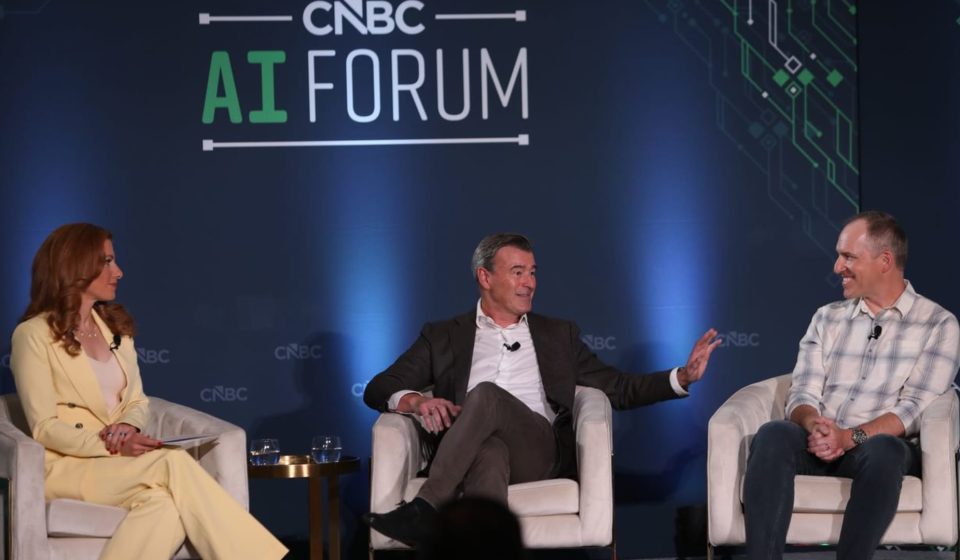

Saul Van Beurden, Wells Fargo co-CEO of consumer banking and head of AI and Bret Taylor, co-founder of Sierra and president of OpenAI, speaking at the CNBC AI Forum in Dallas, Texas, October 1, 2026.
Carla Thorpe | CNBC
Hello, this is Hui Jie writing to you from Singapore. Welcome to another edition of CNBC’s Daily Open.
A line from Netflix’s Bojack Horseman says: “When you look at someone through rose-colored glasses, all red flags look like flags.”
For much of this year, investors have viewed the AI business through rose-colored glasses. This week they put down their glasses and what they saw was clearly not pleasant.
Credit strains at CoreWeave, concerns about corporate AI spending and another report of red-hot inflation wiped more than $1 trillion from 20 of the world’s biggest AI and semiconductor stocks this week.
What you need to know today
Caution now appears to be in order in the AI sector, as investors worry about how much companies are spending on AI.
One example is CoreWeave, which is facing a spiral of credit stress that has been highlighted amid a selloff in AI-related stocks.
Yields on CoreWeave debt continued to climb, with the yield to maturity on its 9.75% bond due in 2031 reaching 15.78%. Yields generally increase when investors view a bond as riskier.
Meanwhile, the spread on its five-year credit default swaps, which provide insurance against default, at one point climbed above 1,140 basis points.
A spread level of 1,000 basis points or more is generally a sign of credit difficulties, said Gavan Nolan, executive director of fixed income pricing at S&P Global Market Intelligence.
Concerns around AI funding led to a rotation out of the sector, with big AI names like Nvidia losing 1.84%, while AMD fell 1.5% and Intel lost around 2.8%. Dell Technologies fell 6.8%.
Collectively, 20 of the world’s most valuable AI and semiconductor stocks have lost more than $1 trillion so far this week, as interest rate hikes, AI funding and intensifying competition weighed on sentiment.
AI Security
Concerns were not limited to funding. Nvidia chief Jensen Huang also reiterated his warnings about AI safety, saying the chipmaker “absolutely must” work with Chinese AI companies to monitor the risks of this “potentially dangerous” technology.
“We absolutely need to work with each other to advance the technology safely,” he told CNBC during a press briefing Wednesday evening in London.
Discussions around AI safety have intensified in recent months, after researchers at AI labs including OpenAI and Anthropic called for a slowdown in the technology’s development and warned of existential risks to humanity.
Material request
Despite these concerns, the industry’s thirst for chips shows no sign of abating, as Taiwan Semiconductor Manufacturing Company’s record quarter shows.
TSMC on Thursday reported record profit for a sixth consecutive quarter and expects its fourth-quarter revenue to be 58% higher than a year earlier, driven by strong demand for its advanced chipmaking technologies.
Last year, TSMC said it had the capacity to manufacture more than 17 million 12-inch-equivalent wafers. But customers want more.
“The competition is extremely fierce,” said Jordan Klein, an analyst at Mizuho Securities. “It’s about who can get the most leverage and supply.”
Inflationary concerns
Inflation is above all these developments.
Just a day after US consumer inflation figures for September came in better than expected, producer price growth also beat expectations, underscoring continued inflationary pressure from the energy sector amid the US-Iran war.
The PPI climbed 6.3% year-over-year, marking its fastest rise since December 2022 and well above the 5.5% expected by economists surveyed by Dow Jones.
In Bangkok, Federal Reserve Chairman Kevin Warsh will appear Friday morning alongside IMF Managing Director Kristalina Georgieva for his final scheduled public remarks before the central bank’s blackout period ahead of the Oct. 27-28 policy meeting.
With inflation resurgent and traders weighing the Fed’s next move, any signals about the path of rates could ripple through stock, bond and currency markets.
—Lim Hui Jie, Anniek Bao
And finally…
Bela Bajaria, Netflix chief content officer, leaves the post and will be replaced by Peter Rice
Netflix announced Thursday that Bela Bajaria will be replaced as the company’s chief content officer by former Disney executive Peter Rice, effective October 26.
Rice most recently oversaw Disney’s cable channels, news programs and coverage of major sporting events.
In his new role, Rice will oversee the company’s global content organization, including scripted and unscripted series, films and live events.
Before Rice worked at Disney, he held positions at 21st Century Fox and Fox Searchlight Pictures. In its announcement, Netflix called him “one of the most respected creative leaders in the entertainment industry.”
—Laya Neelakandan
Gn bussni