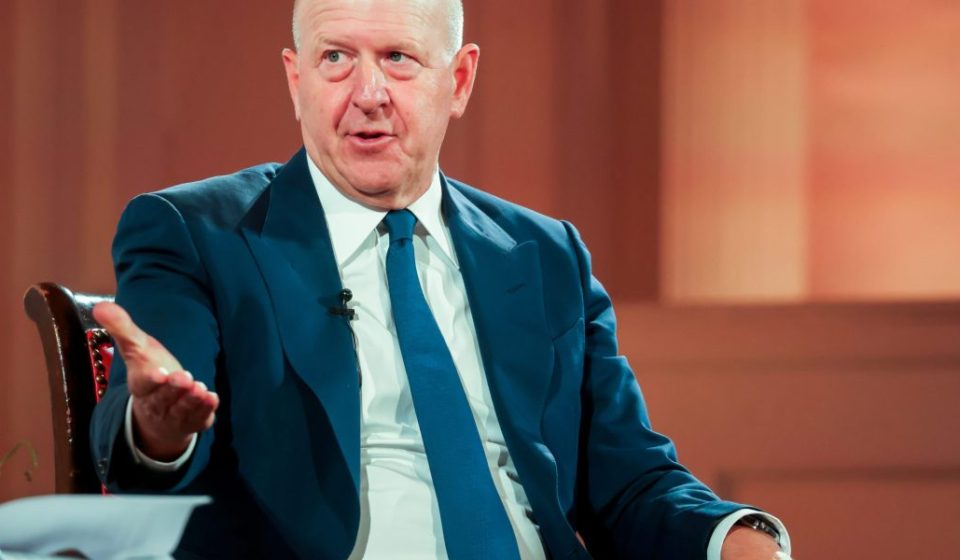
David Solomon, CEO of Goldman Sachs, on the economic impact of AI: “We are doing very little where we need pioneering models”

David Solomon spent Thursday announcing a $500 million AI initiative alongside four of the companies building the world’s most powerful models. Then he told the room that most of the economy doesn’t need these models.
“Border models and how they develop are going to be a very, very interesting thing,” the Goldman Sachs CEO told the crowd at the launch of the company’s new Small Business AI Institute at the bank’s headquarters in Lower Manhattan, where Fortune was present. “But we do very little where we need pioneering models,” he added, appearing to speak generally about economic activity, in the context of small businesses.
“Technology is evolving very, very quickly, and it’s going to continue to evolve rapidly,” Solomon said. But “we have to separate at a certain level” the development of frontier models from the tools that companies actually use on a daily basis, he added.
Pioneering models, he said, are important for cybersecurity, for defense and for healthcare, for example in drug discovery and molecule formation. Security struggles and the “broader border issues that get a lot of attention,” Solomon said, “are really separate from using the basic tools that exist to support your businesses.”
The AI Institute is part of a new $500 million commitment to fund the next chapter of Goldman’s 10,000 Small Businesses program, which will provide education, access to capital and support services, according to the bank’s announcement. Nearly 20,000 entrepreneurs have completed the program since it launched in 2010, part of an earlier $1.25 billion commitment. Small businesses make up 99% of U.S. businesses, an “extremely important ecosystem,” Solomon said.
Anthropic, Google, Meta and OpenAI each have a share. Anthropic will develop a learning series on applied AI for small businesses; organize practical workshops for alumni of the program; and collaborate on research into how small businesses use AI. Google will offer its Grow With Google AI Professional certificate to nearly 20,000 small business owners and employees, with three months of free access to Google AI Pro. Meta will provide AI tools and training through Muse for Small Business, and OpenAI will host AI workshops through the program’s community college partners.
To slow down
Solomon’s advice to small business owners flies in the face of the urgency the AI industry usually sells.
“At the moment it’s an expensive technology,” he said. “I don’t think you need to look at the world and say, ‘I have to be the best at this; I have to have this figured out in the next three weeks.'”
He presented it as a return on investment problem. “If you think about the token costs and the cost of being on these platforms, the return can come from productivity,” he said, citing sales, customer experience, manufacturing and purchasing as points to consider. “The important thing is to do it right, not to do it faster.”
Most homeowners surveyed in Goldman’s survey aren’t spending much yet. In a report released alongside the announcement, 73% of program graduates who use AI reported spending less than $100 per month on it, including 16% who only use free tools. Most rely on chatbots such as ChatGPT, Claude or Gemini (86%) or AI features built into software they already use (54%). Only 18% use agentic AI.
Adoption itself is not the problem. The survey, conducted by Babson College in August, found that 86% now use AI in their business, up from 56% in 2024. But only 15% said AI is fully integrated into their core operations, and 77% said they would benefit from more training and resources.
“Without fixed cost base”
Goldman’s pitch for the institute centers on productivity. An owner doing more strategic work would typically hire a strategy consultant, but AI allows them to move that work forward without actually hiring someone. “So it’s not limiting the work, but it’s creating more leverage in the business without a fixed cost base,” Solomon explained.
Goldman’s investigation confirms this, for now. Among graduates using AI, 84% reported no change in their workforce because of it. Five percent said they added positions and 6% said they reduced their workforce. When asked what they do with the time AI saves them, 56% cited strategic planning, 44% marketing expansion, and 31% new products or services.
Small business owners on stage described AI as augmentative.
Allison Dunn founded Hibiscus Brew, a Caribbean coffee and wellness beverage brand in Brooklyn, during the pandemic. She built it around sorrel, a ginger-infused hibiscus drink traditionally served during the holidays. She calls AI her “thinking partner.” He sorts through emails, builds his to-do list, fills his calendar and helped develop the cafe’s fall menu, which pairs pumpkin spice with roasted plantains. Every morning at 8 a.m., this has him doing 10 minutes of public speaking practice. It also recently solved his biggest headache, an inventory checklist for a coffee shop that works on milk, espresso and everything in between. She keeps it at the back of the house and treats what it produces as “a first draft.” Customers are always greeted by name “within three seconds”.
“I think AI is not here to replace,” Dunn said. “These are the people who can use AI who could replace you.”
Hagan Walker co-founded Glo Pals, a light-up toy brand whose founders got their start as students at Mississippi State University with a patented light-up drink cube. He uses AI “all day, every day. My team might say a little too much sometimes.” An AI agent wrote the algorithm that selects the cheapest box size for each order. The AI created the company’s website theme after three months of iterations, and an agent analyzes its advertising data on Google and Meta. One rule remains firm: “Anything that is copyrighted or illustrative is made by a person,” Walker said, citing legislation around AI and children’s toys. The company is in a hiring sprint and is looking for candidates who are familiar with the tools. “It’s definitely increasing,” he said.
Salomon’s institute has three parts, he explained: each partner’s training and learning programs; research into how small businesses actually use AI; and access to capital. “Access to capital continues to be a constraint,” he said.
Generative AI was used for research assistance and/or transcription of this article. The journalist independently reported and verified the factual claims in this article, and a human editor reviewed it before publication.
Gn bussni