Why Olivia Colman Didn’t Get Any Breaks While Getting Intimate In Alexander Skarsgård’s ‘Wicker’ Costume

Believe the hype. “Wicker,” now in theaters, is every bit as exciting, romantic and wonderful as the trailer leads you to believe.
Olivia Colman plays a single fisherwoman in a medieval community where marriage is what gives a woman value. Although she is a fiercely independent woman, the village mocks her as she earns a living. One day, she goes to the local basket maker, played by Peter Dinklage, and asks him to make her a wicker husband.
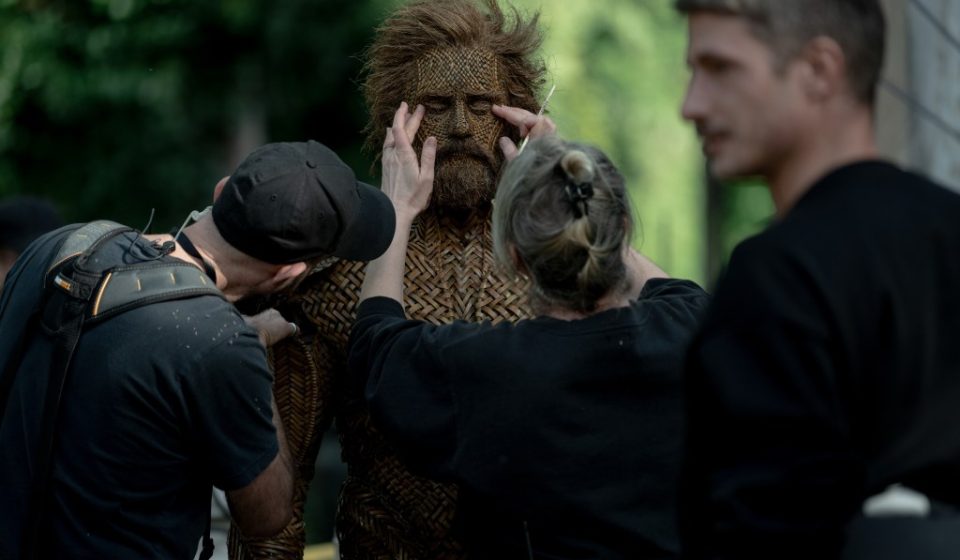
Enter Alexander Skarsgård – yes, that’s him under all that makeup – dressed in a practical suit and prosthetic makeup to transform him into a basket man.
It all started with Alex Huston Fischer and Eleanor Wilson, who were adapting Ursula Wills’ short story “The Wicker Husband.” Weta Workshop artists, prosthetic makeup artist Joe Dunckley and lead FX makeup artist Sarah Rubano, received the script and a call from the writers and directors who said, “We want to do this in a hands-on way,” Dunckley says. “They wanted a beautiful piece of conceptual art that showed their vision.”
The couple spent 18 months on research and development alone. Since prosthetic makeup materials are made to mimic human flesh and skin, this presented a challenge. “This guy is made of wicker, so we had to do it differently,” says Dunckley. He continues: “We tested our theory. We thought that if we could make the strands of the weave individual and make them move as if they were individual muscle fibers driving its movement, then it could be a believable sentient wicker being.”
But they couldn’t mold it, so the two were pushed toward modern innovation using 3D digital sculpting and 3D printing.
They started with a full body scan of Skarsgård so they could sculpt parts specific to him.
The intricate basket weave was created using a relatively new powder bed laser sintered printing process. Dunckley explains: “It’s a volume of thermoplastic elastomer; you shoot a laser at it and where that focal point of the laser is, it fuses the powder and you can create a complex weave and complex geometry. The powder in the bed keeps the strands separated while they solidify.”
And why didn’t Colman have any outbursts during the film’s steamy scenes?
Almost the entire Skarsgård costume was made up of 50 individual 3D-printed devices that were painted to look like wicker before being sewn onto a soft, flexible spandex costume – so no straws were involved.
Dunckley says: “It’s a semi-flexible material, not much different from the feeling of touching real wicker weave.”

As for the prosthetics, Rubano focused on the makeup, consisting of 10 individual pieces.
Rubano says, “He would put on this very fitted suit and we would jump between the makeup chair and get him ready in the suit, depending on the different steps. She goes on to say, “We had ears, eye bags and lips. We had an under lip piece and a jaw piece, as well as a wider forehead, nose and cheekbones and there was a lot of hand painting around his eyes.”
His facial hair – beard, hair and eyelashes – was made from muka, a soft, silky fiber extracted from the harakeke plant. This material allowed them to tie the individual strands onto the weave itself so they could cut and style it like human hair.
The key was not to lose Skarsgård under the makeup. Dunckley explains that the team used 3D animation software: “We were able to track the range of facial expression so we could build into the weave the ability to move for its expression.”
In all, it took less than two hours to transform Skarsgård into a wicker husband. “90 minutes is where we were at the end,” Rubano said.
Dunckley adds: “The other big piece of the puzzle was Alexander himself. What a wonderful collaborator and team player! He was resilient. He was funny. He was so invested. He sat as still as a statue in his chair.”
They encountered a small problem. Rubano reveals: “He’s hot; the suit is pretty hot and it was a Hungarian hot spring.”
And what about the wicker penis?
“There has been a lot of speculation about how this would work and the potential danger of a wicker penis,” says Dunckley. “I think the basket maker is competent. He’s traveled the world. He’s learned from every culture how to weave, and I think he would know exactly how to weave a wicker so that it would be user-friendly.”
Rubano thanks the film’s costume designers András Dániel Tóth and Attila Godena-Juhász for this detail. “They made the wicker for the full-body river shot. They did a great job because it was last minute, but it’s baggy spandex. The weave was 3D, so it had dimension. From a distance, they matched the colors so well.”
Gn entert