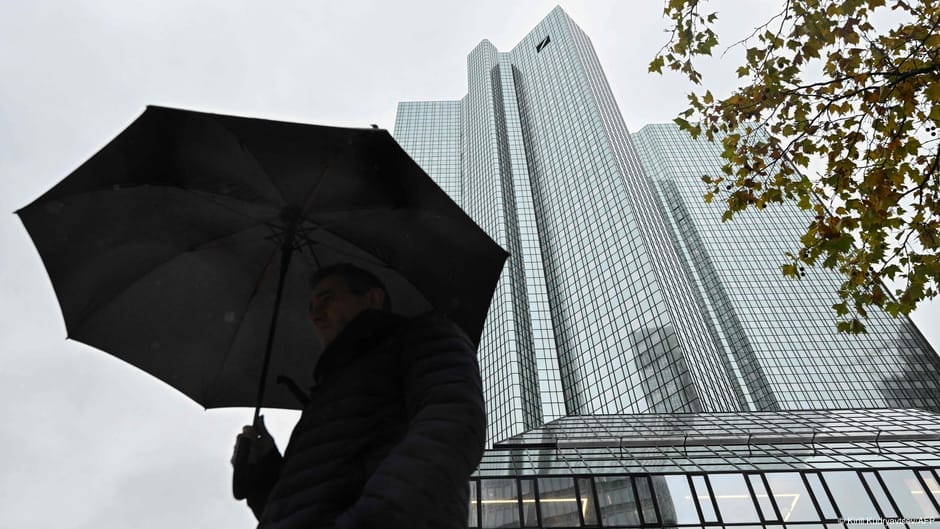
Deutsche Bank is once again in damage control mode after an international consortium of more than 200 investigative journalists published internal documents from the global lender on Tuesday under the name “Inside Deutsche Bank.”
The documents, published in Der Spiegel, Financial Times, Le Monde And The New York Times, among others, cover Deutsche Bank’s business dealings with convicted sex offender Jeffrey Epstein, current US President Donald Trump, and a host of Russian oligarchs.
Drawn from nearly 15 million documents leaked to an Indian and another South African journalist, the emails and meeting minutes trace the bank’s aggressive pursuit of business deals in Russia and with prominent Russian oligarchs, through to Moscow’s launch of its full-scale invasion of Ukraine in 2022 – despite warnings about the risks from many leaders.
Deutsche Bank CEO Christian Sewing was among the executives who participated in the bank’s Russia strategy working group. The bank also still employs more than 160 people in Russia and generated a pre-tax profit of 61 million euros ($67 million) there in 2025 through a local subsidiary.
It’s not just about Deutsche Bank’s dealings with Trump, Epstein and the Russians
In total, the documents cover the last 20 years of the German bank’s business dealings and raise questions about the effectiveness of internal controls by showing that Deutsche Bank had repeatedly put financial interests ahead of compliance with international sanctions and anti-money laundering rules.
Other red flags raised in Tuesday’s reports suggest that Deutsche Bank sought to set up tax optimization programs for its wealthy clients, that criminal networks may have moved illicit cash through the institution, that it helped facilitate arms sales, that it helped companies in environmentally harmful sectors and that it held funds for the far-right populist Alternative for Germany (AfD) party.
Has Deutsche Bank really changed its ways?
Beyond more recent negative headlines reporting alleged anti-money laundering and non-compliance failings, Deutsche Bank has been trying to repair its public image since its involvement in the U.S. subprime mortgage rate scandal helped trigger the 2008 global financial crisis – a fiasco that ultimately cost the bank more than €20 billion in sanctions and settlements.
When Sewing took over in 2018, he promised to turn around the institution. Although he made Deutsche Bank profitable once again, he did so at the cost of massive job cuts, and some compliance lapses persisted.
Couture in everyday German economic life Handelsblatt newspaper that certain errors had been made under his leadership.
“When you look at today’s events, you naturally wonder if you could have done some things differently,” he told the newspaper. “I’m not without mistakes,” he said, but added that the course he set for the bank “has always been the right one and remains so.”
The bank’s shares fell as much as 6% on Tuesday.
German government wants ‘full transparency’ from Deutsche Bank
Deutsche Bank issued a statement saying that these reports were old news and that the institution had long since turned over a new leaf.
In an emailed statement to the press, Deutsche Bank Supervisory Board Chairman Alexander Wynaendts wrote: “During my tenure, I have not seen a single decision by Christian Sewing that I was not comfortable with.”
A statement released by the bank on Tuesday called the revelations “legacy” issues and said they would have no lasting negative financial impact on the institution.
Nonetheless, German Finance Minister and Vice Chancellor Lars Klingbeil on Tuesday called on Deutsche Bank to “demonstrate full transparency about how it has addressed past failures and internal control deficiencies and how it intends to effectively prevent them in the future.”
Additionally, Klingbeil said authorities must investigate and “take necessary action” if necessary.
Gn bussni