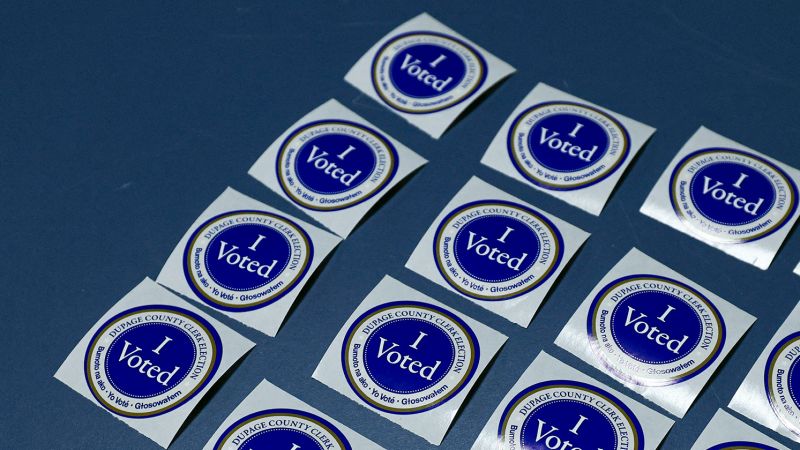

Election Day is still a month away, but more than 690,000 Americans have already voted in at least 29 states. There are signs of the advantage Democrats have in motivating their voters — a trend that has played out in polls throughout the summer.
In several states with key Senate or gubernatorial elections this fall, Democrats account for a larger share of voters requesting ballots so far than at this point in 2024.
In Iowa, Democrats have made 67% of the ballot requests, up from 54% at this point in 2024. In Pennsylvania, it’s 66%, up from 62%, and in Maine, it’s 57%, up from 53%. And according to data from the North Carolina State Board of Elections, 42% of ballot requests come from Democrats, up from 36% in the same period two years ago.
It’s worth noting that in all of these states except Iowa, voting demands at this point in 2022 were more Democratic than they are now.
The rise in the share of demands from Democrats would be consistent with results from polls, special elections and primary turnout, all of which indicate that Democrats may be more motivated to vote in November.
On the other hand, this might just be further evidence that Republicans continue to prefer other forms of voting.
An important caveat: Although whether someone voted is generally public information, your vote itself is secret, so this data can’t tell us how many votes a party or candidate won. This won’t be known until states begin reporting results after elections close on November 3.
The early voting data also shows only one slice of voters: one that is generally older and less Republican than the electorate as a whole.
Voting patterns have changed in recent years as the country emerged from the Covid-19 pandemic.
While mail voting has fallen from its 2020 highs, voters 65 and older make up a larger share of people choosing to vote this way, rising from 27% of mail voters in 2020 to 31% in 2022 and 37% in 2024, according to CNN Exit Poll data.
This is not unexpected. Voting by mail can be a convenient option for seniors who might have difficulty getting to the polls. In many states where voters need an excuse to vote by mail, age itself may be considered a reason to receive an absentee ballot.
There are signs that this trend is continuing this year.
In almost every state for which there is comparable data, voters 65 and older make up a larger share of ballot requests this year than at this point in 2022 or 2024.
Perhaps the most positive signs for Democrats so far come from Virginia, which reported by far the most votes of any state according to CNN’s tally and is the only state to report substantial numbers of early in-person and mail-in votes.
Although Virginia voters do not register by party, there is a clear relationship between how a locality voted in 2024 and its relative pace of early voting.
Cities and counties that voted for former Vice President Kamala Harris by more than 20 percentage points are at 78% of their turnout rate at this time in 2024, while those that voted for President Donald Trump by 20 percentage points are at just 61%.
Partisan turnout, measured by the share of voters who have only participated in a party’s primary since 2022, also indicates a sizable Democratic advantage during the early voting period compared to the same time in 2024.
Even though turnout so far shows a clear advantage in Democratic motivation, Republican voters could narrow the gap as Election Day approaches. It’s still early in the voting period: Virginians have cast more than 4.5 million votes in 2024 and more than 3.4 million votes in 2025. Virginia’s Senate race is not expected to be competitive this year, and Republican voters may be more motivated in more closely contested races.
Yet two competitive House races in the state also suggest a shift toward Democrats in enthusiasm.
Democratic primary participants outnumber Republicans in the primary by 15 points in votes cast so far in the 1st District and by 18 points in the 2nd District. Both districts are battlegrounds currently represented by Republicans facing tough opponents: Rep. Rob Wittman in the 1st and Rep. Jen Kiggans in the 2nd.
At the same time in 2024, the partisan composition was relatively divided in the two districts, with Republican primary voters leading by about 3 points in the 1st District and Democratic primary voters leading by 2 points in the 2nd District.
Statewide, Democratic primary participants lead Republicans by about 18 points, up from 8 points at the same point in 2024.
Pre-election voting data is valuable but has limitations.
Early voting data is compiled by CNN, the Associated Press and the data firm Catalist, a company that provides data, analysis and other services to Democrats, academics and nonprofit advocacy groups, including information on who will vote before November.
The number of votes cast so far represents only a tiny fraction of the approximately 57 million pre-election votes cast in 2022 and an even smaller share of the approximately 112 million total votes cast in this election, but it is expected to increase significantly in the coming weeks.
Data so far is also largely limited to mail-in ballots because very few states have started early in-person voting. In recent years, mail-in voters have been much more Democratic, while early in-person voters have been more evenly split or Republican-leaning.
Gn usa