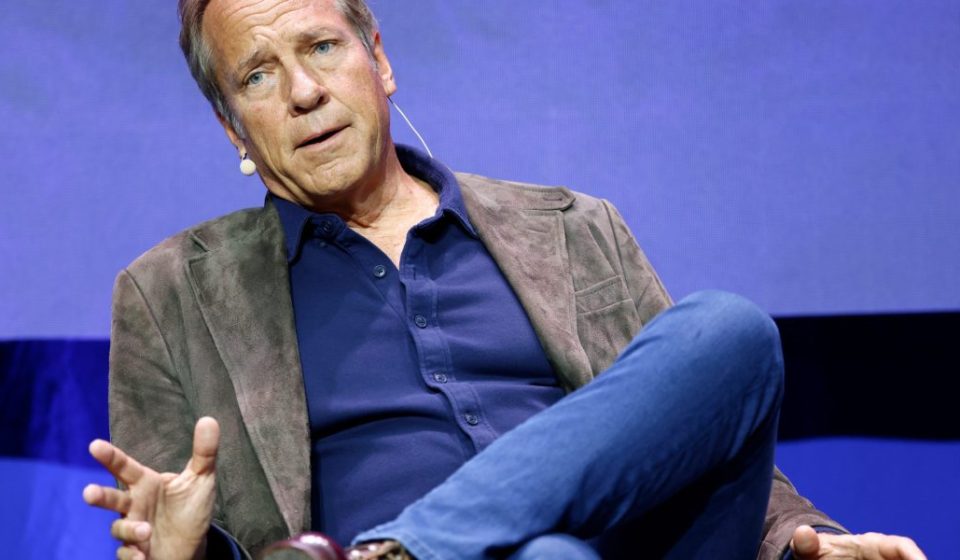
Mike Rowe on the great shortage of tradespeople in the United States: “I don’t care about your politics. The math doesn’t care either.

Mike Rowe offered a straightforward way to describe the shortage of skilled workers in the United States: The country is losing craftspeople faster than it is replacing them.
“For every five tradespeople who retire this year, two replace them,” Rowe said during a Ford Pro Accelerate panel on workforce development. “Five out, two in. I don’t care how you vote. I don’t care what your political views are. Math doesn’t care either.”
The host of Dirty work has made variations of this argument for years. But at Ford’s rally, Rowe’s warning about welders, electricians and other skilled workers became the opening for a deeper conversation with Education Secretary Linda McMahon and Michael Duffey, undersecretary for acquisition and sustainment at the U.S. War Department, about the country’s mistakes in treating college and job training as opposing paths.
The argument that emerged was not simply that Americans needed more people in the trades. That’s because the terms “blue-collar” and “white-collar” may no longer describe the jobs that employers need to fill — or the education workers they need to fill them. Try “purple,” Rowe said.
The arithmetic of a shrinking workforce
Rowe argued that the shortage of skilled labor has become difficult to ignore as a routine hiring challenge. The shortage, he said, is “real,” “widespread,” “widening” and “dangerous.”
It’s partly a question of demographics. More experienced tradespeople are retiring, while fewer younger workers are entering fields such as welding, electrical, plumbing, advanced manufacturing and industrial maintenance.
“How long do you want to wait for your toilet to be repaired?” » he said. “How long do you want to wait for the lights to come back on when you flip the switch?”
The gap also increasingly extends to manufacturing and national defense. Rowe cited the underwater industrial base as an illustration of the problem, describing the shortage of welders and electricians at a time when the United States is trying to increase its production capacity.
Rowe said he received a call in his capacity as CEO of the BlueForge Alliance’s MikeRoweWorks Foundation, which oversees 16,000 individual companies collectively tasked with delivering nuclear-powered submarines. “These guys are calling me saying, ‘Hey, we’re having trouble finding welders and electricians. Can you help me?” I said, ‘I don’t know. How many do you need?’ » And the number is huge: BlueForge says that around 100,000 workers in critical manufacturing trades will be needed over the next 10 years for the next-generation submarine fleet.
When asked where to find these future workers, Rowe said, “They’re in eighth grade. »
This is the problem, according to Rowe. Companies across the economy — Ford and General Motors, major retailers, manufacturers and defense contractors — are competing for workers who will take years to develop. “You can’t recruit outside of eighth grade,” he said.
Linda McMahon’s response
McMahon agreed with Rowe’s premise, but focused on the institutional changes needed to build a larger pipeline. She said the Department of Education is working with the Department of Labor to place greater emphasis on workforce training and accelerate access to skilled jobs.
Her preferred model begins before graduation. High schools, she said, should work more closely with community colleges, technical schools and vocational programs so students can earn both a high school diploma and a usable degree.
A student might start with electrical work, for example, then add qualifications in HVAC or welding. The aim is to enable young people to enter the job market more quickly, avoid unnecessary costs and continue to accumulate skills over time.
McMahon also urged schools to introduce hands-on learning much earlier, including virtual welding and electronics programs that can make technical work tangible and engaging for young students.
But his sharpest point concerned parents and the status hierarchy around higher education. Skilled work, she argued, should not be described as what a student does when college is not operating.
“It’s not just saying, ‘Boy, my kid really wasn’t smart enough to go to college, so I guess he’ll be an electrician or a plumber,'” McMahon said.
A “purple” workforce
Rowe took the conversation further. The problem isn’t just that too many people are steering students away from the trades, he said. The fact is that the country still considers intellectual work and practical work as separate worlds.
He questioned the usefulness of the labels “blue-collar” and “white-collar,” particularly in places like Detroit and his hometown of Baltimore, where those identities are deeply ingrained. Perhaps, he suggests, the next generation of works will have “a more gray or purple hue.”
Rowe then presented his smartphone as an emblem of this change.
“Here’s my liberal arts degree,” he said, asserting that a smartphone with an Internet connection allows anyone to access “99 percent of the information known.” He said he recently watched an MIT lecture for free from a hotel room.
His argument was not that education is obsolete. This is because intellectual ambition is no longer limited to a campus or to students following a conventional academic path. Nor should people with elite degrees be insulated from the value of learning a physical trade, he argued.
Recalling the political line that America needs “fewer philosophers and more welders,” Rowe offered his own version: “Our country needs more philosophers who can lead equal work and more welders who can speak intelligently about the Stoics and think critically,” he said.
The new industrial mix
Duffey linked this argument to the changing nature of manufacturing and defense. Newer companies in the defense industry, he said, combine technology and manufacturing in a way that doesn’t suit older workforce categories.
The need, he said, is for people with skills rather than a particular job label – and for “flexible factories and (a) flexible workforce” that can respond to changing industrial demands.
This made Rowe’s demographic warning more than a slogan about empty trade school seats. The panel was actually arguing for a different educational hierarchy: one in which the future welder could be a self-taught person with access to MIT courses; the future engineer can understand the workshop; and skilled work is no longer presented as an alternative to an intellectually serious life.
The workforce of the future, Rowe suggested, may not be blue-collar or white-collar. Maybe it’s purple.
For this story, Fortune journalists used generative AI as a research tool. An editor checked the information for accuracy before publishing it.
Gn bussni