At least 5,069 people died during the magnitude 7.2 and 7.5 earthquakes which struck northern Venezuela, and particularly the state of La Guaira, on June 24, 39 seconds apart, according to a new report published Friday July 17 by the President of Parliament, Jorge Rodriguez.
See alsoEarthquakes in Venezuela: residents search the rubble in search of the missing
The earthquakes also caused 16,740 injuries. According to a UN estimate, the number of missing, not communicated by the authorities, could reach 50,000.
The violent tremors damaged several hundred buildings, making them uninhabitable, or caused their total collapse, mainly in the town of La Guaira.
Around 20,000 people, now homeless, are grouped in makeshift camps set up in stadiums, in public squares and even on the sidewalks of this popular seaside resort, located near the capital, Caracas.
To finance the reconstruction, Venezuela obtained from the International Monetary Fund (IMF) the release of a sum of 346 million dollars, until then frozen due to the non-recognition of the legitimacy of the former Venezuelan president, Nicolas Maduro.
This financial package aims in particular to “support” affected “families in terms of housing, infrastructure and essential public services,” said Delcy Rodriguez, interim president, in a statement on Friday.
The IMF and the World Bank announced in April the resumption of their relations with Venezuela, interrupted since 2019, after the overthrow of President Nicolas Maduro by the United States during a military operation in January.
Finding bodies for pay
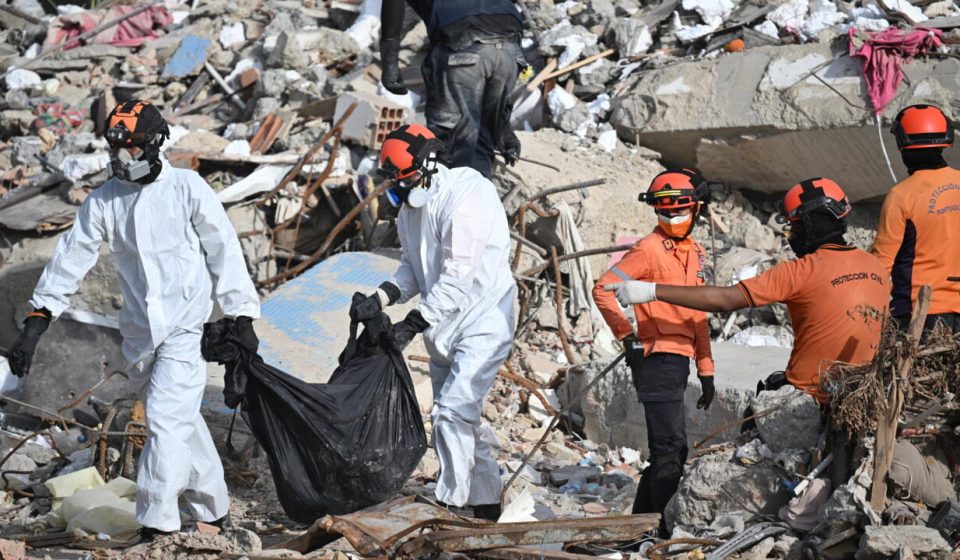
In La Guaira, relatives of victims and volunteers continued to search for bodies in the ruins on Friday, amid swarms of flies.
Some have rented machines to lift the walls that prevent them from accessing their loved ones.

Two people atop the rubble of a building destroyed by the June 24 earthquakes in Caraballeda, Venezuela, July 17, 2026. © Raul Arboleda, AFP
“There are a lot of people down there, no one wants to touch the dead,” lamented to AFP Hildegar Mujica, a 60-year-old economist looking for his ex-wife, buried under the concrete slabs of a 12-story tower.
“At no time have state agencies expressed any interest in the bodies that are in this entire stone structure,” he added. “In fact, there are visible bodies and, if there are no families to recognize them, they are not taken into account.”
Delcy Rodriguez assured at the beginning of July that “no one would go to mass graves”.
As the days go by, some rely on “moles”, individuals who, for remuneration, help families recover their dead.
Johan Torumo, a 45-year-old volunteer from La Guaira, disapproves of the practice. “I have a witness from whom they took $1,300,” said the rescuer, criticizing the lack of government assistance in recovering the bodies. “We didn’t even see a grinder, nothing,” he assures.
The “moles” are contacted with the greatest discretion, according to him, and charge $300 per person found. “Once they find your loved one, they ask you for a black trash bag and they put it in you.”
With AFP