
Saudi civil nuclear power could well become a reality after the announcement by the United States, Wednesday July 22, of an agreement with Riyadh paving the way for the construction of nuclear power plants in the kingdom which currently depends on gas and oil to produce its electricity.
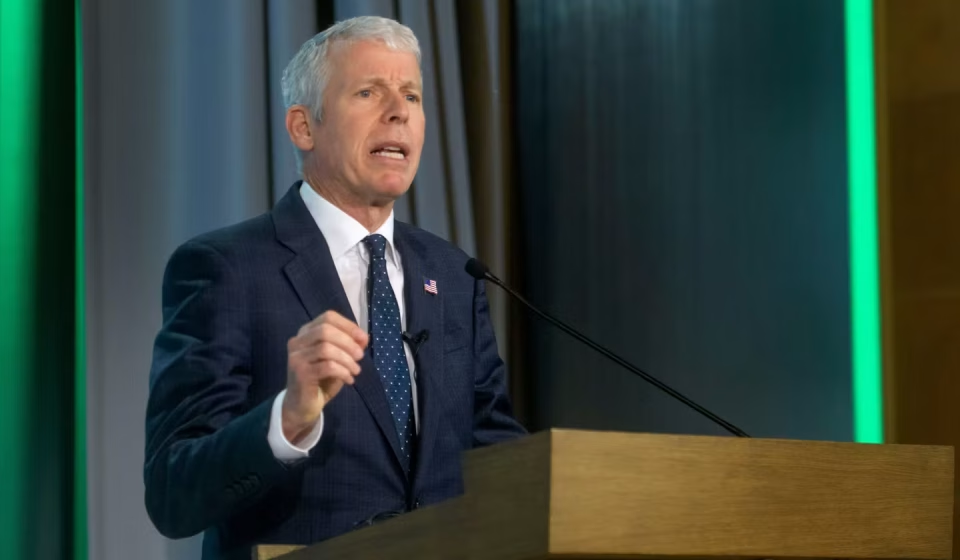
In a statement, US Energy Secretary Chris Wright said the agreement “lays the legal foundations for a decades-long partnership” aimed at “strengthen trade relations between the United States and Saudi Arabia, ensuring prosperity at home and the security of our allies abroad”.
The agreement concluded between the two countries will allow “to develop American exports of nuclear technologies” and of “create well-paying jobs in the United States”it is specified in the document signed by Mr. Wright and his Saudi counterpart, Prince Abdulaziz Ben Salman. It must still be submitted to the American Congress but the latter, with a Republican majority, should not oppose its implementation.
The American media reported the signing of the agreement at the start of the day. According to the Wall Street Journala clause provides for American companies to build a uranium enrichment complex in Saudi Arabia, if a joint study establishes that it is justified.
Dan Sumner, CEO of the American nuclear reactor manufacturer Westinghouse Nuclear, described this agreement on CNBC “major milestone” and believed it would strengthen energy security and increase opportunities for American industry.
Washington puts forward “strict” standards
The announcement comes as the United States has resumed its conflict against Iran, a rival of Saudi Arabia. By entering the war alongside Israel at the end of February, Washington notably declared that it wanted to definitively prevent Tehran from acquiring atomic weapons. The Islamic Republic denies this intention, but defends its right to civil nuclear power.
“Washington is right to strengthen its relations with Riyadh, but this must not come at the expense of the effectiveness of its norms regarding the non-proliferation of nuclear weapons”estimated, earlier in the day, Matthew Kroenig, former official of the Ministry of Defense and researcher at the Atlantic Council. “It would therefore be a mistake to authorize enrichment in Saudi Arabia”he insisted then.
In its press release, the American Department of Energy highlights compliance with “the highest standards in nuclear safety and non-proliferation”. US lawmakers, Republicans and Democrats alike, as well as Israeli officials, have expressed opposition to any civilian nuclear projects in Saudi Arabia, fearing that they could ultimately be used to develop nuclear weapons.
Democratic Senator Chris Murphy regretted that this agreement risks “trigger a nuclear race in the region, further dissuading Iran from curbing its own program” nuclear. In a message published on “further proof that (Donald) Trump is absolutely not serious about making a nuclear deal with Iran ».
“Absurd”, according to Bernie Sanders
Senator Bernie Sanders, a figure of the American left, noted that the American president justified “its war against Iran as a way to prevent an authoritarian country from enriching nuclear fuel”. And “Now he’s letting his best friends in Saudi Arabia – one of the world’s most brutal dictatorships – do just that. It’s absurd”he wrote on X.
Questioned Wednesday in Manila, on the sidelines of a meeting of the Association of Southeast Asian Nations (Asean), the American Secretary of State, Marco Rubio, refused to confirm the existence of the agreement with Riyadh. Pressed with questions by journalists and visibly a little embarrassed, he nevertheless assured that the United States “would never enter into an agreement with any country in the world that would lead to a risk of proliferation” nuclear.
Nonproliferation experts nevertheless warn that any centrifuge spinning in Saudi Arabia could open the door to a possible weapons program for the kingdom, a possibility that its leader, Crown Prince Mohammed Ben Salman, has not formally ruled out in the event that Iran obtains, for its part, the atomic bomb.
Saudi Arabia has long insisted on its right to civilian nuclear power. In recent years, Washington has sought to integrate any nuclear deal into a broader strategy, which would include normalizing relations with Israel and signing a defense pact.
The country signed a nuclear agreement in 2009 with Saudi Arabia’s neighbor, the United Arab Emirates, which does not, however, enrich uranium.