
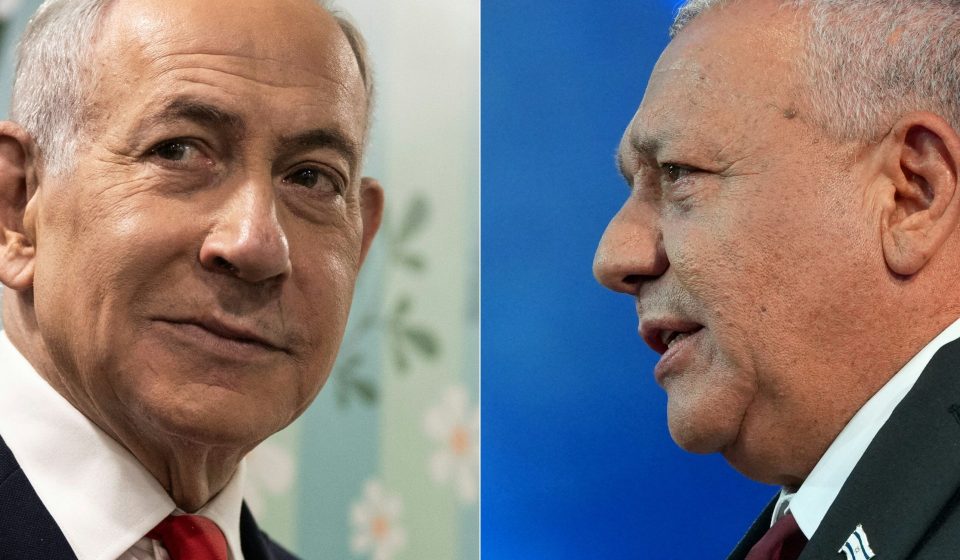
Eisenkot and Netanyahu discuss: can they agree on a unity government? | Explanatory news

Benjamin Netanyahu met with his main political rival, Gadi Eisenkot, after Israel’s interim prime minister proposed forming a unity government under a rotating premiership.
“The discussion took place in a professional spirit, with both parties seeking to resolve the substantial differences between them,” said a joint statement following the meeting.
Recommended Stories
list of 3 itemsend of list
Sunday’s meeting, being held at Israeli military headquarters in Tel Aviv, comes more than a month after inconclusive October 27 parliamentary elections, which left neither political bloc on a clear path to power.
Eisenkot, who President Isaac Herzog has tasked with forming a government, has until Dec. 6 to secure a parliamentary majority, with the possibility of requesting a one-time 14-day extension, although he has ruled out asking for more time.
But disagreements over the inclusion of parties representing Palestinian citizens of Israel and ultra-Orthodox parties have complicated his efforts to form a coalition that would end Netanyahu’s rule.
The blocs led by Netanyahu and Eisenkot refused to take help from Arab parties, which won a record 19 seats in the 120-member Knesset.
So what did Netanyahu propose, and can the two leaders reach an agreement?
What offer did Netanyahu make?
Netanyahu proposed allowing Eisenkot to serve as prime minister initially as part of a power-sharing deal between their respective parties, Likud and Yashar.
He said Likud, as the largest party in parliament, would normally lead a unity government, but was willing to set that aside because of the security threats Israel faces.
Eisenkot welcomed the possibility of negotiations but questioned Netanyahu’s willingness to compromise.
“If Likud is ready for real unity, I am ready to see how bad this will be over the next 24 hours,” Eisenkot said.
The former army chief accused Netanyahu of deliberately prolonging negotiations to trigger new elections, which would allow him to remain interim prime minister.
Netanyahu has not publicly clarified when Eisenkot’s proposed transfer would take place.
Discussions between the two leaders have recently stalled, mainly over who will lead the unity government and the inclusion of far-right National Security Minister Itamar Ben-Gvir. Likud would like him to be included, while Yashar insists on his exclusion.
What is a rotating government?
A rotating government is a power-sharing arrangement in which two leaders take turns serving as prime minister during a government’s term.
Under Netanyahu’s proposal, Eisenkot would initially serve as prime minister, with Netanyahu serving in the role for the second half of the coalition government’s term.
Israel has already experimented with such arrangements.
In 2020, Netanyahu reached a power-sharing deal with his then-rival Benny Gantz after three inconclusive elections. However, their government collapsed before Gantz could assume the premiership.
In 2021, Naftali Bennett and Lapid reached a rotation deal that ended Netanyahu’s 12 consecutive years in power. Lapid then succeeded Bennett in 2022, before Netanyahu returned to power following another election.
Alon Pinkas, former Israeli consul general in New York, said Eisenkot had no choice but to meet with Netanyahu to demonstrate that he had made a genuine effort to form a unity government.
“The problem here is that Netanyahu is pushing as many buttons as he can to stay in power,” Pinkas told Al Jazeera.
He said Netanyahu could also seek to stay in power by citing threats to Iran’s security if negotiations on a unity government fail, calling such a move a “show of desperation.”
Pinkas added that Netanyahu’s historic failure to honor power-sharing agreements had increased distrust among opposition leaders, calling his latest proposal a “Hail Mary” that he said would not succeed.
How did the other parties react?
Netanyahu’s offer drew skepticism from opposition parties, some of whom accused him of trying to cling to power.
Former Prime Minister Yair Lapid, co-chair of the centrist Beyachad party, dismissed the proposal as “yet another transparent scam by a serial fraudster who deceived all partners and violated all agreements.”
Youssef Jabareen, leader of the Joint List, who is expected to support an Eisenkot-led government outside the coalition, also rejected the prospect of Netanyahu remaining in power.
“The Democratic majority has decided: this negligent and bloodstained government must go,” he wrote on »
Democratic group leader Yair Golan, who has publicly opposed any formula for unity with Netanyahu, also rejected the latest offer.
“Enough of the trickery and deceptive tactics; Netanyahu lost, and our duty is to respect the will of the voters and form a government of change and rescue,” he posted on X.
What is happening with the opposition coalition?
Eisenkot’s Yashar has already reached preliminary coalition agreements with Yair Golan’s left-wing Democrats and Avigdor Lieberman’s right-wing Yisrael Beiteinu. Together, the three parties hold 36 seats (Yashar – 21; Democrats – 8; Yisrael Beiteinu – 7), which leaves them 25 seats short of a parliamentary majority.
As part of the Yashar deal, Democrats said they would receive four cabinet portfolios:
- Public safety
- Labor and social affairs
- Communications
- Culture and sport
Meanwhile, earlier this week, Eisenkot announced that he and Lieberman had agreed to sign a deal formally uniting their factions into a coalition.
The party would also obtain several parliamentary positions.
However, major obstacles remain, including compulsory military conscription.
Eisenkot and his allies have pledged to end military service exemptions for ultra-Orthodox Jewish seminary students – a move strongly opposed by Haredi parties such as United Torah Judaism and Shas, both potential coalition partners.
Why were Arab parties sidelined?
Attempts to exclude Palestinian-led parties are not new.
The Palestinian legal rights group Adalah has documented challenges to Arab candidates or lists in the 2003, 2013, 2015, 2020 and 2022 elections.
Attempts to restrict Palestinian political representation were also evident in the run-up to the October 27 elections. In September, Israel’s Central Election Commission voted to exclude Ra’am and the Joint List from the race.
Although the Supreme Court later overturned the bans, Balad party leader Sami Abu Shehadeh, one of the three Joint List parties, withdrew his candidacy after the court indicated he would uphold his disqualification.
“Palestinian parties are sidelined due to deep-rooted and pervasive racism in Israeli society, which is based, according to Israeli human rights organization B’Tselem, on a regime of Jewish supremacy,” academic Neve Gordon told Al Jazeera.
“Netanyahu has been saying for years and especially since the elections that those who sit alongside or receive support from Palestinian parties are traitors,” added Gordon, a professor of international law and human rights at Queen Mary University of London.
Political analyst Ahmed Najjar said their exclusion reflects a broader question about what political participation Israel considers legitimate.
“Palestinian citizens can vote, but their elected representatives remain subject to loyalty and security tests that are not applied to Jewish parties, including those on the far right,” Najjar told Al Jazeera.
He added that Netanyahu’s offer of a rotating prime ministership should also be understood as an attempt to exclude Palestinian parties from government while preserving Likud’s political influence.
“By describing a government they support as an ‘existential danger,’ he turns their democratic participation into a threat,” he said.
On Saturday, Raam leader Mansour Abbas implicitly recognized Hamas as a “terrorist group,” potentially removing an obstacle to his party joining an Eisenkot-led coalition. Eisenkot made recognition of Hamas as a “terrorist” group one of the conditions for joining his future coalition.
At the same time, the Joint List has indicated its willingness to support such a government outside the coalition.
But Najjar said the reluctance to include Palestinian parties reveals a fundamental contradiction in Israeli democracy.
“So the 19 Palestinian-led seats are not being sidelined because they lack influence,” he said.
“They are sidelined precisely because they have influence, and because recognizing this influence would call into question the ethnic hierarchy embedded in the Israeli political system. »
Gn headline