
Soldiers of a separate mission rifle battalion of the Ukrainian National Police in the Zaporizhzhia region installed a Starlink satellite communications terminal at a combat position in the Donetsk region, Ukraine, October 16, 2026.
Dmytro Smolienko | Ukrinform | Future publications | Getty Images
Elon Musk’s latest clash with Ukraine highlights the crucial role Starlink from his company Satellite internet service played a role in kyiv’s defense against Russia, which invaded without provocation in 2022.
It also highlights the downsides of relying on a single provider for satellite internet communications, although other options don’t yet compare to SpaceX’s Starlink and its military-grade Starshield offering.
On October 14, Ukrainian officials accused SpaceX of harming the country’s ability to defend itself.
SpaceX and the United States, they said, suddenly and without warning imposed speed limits on Starshield. SpaceX describes Starshield as a “secure satellite network for government entities” that “leverages Starlink technology.”
The changes removed wireless internet connectivity from drones and other aircraft traveling at speeds above 100 mph. which Ukrainian forces used in the campaign against Russia. A senior Ukrainian commander told the New York Times that Starlink’s restrictions cost his unit more than $1 million and delayed missions by three days.
Musk and President Donald Trump, both critics of Ukrainian President Volodymyr Zelenskyy, have each avoided reporting on communications disruptions in the war-torn country.
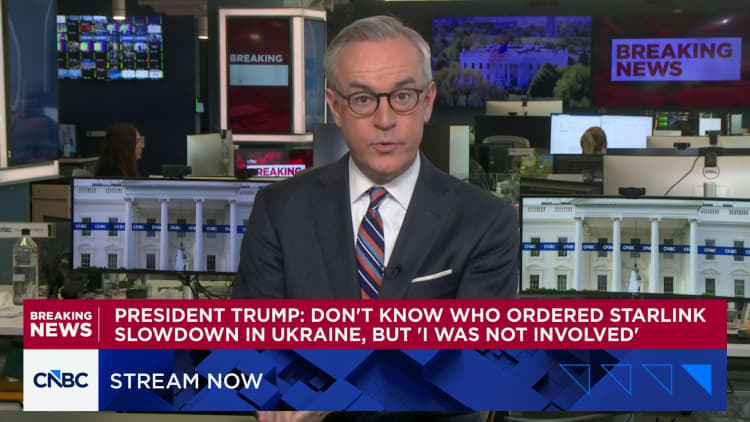
On Tuesday, the Wall Street Journal reported that Musk individually ordered the service changes and discussed them with Trump before implementing them. Trump insisted Wednesday that he “wasn’t involved.”
Robert Weissman, co-chair of the watchdog group Public Citizen, said the situation posed “extreme danger.”” This raises competition and security concerns about Musk’s ability to control a “crucial means of communication.”
“People worry about the political and economic impacts of oligarchy, and that’s it,” Weissman said in an interview. “It’s not just that Musk can stifle other stakeholders, he can also cut off communications in a context of national security for a country. No one should have that ability or power.”

The disruptions prompted a bipartisan group of U.S. lawmakers to call for an investigation into Musk’s actions, including asking him to potentially testify under oath.
Sen. John Cornyn, Republican of Texas, told CNBC on Wednesday that he didn’t think Musk would have acted “without at least the White House’s agreement,” and called attempts to limit Starlink service in Ukraine “frankly shameful.”
“There’s a reason we’ve had relative peace in Europe since World War II,” Cornyn said in an interview on “Squawk on the Street.” “And that’s because of the alliance between the United States and our European allies. And I think anything we do to undermine or degrade that is a big mistake.”
Rep. Pramila Jayapal, a Washington Democrat, called for an investigation into the matter and wrote in a social media post Wednesday: “No billionaire, especially one who gets massive contracts from our government, should have the power to unilaterally decide to cut off communications and weapons during a war of critical importance to the United States and Ukraine.” »
During SpaceX’s earnings conference call this week, executives did not address the issue and were not asked about it by analysts.
CNBC contacted Musk, Tim Hughes, SpaceX’s senior vice president of global affairs and government affairs, and a company spokesperson regarding Starlink’s restrictions in Ukraine and did not receive comment prior to publication.
Starlink Dominance
Governments or companies looking for an alternative to Musk, SpaceX and its satellite internet services have few options.
AmazonLeo’s, which also provides internet connectivity via a constellation of low-Earth orbit satellites, has been in the works for seven years and has yet to come fully online, with only 390 satellites in orbit.
SpaceX, by comparison, has a Starlink constellation of more than 11,000 satellites in orbit, according to data tracked by astronomer Jonathan C. McDowell. Starlink connectivity is available in 174 countries, Gwynne Shotwell, SpaceX’s chief operating officer, said during Tuesday’s earnings call.
Blue Origin, Jeff Bezos’ space company, unveiled a service in January called TeraWave aimed at businesses and governments. It targets the deployment of the first batch of satellites in the fourth quarter of 2027.
that of France Eutelsatalso a competitor to Starlink, has more than 600 satellites in orbit. The stock jumped 23% on October 14 when reports emerged that Musk had restricted Starlink in Ukraine.
Several countries are considering sovereign satellite communications systems. The European Union is currently building IRIS², which is expected to expand to hundreds of satellites, but the first launches are not expected until 2029.
Most of these planned systems are unlikely to “come close” in capacity, coverage, resilience or cost to Starlink, said Christian Freiherr von der Ropp, an independent satellite consultant. The cost, size, weight and power consumption of Eutelsat’s terminals make them particularly unsuitable on the battlefield, he added.
Although SpaceX’s Connectivity business has outpaced its competitors, the company also has the advantage of overseeing a hugely successful rocket launch business, which has put satellites into orbit for many of its competitors.
SpaceX is now phasing out commercial flights on its Falcon 9 rocket, while testing and developing its massive Starship rocket.
Many new constellations “could therefore face substantial delays and significantly higher launch costs,” von der Ropp said.
A Ukrainian man uses a Starlink satellite internet communications system on a rooftop in kyiv, Ukraine, Tuesday, March 11, 2025.
Andrey Kravchenko | Bloomberg | Getty Images
This week, Ukrainian and European lawmakers decided to explore alternatives to Starlink, viewing the issue as a matter of national security.
Their concern is that access to a critical communications service could be disrupted “due to Musk’s political agenda,” von der Ropp said.
“The degree of soft power that SpaceX has amassed over corporations, governments and militaries is substantial, and this has now become very visible,” von der Ropp said. “Inevitably this creates distrust and accelerates the demand for alternatives.”
Zelenskyy wrote in an article on X on Wednesday that he met with Norwegian officials and Kongsberg, a Norwegian defense company, to discuss air defense systems and “starting work on new satellite communications capabilities for our warriors.”
Musk received praise for providing Starlink terminals and satellite internet service at the start of the war, but relations deteriorated between the world’s richest person and Ukrainian officials over the years.
Musk previously ordered SpaceX engineers to shut down Starlink’s satellite network over Crimea in order to thwart a Ukrainian attack on Russian warships, according to a chapter in Musk’s 2023 biography written by Walter Isaacson. Musk disputed this information. The revelation sparked criticism from Ukrainian officials, including a top aide to Zelensky, who said it led to the deaths of Ukrainian civilians.
“This is the price of a cocktail of ignorance and selfishness,” Mykhailo Podolyak, one of Zelensky’s top advisers, wrote in a post on X, then known as Twitter.
Musk has also repeatedly argued that Ukraine should enter into a “truce” with Russia and cede ownership of Crimea, a strategically important territory, to Putin.
Musk’s treatment of Ukraine played a role in Canada’s decision to cut ties with Starlink. Indian and Taiwanese officials have also expressed distrust of Starlink, citing national security concerns and preferring to adopt a mass communications service that is not controlled by SpaceX.
Musk attacked Indian “oligarchs” for blocking the deployment of Starlink in the country.
It also targeted some potential Starlink enterprise customers.
Starlink has become the leading provider of satellite Wi-Fi services onboard airlines, signing with dozens of carriers, including United Airlines, Alaska Airlines, American airlines And Southwest Airlines.
But Delta Airlines is one of the few operators to choose Amazon’s Leo service.
Earlier this month, Musk posted on X that Delta CEO Ed Bastian would “lose his job” if he didn’t choose Starlink, following unconfirmed comments posted on
Bastian denied making the comment and told CNBC on October 9 that he was a “big fan” of Starlink and even drove a Tesla.
“All this nonsense about it being personal is not true at all,” he said.
– CNBC’s Elsa Ohlen and Leslie Josephs contributed reporting to this story.
WATCH: Musk reportedly ordered Starlink slowed down for Ukraine

Gn headline