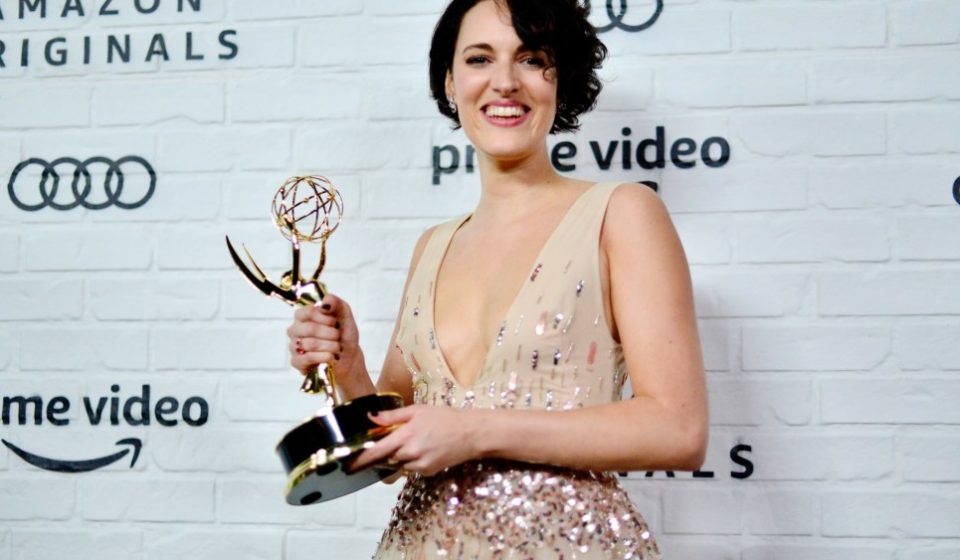

The Television Academy made it official Tuesday morning: The Emmys are cranking up the wheel and heading to the stream. Amazon’s Prime Video streamer has reached a six-year deal with the organization to resume broadcasting the Primetime Emmys starting next year.
Terms of the deal were not revealed, but Prime Video would pay a licensing fee of approximately $15 million for worldwide rights to the Emmys starting in September 2027, according to sources. Before that, the “wheel deal” mix of ABC, NBC, CBS and Fox paid between $8 million and $10 million a year – but that was only for national rights.
“It’s a significant investment,” said Cris Abrego, president of the TV Academy, who did not confirm a figure but said it was “without a doubt an increase” over previous licensing fees.
Mike Hopkins, head of Prime Video and Amazon MGM Studios, also wouldn’t elaborate on his investment, but said he thought it was “a fair deal. We’re comfortable with it. We think it makes sense, particularly when you look at the long-term situation. We think we’ll ultimately be very happy with it, as will, I think, the Academy.”
As for striking a six-year deal, Hopkins added: “It seemed, as it did for us, that the number of years was enough to see if we can together make a significant impact. We’re confident we will, and I hope it’s a long-term partnership beyond six years. We’ll see what happens.”
The Prime Video deal not only marks the end of the “wheel deal” after 31 years, but it also moves the Emmys away from televised broadcast for the first time since the ceremony began in 1949.
Under the new pact, the Emmys will be offered for free on Prime Video, as it will be placed in front of the paywall here in the United States and in the streamer’s more than 240 countries and territories. The Primetime Emmys were previously broadcast internationally (except Canada and Australia) by British distributor Rainmaker Content.
The deal also comes with the possibility of other Emmy programs streaming on Prime Video as well. This includes the artisan-focused Nights 1 and 2 (formerly known as the “Creative Arts Emmys”), which were previously edited into a condensed special a week after the ceremonies on FXX.
“We timed it perfectly so that all of our agreements were made collectively and it was free and clear,” said Cris Abrego, president of the TV Academy. “The Wheels deal, the FXX deal, and the international deals – all of that is done, and we put it all together in one package, and it’s now part of this deal at Prime.”
With that in mind, Abrego imagines a partnership with Prime to create a “road to the Emmys”: “We definitely talk a lot about not making it a one-night event,” he said. “The Hall of Fame has really become something pretty incredible and special. It could be anything. Our TV Academy Honors events. The interviews that we do. There’s a lot of opportunities to create content that builds off of the Emmys.”
And then there’s the TV Academy’s impending merger with the National Academy of Television Arts and Sciences — which Abrego says is expected to happen as soon as mid-2027, before the next Emmys: “We’re moving forward. It’s been a ton of work, and it’s taken us a full year to get there. But I’m very positive about the timeline for the middle of next year.”
Once that’s done, NATAS awards shows (particularly the Daytime Emmys) could also become part of the Prime Video mix – although that would require a separate licensing fee negotiation.
“Without pre-empting things, that would definitely be explored, and I think it makes sense that we would do that,” Abrego said.
Hopkins agreed that the NATAS awards could “potentially” join this arrangement, but it’s still too early to discuss it, as they’re just starting to get into details with the TV Academy on the Primetime Emmys now that this deal is done.
“We would like to try to create some momentum for the Emmys that could increase viewership and get people more excited,” he said.
As Variety exclusively reported in September, Prime Video emerged as the leading contender for the Emmys after it appeared likely that the “wheel deal” would not continue, with at least one of the networks (supposedly Fox) dropping out. NBC broadcast on 78th Emmys last month, which was the final telecast under the most recent deal (agreed for eight years in 2018).
Although the TV Academy has considered continuing the wheel, including adding new partners to the mix, Abrego said the organization is also eager to explore other options. (An idea of multi-network simulcast/roadblock and streamer which had been defended by Variety was actually considered, Abrego previously said, but logistical complexities ultimately doomed that scenario.)
“The Wheel deal has been an incredible success for the Academy and the Emmys for a long time,” Abrego said. “But as we got closer to the end, I was convinced that it shouldn’t just go back to the way it had always been done.”
Although there has been widespread industry speculation that the Television Academy was having difficulty finding a new home as an alternative to the “wheel deal,” Abrego said the Academy had “a lot of choices” when it came to potential new homes, including some independent suitors he declined to name.
But Prime Video became the preferred option when they threw their hat into the ring. Hopkins said his team was keeping an eye on the Emmy renewal discussions and began discussing whether to make a bid.
“What would we want to do differently and how would we approach it? What are the benefits of doing it on an annual basis, rather than every four years?” Hopkins said they discussed it. “Once we embarked on this journey with Cris and his team, we realized that they too thought it might be a good idea to make the Emmys a global, single-service event.”
Abrego said he sees an advantage in sticking with one permanent broadcast partner, rather than rotating between networks each year. The idea was that under the “wheel deal,” even if the Emmys did well, the networks felt like they were just setting the stage for a competitor to take it over next year, which limited the effort they would want to put into broadcasting. At the same time, it is believed that an exclusive partner would likely be more motivated to expertly produce and heavily promote the Emmy telecast since it would air it again the following year.
“Continuity is difficult when you start again every year,” he said. “Wherever we were in this market and in this climate, starting every year from scratch, trying to think of new creatives, trying to find new brand partners, and the next network might not be in the same position, it made growth very difficult. We wanted a real type of commitment and investment, to build and scale.”
Of course, the Academy has struggled in the past to commit to a single, exclusive broadcast partner. The “wheel deal” originally existed from 1966 to 1986 between ABC, NBC and CBS – but the new Fox network then won exclusive rights in 1987 by significantly outbidding the Big Three. Because Fox was still a fledgling network with less distribution and smaller audiences, ratings plunged.
Then ABC took over exclusive rights — until competitors told the Academy they wouldn’t support the Emmys if it aired only on a rival. The ABC deal was scrapped and the wheel deal was born. The “wheel” has almost been replaced once before, in 2002, when HBO shocked the networks by offering $10 million a year for exclusive rights. But when broadcasters threatened to boycott the show, the Television Academy stuck to the status quo of the four channels.
Now that the Emmys will once again be parked exclusively on one platform, will the contestants balk? “I don’t think they will,” Abrego said. “The whole industry is a partner.”
Hopkins also wasn’t concerned that other streamers could resist the Prime Video Emmys — and noted that Amazon was already in business with many of them. “I think if we do it right, we want to celebrate the art of television, and we want to celebrate the best shows, the best talent telling stories in this medium, because we love it,” he said. “We want to have Netflix’s biggest stars, and we want to have Disney’s biggest stars, and we want to have everyone else’s biggest stars too. I think it’s a great opportunity, particularly if we can get on a nice growth trajectory globally and in the United States.”
Hopkins pointed out that Prime Video Channels (formerly Amazon Channels) already sells subscriptions to a number of competitors, such as HBO Max, Apple TV, Paramount+ and Peacock. This could help fuel the Emmy telecast – what if you could subscribe to an award-winning service to watch this show?
“A lot of what we offer our customers is our subscription business,” Hopkins said. “We have all these great streaming services, about 100 of them that you can subscribe to and then integrate into a seamless experience on Prime. A lot of our partners win and are nominated for a lot of Emmy Awards. We’re at the Emmys, and we stand up and applaud when HBO Max and Apple TV win because our customers have access to them, we’re partners. So we thought we could probably do a great job with this. We’re really excited about this opportunity.”
The international component also attracted the TV Academy and Amazon, Abrego and Hopkins said. Abrego said more global series and stars have been Emmy contenders and winners in recent years (“Baby Reindeer,” “Squid Game”), while Hopkins noted that in the age of streaming, there are fewer boundaries since some of TV’s most popular series and stars are now broadcast day and date all over the world.
Post Views: 3