
WASHINGTON — The Federal Reserve’s independent watchdog said Wednesday it found no reasonable reason to believe there was a violation of federal law in a multibillion-dollar renovation project that drew criticism from President Donald Trump and a short-lived review from federal prosecutors.
But the central bank’s board “failed to effectively execute” a contract and its cost management provisions, according to a 120-page report from the Office of Inspector General of the Federal Reserve Board of Governors.
Even after four years of construction and more than $2 billion in attributed construction costs, the Fed board had “failed to establish a guaranteed maximum price” for the project and had “insufficient” internal governance in place to manage a project of such “scale and complexity,” the watchdog said.
Yet the report “identifies no administrative misconduct” or “reasonable grounds to believe that a violation of federal criminal law occurred.”
The closure of the investigation follows a more than year-long review of the construction site on the central bank’s campus in Washington, D.C., which has become an obsession of the Trump administration, with the president also pressuring Jerome Powell, who was Fed chairman until Kevin Warsh took over in May, to cut interest rates.
Several elements of the renovation’s design that came under scrutiny — the building’s marble, water features and a garden terrace — “did not contribute significantly to subsequent cost increases,” the watchdog found. Removing four water features from renovation plans would not result in significant savings, an official told the watchdog, because landscaping and other costs would be required to replace the fountains.
The watchdog said the cost overruns were a result of “inflation, limited tendering by subcontractors, substantial changes to the Council’s interior fitout design and difficult site conditions”.
Shifting from a design focus on closed offices to open workspaces after construction began, the watchdog found, was a “clear example of the consequences of ineffective project management” and “extended the duration of the project and its exposure to inflationary pressures.”
In a letter to Inspector General Michael Horowitz, Warsh wrote that as board chairman, he agreed with the need to complete the work “as efficiently and transparently as possible” and said the General Services Administration would lead the project, effective immediately.
Warsh, who had also criticized the renovation, said the American people owed “prudent and conscientious use of public funds.”
GSA is the federal agency responsible for overseeing the federal government’s office buildings, technology services, and real estate.
The renovation became a point of contention during a Senate hearing on June 25, 2025. Sen. Tim Scott, R-S.C., asked Powell about the Fed renovation project, which has attracted attention from the White House.
Scott accused Powell of “spending billions on lavish renovations” that included “rooftop terraces, custom elevators that open to VIP dining rooms, white marble finishes and even a private art collection.”
Powell denied Scott’s accusations.
“There is no (VIP) dining room. There is no new marble. We took down the old marble, we are putting it back together. We will have to use new marble where some of the old marble broke. But there are no special elevators. There are just old elevators that were there. There are no new water features. There are no beehives and there are no terrace gardens on the roof,” the then-Fed chairman said.
On Wednesday, Scott responded to the inspector general’s report, saying he welcomed its findings. “Inflation does not change the Fed’s responsibility to manage its resources prudently and be accountable to Congress,” he wrote in a statement. The Senate Banking Committee, chaired by Scott, “will continue rigorous oversight to ensure the Fed is transparent and remains focused on its mission,” he added.
Shortly after the June hearing, Trump’s Office of Management and Budget director Russell Vought wrote Powell a letter saying the president was “extremely troubled by your management of the Federal Reserve System,” citing the renovation.
“Comparable renovations to a federal building cost several orders of magnitude less than the office you build yourself at taxpayer expense,” Vought added. He then compared the renovation of the office building to “a palace.”
The Federal Reserve System is not funded by taxpayer money. It is self-funded through fees it charges on services such as check processing. It is also financed by the interest it earns on its vast bond portfolio.
Powell denied Vought’s allegations, saying the central bank had “taken great care to ensure that the project was carefully supervised since it was first approved by the Board in 2017.”
As Powell noted, the plan was first approved by all seven members of the Fed’s Board of Governors. Powell became Fed chairman in 2018 after Trump appointed him in late 2017.
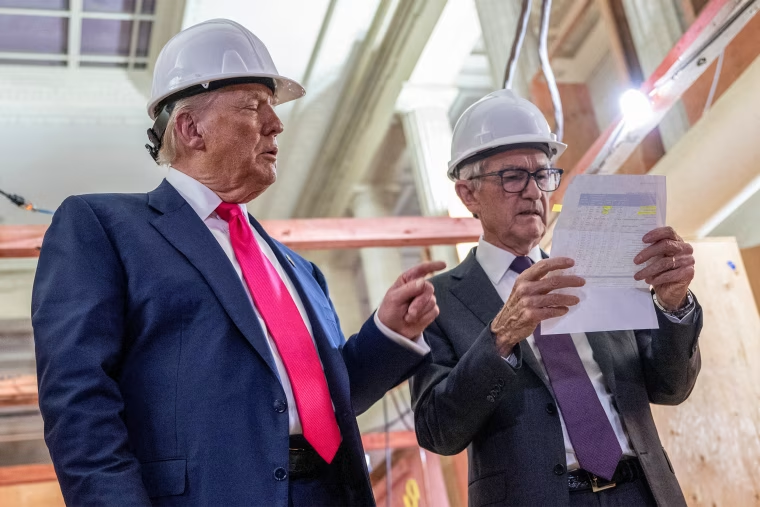
The Trump administration has not given up its campaign against Powell. On July 24, Trump himself made a surprise and unprecedented visit to the Fed construction site.
Touring the project alongside Powell and Scott, the president began to suggest that the price had increased further. Powell responded curtly: “I didn’t hear that. » Handed a piece of paper by Trump, Powell said Trump was including an already completed construction project in his new, higher cost estimate.

The Fed also launched a website, which noted that the price of the project had increased beyond its first estimate due to changes made to the design after voluntarily consulting with review panels, and the rising cost of materials, equipment and labor. He also said unforeseen circumstances, such as “more asbestos than expected,” contributed.
Yet throughout the year, Trump openly considered firing Powell, which at times shook markets. A Federal Reserve chairman has never been fired before.
After months of quieter complaints about the project, in January a new revelation about it shook Washington.
In an extraordinary video statement posted to the Fed’s social media pages on a Sunday evening in January, Powell announced that “the Department of Justice has issued grand jury subpoenas to the Federal Reserve.”
He said a criminal investigation had been launched against him and the central bank following his previous Senate testimony.
“No one – and certainly not the chairman of the Federal Reserve – is above the law,” Powell said. “But this unprecedented action must be seen in the broader context of the administration’s continued threats and pressure.” He added: “It’s a question of whether the Fed will be able to continue setting interest rates based on evidence and economic conditions – or whether, instead, monetary policy will be driven by political pressure or intimidation.” »
Those subpoenas were later blocked by a judge, who said Trump’s hand-picked U.S. attorney in Washington had “produced virtually no evidence to suspect Chairman Powell of a crime.”
But the damage was already done. Trump’s U.S. attorney for DC, Jeanine Pirro — whose aides attempted to visit the Fed as part of the investigation — said her office had closed its investigation and referred the matter to the inspector general. The watchdog had already opened an investigation at Powell’s request.
Pirro, a longtime friend of Trump’s, however, kept her threat to investigate Powell on the table. As a result, Powell decided to remain on the Fed board when his term ends on May 22, thereby depriving the Trump administration of the opportunity to fill a vacancy.
Democratic Sen. Elizabeth Warren of Massachusetts, the top Democrat on the Senate Banking Committee, applauded the report and said it confirmed that “Trump’s lapdogs, U.S. Attorney Jeanine Pirro and Attorney General Todd Blanche, have no basis to reignite the president’s witch hunt” against Powell.
“The president should stop trying to fire Fed governors to cover up his economic failures and instead stop his chaotic tariffs and end his war in Iran,” she said in a statement.
Meanwhile, under Warsh, the Fed raised rates once and is expected to do so again this year.
Ryan J. Reilly reported from Washington; Steve Kopack from New York.
Gn bussni