Former diplomats assess the US withdrawal from Iraq and the future of the region

Geoff Bennett:
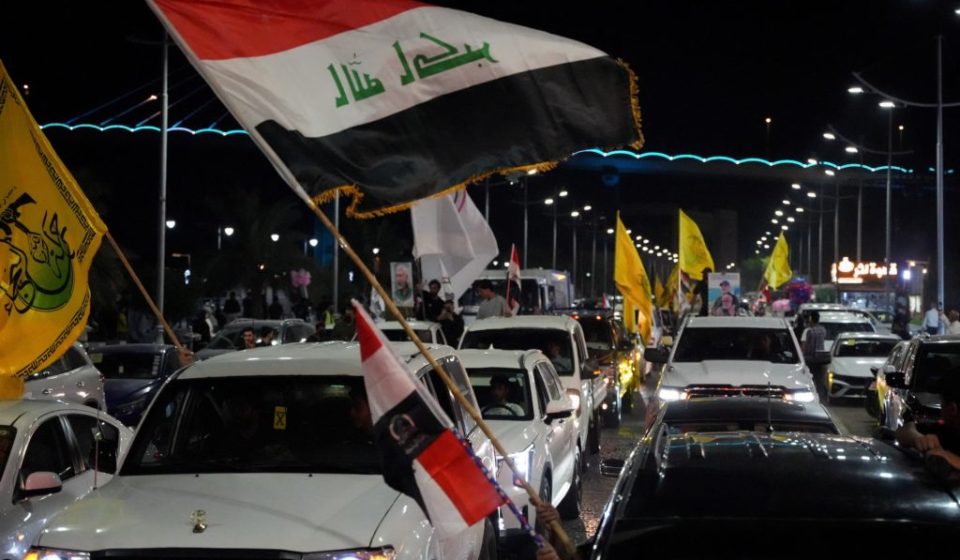
U.S. forces officially withdrew from Iraq today, marking the end of a long and turbulent military presence. The withdrawal sparked celebrations in the capital, but also concerns about what might happen next.
Thousands of people gathered in the streets of Baghdad for a celebration more than 20 years in the making, military trucks and soldiers in fatigues, this time from Iraq, as the United States announced its forces had officially left the country. The Iraqi prime minister called the withdrawal an opportunity.
Ali Faleh Al-Zaidi, Iraqi Prime Minister (through interpreter):
A new phase has begun, defined by Iraq’s sovereignty, the strength of its institutions, the readiness of its forces, and balanced partnerships with its friends.
Geoff Bennett:
But as the war in Iran spreads and draws in neighboring countries, U.S. bases in the northern Kurdish region are under attack. And remaining Kurds fear further attacks from Iran-backed groups or the resurgence of Islamic State.
Osman Kamusashi, Erbil, Iraq, resident (through interpreter):
I am not in favor of this at all. I mean, the departure of the US military and the coalition from the Kurdistan Region will impose a serious threat to the Kurdistan Region. And there is another threat, that of restructuring and the return of the Islamic State.
Geoff Bennett:
Despite these concerns, the United States faced a deadline. The withdrawal had been agreed to two years earlier under former President Biden and was ultimately carried out by President Trump.
The Pentagon called the orderly departure a milestone that reflects the success of a 12-year campaign that defeated ISIS and said it would continue to provide targeted training and intelligence support. This continued support still represents a dramatic reduction from more than two decades of U.S. military involvement in Iraq.
American forces invaded the country in 2003 and toppled the country’s oppressive dictator, Saddam Hussein. The first US withdrawal took place in 2011, but American troops returned three years later to help Iraqi forces fight ISIS. Decades of brutal fighting have resulted in the deaths of more than 4,000 U.S. troops and hundreds of thousands of Iraqi civilians.
Today, as Iraqi leaders tout their strength and sovereignty, the world is watching to see if Iraq can resist outside forces.
For an overview and analysis of the formal U.S. withdrawal from Iraq, let us now turn to James Jeffrey, who served as ambassador to Iraq under former President Barack Obama and special envoy to the Global Coalition to Defeat ISIS in the first Trump administration. And Feisal Istrabadi served as Iraq’s ambassador to the UN after the US deposed Saddam Hussein. He is now a professor at Indiana University.
Welcome to both of you.
And, Jim, we’ll start with you.
What does the American withdrawal from Iraq change concretely from today?
James Jeffrey, former U.S. ambassador to Iraq: In practice, what it changes is mission accomplished. In an era where we have not seen as many successful military operations, this one, launched in 2014, was spectacularly successful in defeating a major terrorist entity, the Islamic State.
We did so, tragically, with losses, but very, very few compared to our other wars. And we did it with the cooperation of Iraqi and Syrian officials. This is very important. But ultimately, once the project was finished, they said we’d like you to leave at that point, and we said, fine.
This doesn’t change much because, as we just heard, we will still have a military presence, as we had after 2011, when I was ambassador, under the embassy. This is a technical formality, but it is important, because they are not under military command. They are not fighters, but coaches, teammates. They provide intelligence support and can call upon real American military power if necessary.
So we will always have that in place if Iraq needs it.
Geoff Bennett:
Feisal Istrabadi, of course we know that the United States already left Iraq in 2011 and returned three years later to fight ISIS. What’s different this time?
Feisal Amin Al-Istrabadi, former Iraqi deputy ambassador to the United Nations: On the surface, what’s different is that when the United States returned in 2014, about a third of the country was occupied by a terrorist organization that sought to erase an internationally recognized border between Iraq and Syria.
We don’t have that. What we — what amounts to the same thing is a deep skepticism about whether or not Iraqi forces can secure the country at a time when Iraq, A, has both — has been the target of both the ongoing Israeli-US and Iranian war, and its territory has been used to launch attacks against its neighbors with whom Iraq is not at war.
That remains to be seen. In 2011, when the United States withdrew, I have to disagree with my colleague somewhat, much of the intelligence cooperation ceased between Iraq and the United States. And the end result was the rise of ISIS. I remain deeply concerned that this may be the case for Iraq’s future.
I am therefore skeptical about this withdrawal. I would also add that this is, I think, a strategic defeat for the United States, in the sense that it was also supposed to be – today was supposed to be the date that the pro-Iranian militias in Iraq would be disarmed, and that did not happen.
Geoff Bennett:
Well, on that point, the Iranian-backed militias were supposed to be brought under tighter control of the Iraqi government. This did not happen. How important is this? And what is Iran’s involvement in Iraq?
James Jeffrey:
This is all very important. And here, I agree with my colleague.
As for the Islamic State, they are defeated. There are only a few cells left. There are others in Syria, but we have the situation under control because all of our operations remain focused on Jordan.
But the problem is that Iran has slowly, through political parties and these militias, tried to establish a presence like it did in Lebanon and Iraq. This is something that the handful of American forces have been unable to stop. In fact, they were there from 2014 until now, and they haven’t stopped it.
I agree that the pro-Iranian side presents this as a victory. We have driven out the oppressor, but very few people in Iraq really believe it. But I also agree that the Iraqis are nervous because, on the contrary – nothing else – the American military presence is the symbol of our return. We showed last time when we left that we would come back at the last minute, but everyone is wondering: will they come back?
On the other hand, if you have troops on the ground, it is almost certain that you will stay and reinforce them, rather than retreat.
Geoff Bennett:
And what does all this mean specifically for the Kurds? The Prime Minister of the Kurdistan Regional Government has widely expressed his dissatisfaction with this formal withdrawal.
Faisal Amin Al-Istrabadi:
Yes, I understand that and I sympathize.
However, I think the Kurds have always gone overboard in relying too much on the United States to resolve problems between Erbil, the capital of the Iraqi Kurdistan region, and Baghdad, the capital of Iraq.
I think there must be an introverted dialogue within the Iraqi political class, in which the American embassy must sometimes be an organizer, an encouragement. But relying on the United States to intervene on behalf of the Kurds in Baghdad, or vice versa, has always been a mistake.
And it might actually, if one wants to be optimistic, encourage a better political process at the national level.
Geoff Bennett:
As we end this conversation, we cannot lose sight of the fact that more than 4,000 U.S. military personnel have been killed in Iraq, as well as more than 200,000 Iraqi civilians, as you both know. That’s roughly the entire population of a city like Richmond, Virginia, or Des Moines, Iowa.
At the end of this chapter, how can we begin to assess what has been achieved relative to the human cost of such magnitude?
James Jeffrey:
First, Saddam Hussein, who had terrorized the region since 1980, from his rise to power until his removal in 2003, was deposed. Most of the Iraqis I’ve spoken with, and they number in the thousands now, don’t regret us getting rid of him.
Furthermore, Iraq remains, for all its faults, one of the few democracies in the Middle East, and the country still has political parties and political factions that argue in parliament and in the courts rather than on the battlefields. So those are two big advantages. We do not want to see Iraq follow the same path that Syria experienced between 2011 and just two years ago, an all-out civil war.
It was a possibility if we hadn’t intervened. So I would say that it is mixed, unlike Afghanistan. It’s a failure. Iraq, call it mixed.
Geoff Bennett:
Mixed.
How do you see it?
Faisal Amin Al-Istrabadi:
As Zhou Enlai would have said about the French Revolution, it is too early to know. But I think I generally agree with this assessment.
Look, what I think the Americans gave the Iraqis in 2003, paid for with the lives of many Iraqis and Americans as well, was the hope that the future would not be what it had been under Saddam Hussein. Saddam Hussein is responsible for the deaths of a million Iraqis when he ruled Iraq from 1979 to 2003.
There is hope that this is the case, that the future will be better than the past. This would not have been possible without the American intervention in Iraq. Have things gone well since 2003? No, there were many, many mistakes made by the Americans, many mistakes made by the Iraqis. But, fundamentally, we can hope that the future will be better than the past.
Geoff Bennett:
Ambassadors Feisal Istrabadi and Jim Jeffrey, my thanks to both of you.
James Jeffrey:
THANKS.
Faisal Amin Al-Istrabadi:
Thank you so much.
Gn headline