
Francis Halzen wins Nobel Prize in physics for his work on high-energy neutrinos: NPR


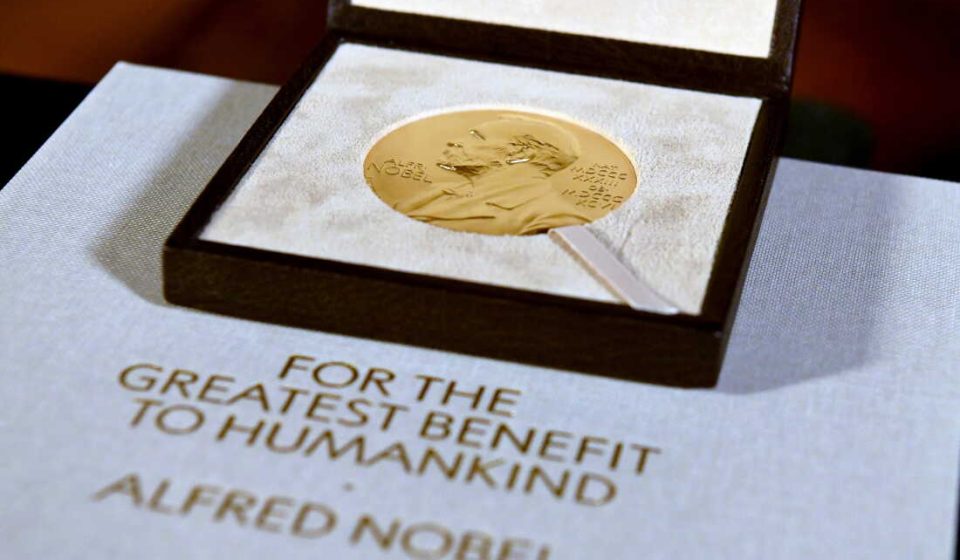
FILE – A diploma and a Nobel medal are displayed on December 8, 2020, during a ceremony in New York.
Angela Weiss/PoolAFP via AP
hide caption
Angela Weiss/PoolAFP via AP
STOCKHOLM — Francis Halzen won the Nobel Prize in physics on Tuesday for his contributions to the IceCube neutrino observatory and his discovery of high-energy neutrinos of astrophysical origin.
“Francis Halzen led an international team of researchers and engineers who gave us a fantastic instrument. His tenacity and scientific vision paved the way for a new type of astronomy,” said Mark Pearce, chairman of the Nobel Committee for Physics, in a press release.
Halzen spoke to the committee by telephone from Italy on Tuesday.
“It was a big surprise and I obviously didn’t expect it,” he said.
Halzen said he had previously been predicted to win the Nobel Prize, but the announcement still made him feel “strange.”
Born in Belgium, this 82-year-old scientist is affiliated with the University of Wisconsin-Madison in the United States. Efforts by The Associated Press to reach him were not immediately successful.
The IceCube Neutrino Observatory is a research center located at the South Pole in Antarctica, according to its website, and the University of Wisconsin-Madison is its lead institution.
Neutrinos are tiny cosmic particles with incredibly small mass. Yet they are everywhere: they spring from stars like the sun and trillions pass through our bodies every second.
Scientists cannot see the mysterious ghost particles that move on their own. Instead, they measure what happens when the tiny particles collide with other pieces of matter, producing flashes of light or charged particles.
Halzen studied a rare group of neutrinos that scientists consider messengers from the cosmos, offering clues about the evolution of the universe.
His research on neutrino capture at the South Pole dates back to the 1980s.
The Royal Swedish Academy of Sciences announced the award in Stockholm.
This year’s prize money is 12 million Swedish crowns (about $1.2 million), whether for an individual, a small group of winners or an organization.
Last year, three scientists won the Nobel Prize in physics for their research into the strange behavior of subatomic particles called quantum tunneling, which enabled the ultra-sensitive measurements made by MRI machines and laid the foundation for better cell phones and faster computers.
The announcement of this year’s awards began Monday with the awarding of the Nobel Prize in Medicine to three scientists whose work led to a tool that uses light to help understand how the brain works.
This week’s awards continue on Wednesday with the Chemistry and Literature awards on Thursday. After Friday’s peace prize, the Nobel Memorial Prize in Economic Sciences will be announced on Monday.
This year’s prize money is 12 million Swedish crowns (about $1.2 million), whether for an individual, a small group of winners or an organization.
Gn headline