
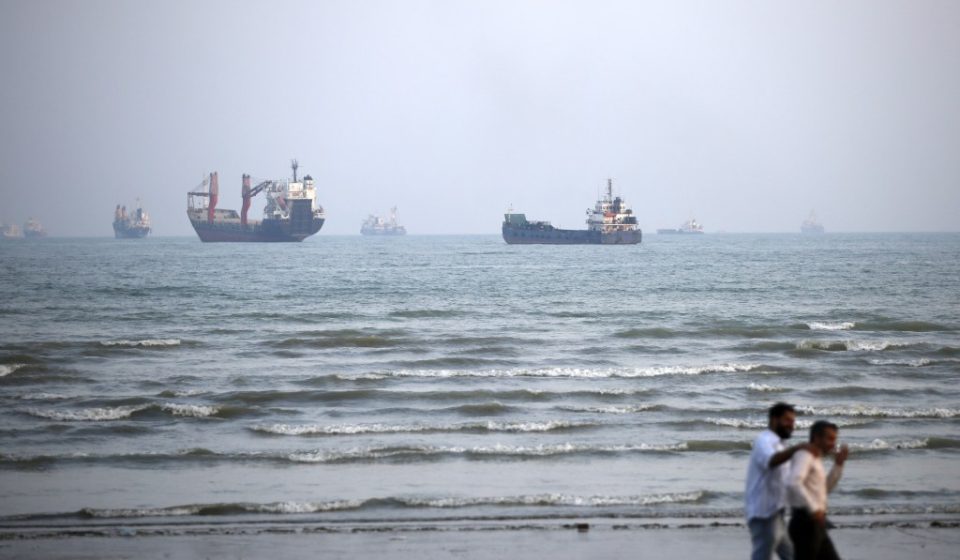
Sailors reportedly offered $25,000 per trip to extract oil from the Persian Gulf amid strikes and drone attacks.

Sailors would be offered up to $25,000 per trip to transport the trapped oil across the dangerous, war-torn Persian Gulf, meaning producers are spending up to $40 million in total for a multi-day journey through the region.
The jaw-dropping payouts — sometimes worth two or three times a sailor’s typical monthly salary — are aimed at convincing crew members to risk potentially deadly strikes and drone attacks in the region, the Wall Street Journal reported.
New data released Monday showed that the payments are working, as crude exports through the Strait of Hormuz reached 16.5 million barrels per day in September – well above the low of 5 million barrels per day in March, just after the outbreak of the war in Iran, according to research firm Kpler.

On Monday, Brent crude futures fell 1.5% to $100.74 a barrel and West Texas Intermediate crude slipped 1% to $90.16 a barrel on news that oil is leaving the Gulf at its fastest pace since the war began – even as attacks on shipping intensified.
In the past two weeks, nine commercial ships have been attacked near the strait, leaving two injured and one sailor dead, according to the International Maritime Organization and Britain’s Maritime Commercial Operations Center, affiliated with the Royal Navy.
Producers have hired very large crude carriers, or VLCCs, to operate dangerous “shuttles,” which is when carriers enter the Gulf through the Straits, load at ports, exit through the Straits and then transfer the oil to another vessel waiting just outside the waterway.
To do so, they are sinking record costs, paying sailors a premium to risk being attacked in the region, but it is better for them to sell the oil at lower margins than to leave it stuck in the Gulf, according to the Journal.
It also costs more to get this oil to global markets. By the end of September, it cost more than $1.2 million a day to charter a supertanker to China – up from $231,400 the day before the war and less than $40,000 a day in January, according to shipping data provider Clarksons Research.
While producers pay $30 million to $40 million for a round trip, shipowners reap record profits – as do sailors.

Many crew members from India, the Philippines and China accept up to $25,000 for round-trip travel to face the dangers of the war zone. For lower-level workers like oilmen and cadets, those payments are sometimes more than their annual salary, the Journal reported.
These risky trips often involve traveling at night with windows closed, no lights or GPS signals turned off, according to reports.
Last week, Europe gave in to President Trump’s demands to release its diesel reserves, as Republicans are eager to reduce gasoline and diesel prices — which are stubbornly above $4 and $6 a gallon, respectively — ahead of November’s midterm elections.
G7 countries, including the United States, France, Italy, Germany, Japan, Britain and Canada, agreed to release 100 million barrels of diesel and crude from their stockpiles, but experts warned that could have little or no effect on U.S. pump prices.
Trump is also expected to issue an executive order as early as Monday to expand access to tax-exempt diesel in an effort to lower consumer prices.
Gn world