From humans to worms, anesthesia pushes nervous systems into the same strange state: ScienceAlert

Every day, thousands of people are subjected to general anesthesia as part of a routine surgical procedure.
Since the first public demonstration of surgery under general anesthesia in 1846, these drugs have allowed doctors to perform life-saving operations that would otherwise be impossible.
And yet we still don’t understand exactly how they send us into oblivion without completely shutting down our brains.
A new study published in Natural neuroscience brings us one step closer to understanding the mechanisms that allow general anesthesia drugs to temporarily suspend our consciousness.
It compares the drug’s effects on a range of animals, from worms to fish to humans.
It seems that no living being is insensitive to the effects of general anesthesia, not even plants or paramecia.
This suggests that there is something universal in the bodies of living beings that this class of drugs acts on.
To test this idea, a team led by neuroscientist Andrea Luppi of the University of Oxford examined the neuronal activity of six very different types of animals when they were awake and under general anesthesia.
“Focusing on effects that are consistently shared across multiple anesthetics and species allows us to rule out physiological or methodological confounds specific to a drug, species, or imaging modality, and instead triangulate on the potential neural underpinnings of what they share: disruption of responsiveness to the environment,” Luppi and team write.
Their data sets came from humans, macaques, marmosets, mice, zebrafish, and nematodes (roundworms), which, based on the life span of their last common ancestor, represent 700 million years of evolution.
The drugs used to induce general anesthesia differed between species, but even so, consistent patterns were evident in their brain activity.
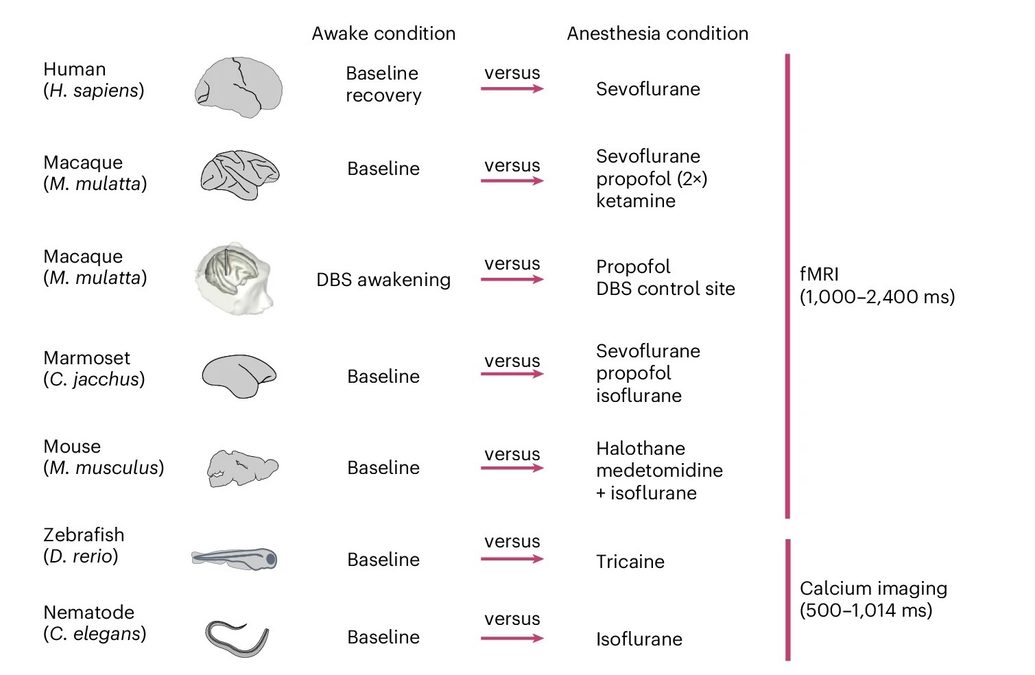
In mammals, neuronal activity has been measured by fMRI, which uses blood flow to determine which regions of the brain are active over time.
Zebrafish and nematodes have been genetically modified so that their neurons literally light up when calcium enters them, allowing scientists to see the neuronal activity of these animals more directly.
“Through this unbiased, data-driven approach, we identified an evolutionarily conserved dynamic profile of anesthesia, indicating that what is common across species and anesthetics is not only the behavioral response to anesthesia (isolation from the environment), but also the effect of anesthesia on specific features of neuronal activity,” write Luppi and his team.
Across species, neural activity between brain regions became less coordinated when they were under anesthesia, suggesting that these regions were still functioning, but weren’t interacting as much as they would when awake.
Neural activity also appeared more chaotic over time, with anesthesia appearing to “induce a break in the relationship between past and future neuronal activity,” the authors explain.
When we are awake, our brain activity tends to follow certain sequences: these predictable patterns break down under anesthesia.
The likelihood that these key differences in brain activity occurred by chance in the six species is “extremely low,” according to anesthesiologists George Mashour and Zirui Huang, who were not involved in the study but wrote an accompanying article in Natural neuroscience News and opinions.
“These results provide compelling support for a final common pathway of anesthesia: spatiotemporal isolation of local neuronal activity, in which individual circuits lose their ability to maintain, propagate, and integrate information across time and space,” Mashour and Huang write.
“During anesthesia, consciousness is disrupted not because the brain ‘turns off’ but rather because its activity becomes fragmented temporally and spatially.”
Given that this forgetting mechanism is shared not only by humans, but also by animals as distant from us as fish and roundworms, these findings could even have broader implications for our understanding of animal consciousness.
The research was published in Natural neuroscience.
This article was fact-checked by Carly Cassella and edited by Carly Cassella. Although we are proud of our process, we are only human. If you spot an error, please let us know.
Gn Health