
The United States will issue a joint statement with 15 other countries on Sunday outlining a shared vision of a “golden age of science” that would embrace the potential of artificial intelligence.
The announcement is expected in Kyoto, Japan, at this year’s Science and Technology in Society Forum, an annual gathering of experts and policymakers that began in 2004.
The declaration, titled “Kyoto Vision for a Golden Age of Science,” begins by recognizing the benefits of science and technology for society, then encourages research incorporating artificial intelligence. (The statement calls it a “super intelligence,” given President Donald Trump’s recent executive order renaming the technology.)
“Superintelligence and new ways of organizing research are opening up entirely new frontiers of discovery,” reads the press release, seen by NBC News. “We recognize the opportunity to take advantage of these changes.”
Michael Kratsios, head of the White House Office of Science and Technology Policy, was behind the vision statement, which also says participating countries welcome the “growing field of metascience,” a term that describes the study of the scientific process itself.
Technology ministers from Japan, Korea, the United Kingdom and the United Arab Emirates were among representatives of other countries who endorsed the declaration.
In remarks Kratsios plans to deliver at the forum, shared in advance with NBC News, he will present a vision of an era of scientific progress in which laboratories run by robots and AI systems can design scientific experiments, iterate and analyze the results at superhuman speeds.
“Superintelligence applied to science will constitute an incredible force for the democratization of research and revolutionary developments,” he plans to say.
Leading AI companies Anthropic and OpenAI have recently launched initiatives to connect biomedical labs with powerful AI systems, while other companies have been trying to automate labs for years.
“The landscape has changed everywhere, the ground is shifting beneath our feet and we all need to reinvigorate our research enterprise and lay new foundations for knowledge, innovation and prosperity,” Kratsios is expected to say in his speech.
The vision statement also states that public trust is the foundation of scientific innovation and progress and that there is value in having a “deliberate portfolio of funding mechanisms” for science.
The Trump administration has repeatedly attempted to drastically cut federal funding for scientific research. His proposed budget for fiscal year 2027 would, for example, cut funding to the National Science Foundation by about half.
Gretchen Goldman, president and CEO of the Union of Concerned Scientists, said the administration has undermined many scientific research efforts. “They have broken the trust of the American people in the way they have treated the American science and technology enterprise,” she said, pointing in particular to cuts to the National Institutes of Health.
“It’s hard to take the promises of increased trust and transparency seriously when you look at the steps they’ve taken,” Goldman said.
The statement is part of a broader initiative by Kratsios to reform how the United States encourages scientific innovation. In July, he submitted a report to Trump recommending changes to how the federal government funds research. He plans to organize a summit on this subject in Washington, DC, on Thursday with scientific and economic leaders.
Kratsios also leads Mission Genesis, a national effort launched by Trump last year to “unleash a new era of AI-accelerated innovation and discovery.”
The next vision statement places a particular emphasis on metascience, an area of study that has received greater government attention in recent years.
Its prominence in the declaration indicates increased international adoption, according to Jenn Gustetic, director of metascience and research and development policy at the nonpartisan think tank Institute for Progress.
“Metascience efforts have been gaining momentum in the UK and US and it is encouraging to see other countries adopting this mindset of experimentation and evidence building,” Gustetic said.
In September, the National Science Foundation announced it would create an Office of Metasciences (OMS), charged with evaluating new funding approaches and identifying reward mechanisms leading to the best scientific results.
“Through WHO, NSF will become a learning and self-improving institution that tries new approaches, measures their effects, frankly admits when they don’t work, and scales them when they succeed,” the agency’s acting director, Brian Stone, wrote in a letter.
The Science and Technology in Society Forum is designed as a place for leaders to discuss how to maximize the benefits of science and address ethics and safety issues.
During the three-day meeting, scientists and policymakers from around the world are expected to discuss the impact of AI on education, how experts can foster trust in scientific research, recent advances in personalized medicine and much more.
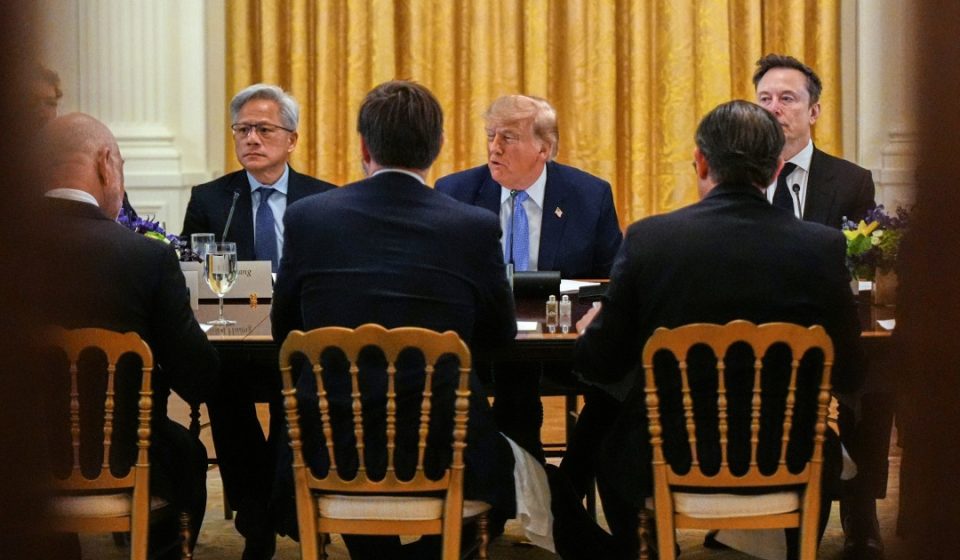
The vision statement is expected to be released just days after Trump convenes the nation’s top tech executives at the White House to build consensus on how to regulate and minimize AI risks. The meeting resulted in the “White House Accord on Super Intelligence,” which sets out a voluntary, four-part approach for companies to independently oversee their own security protocols.
Kratsios attended the AI meeting.
“If you take the risks and benefits of superintelligence seriously, the most important thing you can do is develop your country’s capacity to understand and use it,” he said at a United Nations Security Council meeting on AI last month.
Gn bussni