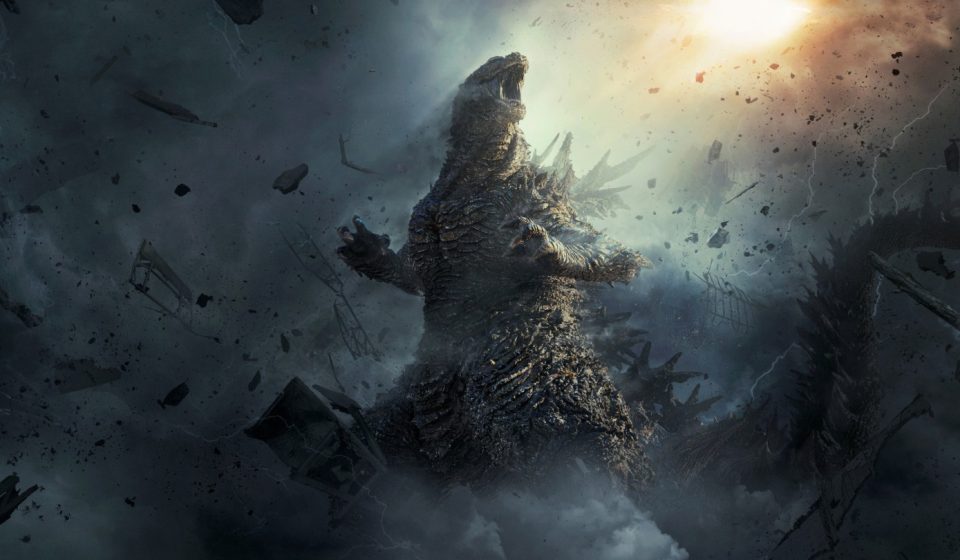

Three years ago, writer, director and visual effects wizard Takashi Yamazaki reinvigorated Japanese production titan Toho’s seven-decade-long kaiju franchise with Godzilla minus onewhich largely delivered monster mayhem with sophisticated (and Oscar-winning) effects, but perhaps more importantly, grounded the creature feature in affecting humanist drama. By dividing the film’s focus between the mass destruction and raw pain of post-WWII trauma, reconstruction, and societal reintegration—not to mention atomic allegory—Yamazaki has boldly reinvented the property while honoring the roots of the 1954 series original.
This same meticulously balanced duality is evident in the director’s approach to the larger-scale sequel, Godzilla minus zeroan equally thrilling jolt of marauding monster action anchored by tender themes of family, friendship, camaraderie and personal courage. These are characters we care deeply about, and Yamazaki trusts his audience to know the value of time spent observing human relationships, ennobling the horror with tangible emotional stakes. Following its world premiere at the New York Film Festival, GKIDS will release the film in the United States on November 6.
Godzilla minus zero
The essentials
A radioactive explosion.
Place: New York Film Festival (Gala Spotlight)
Release date: Friday November 6
Cast: Ryunosuke Kamiki, Minami Hamabe, Yuki Yamada, Kuranosuke Saski, Jun Kunimura, Mio Tanaka, Sakura Ando, Masami Nagasawa, Min Tanaka, Hidetaka Yoshioka
Director-screenwriter: Takashi Yamazaki
Rated R, 2 hours 15 minutes
Although one might expect the setting of 1949 to push the consequences of the war into the past, that is no less felt here, with moments of resonance touching on the Japanese people’s complex perceptions of America and the outsized impact of its military-industrial complex on the rest of the world. World War II may be over, but its vicious cycle of loss, destruction and power manipulation continues.
At the risk of angering the spoiler police – a signal to stop reading now if you prefer to go in blind – the new film ushers in another legendary kaiju first seen in 1964. Promotional material mostly refers evasively to “a new threat”, but fan anticipation and advanced media have all but let the three-headed dragon out of the bag.
Just as Japanese life seems to be returning to some sort of peacetime normalcy, with Godzilla exiled to the depths of the ocean and believed to have been killed in the previous film, King Ghidorah arrives with massive wings generating hurricane-force winds, tearing apart an entire city in the opening action.
There’s a ton of sci-fi mythology in the Godzilla series concerning the origins of Ghidorah the Explorer, a creature repeatedly under the control of alien invaders and time-traveling human terrorists, who is said to have arrived on Earth inside a meteorite with the intention of destroying the planet, just as she had destroyed Venus thousands of years earlier. Yamazaki wisely ignores all this geek lore, instead treating the dragon as simply another killer monster from the Monsterverse with regenerative powers, inevitably destined to wage a death match with Godzilla for alpha status.
Just like Godzilla can charge up his radioactive backplates and fire nuclear-level heat rays at his targets, Ghidorah has his own thing and three gaping fanged mouths to deploy it with. The creature design is magnificent, with the enormous wingspan and tangle of elongated necks and tails ratcheting up the menace, while the ferocity of the monster’s faces is heightened to great effect by growls and roars that can sound almost like an evil sneer.
The mega-dragon spits electromagnetic energy in the form of gravity beams; Some of the most notable sequences involve these lightning bolts enveloping anti-gravity force fields around buildings, trains, and anything else in Ghidorah’s path, sucked into the air and then crushed to the ground for maximum debris.
The heart of the previous film was Koichi Shikishima (Ryunosuke Kamiki), a former World War II kamikaze pilot – stunned by the loss of his parents and crushed by guilt over his conduct in the final days of the war – daring to dream of a life of domestic contentment only to see that dream repeatedly put in jeopardy.
Having more or less a choice, Koichi welcomed a young woman, Noriko (Minami Hamabe), into her house located in the rubble of Tokyo, in the company of Akiko (the adorable Sae Nagatani), the orphan child she had found alone and terrified. Two years later, this found family is inextricably linked, with their flinty neighbor Sumiko (Sakura Ando, so memorable in Hirokazu Koreeda’s transcendent film). Shoplifters), who also lost her family during the war, serving as an “aunt” to lend a helping hand to Akiko.
Once Ghidorah’s rampage spreads terror, Noda (Hidetaka Yoshioka), the former naval weapons engineer who now heads the government’s Office of Disaster Mitigation, begins work on defense plans. He recruits his old comrades from the previous film as well as a few new ones, weather forecaster Aoyama (Masami Nagasawa) and Professor Murakami (Min Tanaka), who lost his family in Hiroshima and who may have hidden agendas.
Veteran Jun Kunimura (much better served here than in Takashi Miike’s dud Bad Lieutenant: Tokyo) also presents himself as a doctor studying the effects of exposure to Godzilla’s cellular tissue on those involved in the Godzilla attacks. Minus one. This phenomenon affects Noriko, who miraculously survived the devastating attack on Ginza last time and has shown remarkable resilience, her injuries healing at an uncanny speed.
Yamazaki instills tenderness not only within the main family but also the larger group, bonded by deep affection as much as a horrible shared experience. As Ghidorah dictates that the fight will now take place in the air, Koichi is eager to return to the pilot’s seat, driven by a sense of duty to his country but also by lingering survivor’s guilt.
Nodo struggles with his own guilt over the countless deaths caused during the war by the weapons he designed; he won’t hear about Koichi putting his life in danger again and possibly depriving Akiko of a father. Nodo only agrees to bring in the pilot as an advisor, but Koichi is not easily dissuaded. The same goes for Noriko, whose medical condition could potentially be used as a weapon.
Nodo and his crew set up a command center in Matsumoto City, where Aoyama determines that they can track Ghidorah as the creature responds to the electromagnetic force of a fast-moving storm system.
Just then, Godzilla – fully regenerated and angry as hell – resurfaces offshore. Since heavy artillery and bombs have failed to slow Ghidorah for long, Murakami calls Godzilla’s reappearance a “divine providence”, insisting that pitting the two monsters against each other is their only hope. Via an ingenious plot, which involves a plan to lure the beasts nearby, using a system tested by the professor in a cheeky homage to Hitchcock’s novel. The birds.
The resulting clash between the legendary kaiju is a heartbreaking slap in the face in a film that never fails to wow audiences with exhilarating action, then continually outdo itself in the dustups that follow. I’m pretty sure I stopped breathing during a tense scene in which Godzilla crashes into a seaplane attempting a hasty takeoff.
While Spider-Man: A Whole New Day generated many sparks and Dunes 3 And Avengers: Apocalypse are yet to come, it’s interesting to note that some of the most thrilling, intense and inventive action sequences hit screens this year have come from two East Asian films – Godzilla minus zero And Hope. Stand back, Hollywood.
As he demonstrated in Minus oneYamazaki’s mastery of spectacle of large-scale destruction is breathtaking, this time overseeing a much larger VFX team that makes the monsters not only powerful physical presences, but also part of an immersive environment in which we experience the full force of their earth-shaking power. This is one of the most impressive seamless integrations of large-scale CGI in recent memory.
But the masterstroke of Yamazaki’s direction lies in the skill with which he ensures that the human drama remains no less convincing than the confrontations between monsters. The film also benefits from initially making Godzilla the underdog in the fight, bringing back the creature’s depiction in Japanese culture from nuclear trauma, natural disasters, and the pervasive anxiety that gripped the nation in the postwar years. Watch the Less films, we realize to what extent the absence of this cultural specificity limits American culture. Godzilla entries and how much these last two Japanese films serve as rehabilitation.
If the action in these American productions, notably Godzilla vs. Kongcan be visceral, the human element is generally forgettable and the mythology sketchy. But the characters here are richly developed, especially Koichi and Noriko, played with a mix of determination and vulnerability by Kamiki and Hamabe that fosters a real emotional investment in them as individuals and as a makeshift family; and Yoshiyoka’s wonderful avuncular Noda, who has some of the film’s most moving moments.
As she was in the previous film, the tough but soft-hearted Sumiko is a funny scene-stealer, and Nagasawa’s Aoyama is a terrific addition – it’s great to see a woman with authority and keen intuition on the science team, even if she’s not immune to self-doubt.
The first Japanese feature film shot in IMAX, the film is breathtaking, with so much detail and agile movement in the returning cinematographer Kozo Shibasaki…
Gn entert