In the early morning of Tuesday July 28, Abolfazl Sepahi, 23, and Amir Safari, 28, were hanged in front of a crowd gathered in Alikhani Square, in Isfahan, central Iran. The two men were on a list of at least twelve people convicted and sentenced to death for the murder of four police officers during anti-regime protests in Isfahan in January 2026. Two other people were executed in prison on July 19.
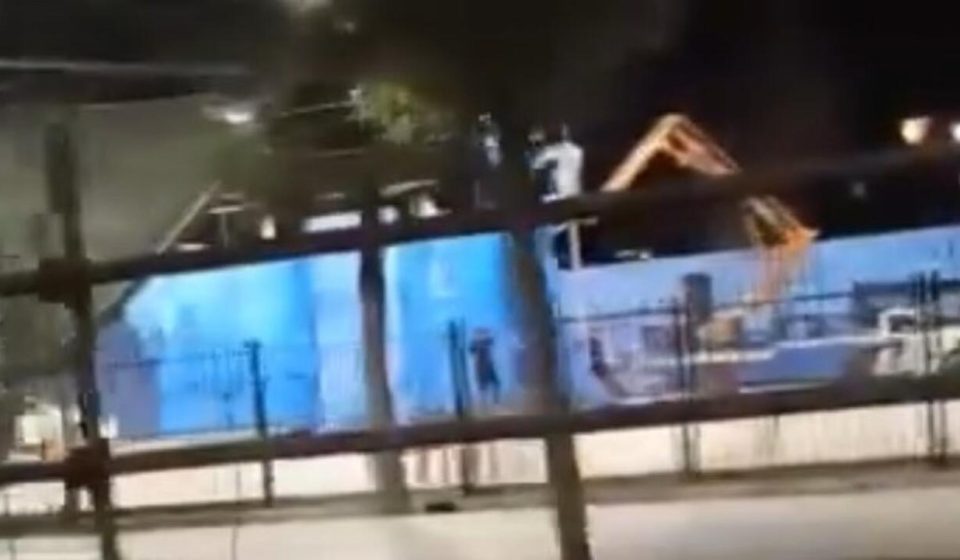
The regime had prepared these public executions the evening before, erecting a platform and a mobile crane visible to all in this square. The location was not chosen by chance because the Iranian authorities claim that the four police officers were killed at this precise location by demonstrators, during the anti-regime rallies of January 2026.
Public executions remain rare in cases of political convictions in Iran. The last public hanging of a political nature dates back to 2022, that of Majidreza Rahnavard, accused of having killed a member of the security forces in Mashhad during the “Women, Life, Freedom” movement. According to a count carried out by the independent daily Shargh, 88 people were publicly hanged in the country between 2011 and 2023.
Videos of crowds chanting slogans against police
In Iran, the authorities view these executions as public events. But this time, they did not achieve the desired effect. An angry crowd gathered at dawn and began chanting slogans against the police, prompting riot forces to intervene.
According to several direct witnesses, the police dispersed the crowd and pursued the demonstrators in the surrounding streets, using tasers, tear gas and warning shots. Short videos posted on social networks corroborate these testimonies.
In one, protesters can be seen fleeing near Alikhani Square in Isfahan, while chanting “Shame on you!” and other slogans hostile to the police.
Other amateur videos show people gathered near the execution platform, booing police officers in Isfahan.
On social networks, the hanging of Abolfazl Sepahi and Amir Safari caused reactions. Within a day, an online petition against the death penalty garnered around 500,000 signatures on Instagram.

Capture of a post published on Instagram displaying the slogan: “No to the death penalty. Never. Nowhere and for no one.” As of midday on July 29, this post had already been reshared more than 450,000 times. © Observers
Despite the risks they face, many Iranians continue to call for the abolition of the death penalty. Detainees in particular protested peacefully as part of a campaign called: “No to executions”.
They staged a sit-in and hunger strike in Ghezel Hesar prison, located in Karaj, northwest of Tehran. According to Amnesty International, Iran executed at least 2,159 people in 2025, mainly in cases related to drug trafficking.
Since the mass uprisings that shook Iran in January 2026, the number of politically motivated executions carried out by the authorities has increased.
According to Amnesty International, “since the start of the year, they have arbitrarily executed at least 52 people convicted of offenses linked to the January 2026 protests, following grossly unfair trials conducted by the revolutionary courts.” The NGO also does not rule out the use of torture to extract forced confessions.
“We don’t even know if they were directly involved”
“Kaveh” is a lawyer and human rights defender in Iran. We have chosen to hide his identity for security reasons.
“Regarding this case, we know nothing more than what the official news agencies reported. They claimed that on January 8, 2026, four police officers were killed by protesters in Alikhani Square in Isfahan.
In the days that followed, police arrested several people they accused of being involved in the incident. A few months later, the courts sentenced twelve of them to death. Two other men were already executed on July 19 in connection with the same affair.
We don’t even know if they were directly involved in the events or if they were simply present during this demonstration.
We also do not know whether they were allowed to choose their own lawyers, whether they were represented by court-appointed lawyers, or whether the latter effectively defended themselves.”
Public television channels broadcast, after the executions of July 19 and 28, what they presented as the confessions of the four young men, during which they appeared to recognize their involvement in the deaths of the four members of the security forces.
On July 27, a group of United Nations human rights experts ruled that “confessions obtained under duress should never be admitted as evidence.”
“The ‘Trump factor’ has accelerated executions”
Iranian human rights activists believe that a “Trump factor” may have encouraged the regime to accelerate its politically motivated executions. Kaveh continues:
“The Islamic Republic passed a special law during the 12-day war in June 2025 and has since implemented a new strategy to crack down on protesters, particularly those who participated in the January 2026 uprisings. Two other factors also play a role: the killing of police officers during the protests and the Trump factor.
After Donald Trump claimed to have prevented executions in Iran and that the Iranians had promised him to stop them, the Islamic Republic instead accelerated the executions. It considers participation in the anti-regime protests of January 2026 as direct cooperation with an enemy of the state.”
In January 2026, Trump claimed that Iran had stopped the execution of hundreds of protesters at his request and even thanked Iranian leaders.
Heba Morayef, Amnesty International’s regional director for the Middle East and North Africa, believes that the regime is seeking to display its strength in a context of war and instability:
“Iranian authorities are unleashing a terrifying wave of executions and death sentences to punish and suppress dissent, and to project an image of strength and absolute control following the popular uprising in January and amid continued attacks by US and Israeli forces,” she said.
“Soon people will find the courage to demonstrate again”
Kaveh adds:
“The way they staged this hanging raises questions. By keeping it public, they clearly wanted people to see what they were doing. Yet they then began to push away those present, preventing them from filming the execution and beating them.
This reveals the deep gap between what the state wants to project and how the population perceives its actions. What the state considers normal does not correspond to what society wants, believes or accepts as a norm.
Ultimately, the main goal is to frighten the population and protesters, while responding to demands for revenge from the regime’s support base.”
“These acts of state violence may frighten people for a while. But as we have seen over the past five decades, they quickly find the courage to protest again and again.
Public and mass executions are nothing new under the Islamic Republic. They began in the first days following its creation in 1979. At certain times, they even took place daily. Yet 47 years later, people continue to protest. And the biggest protests against the regime took place a few months ago in January 2026.”
According to Amnesty International, at least 60 other people, including three Iranians arrested when they were still minors, remain exposed to the death penalty, for charges linked to the anti-regime uprisings of January 2026.