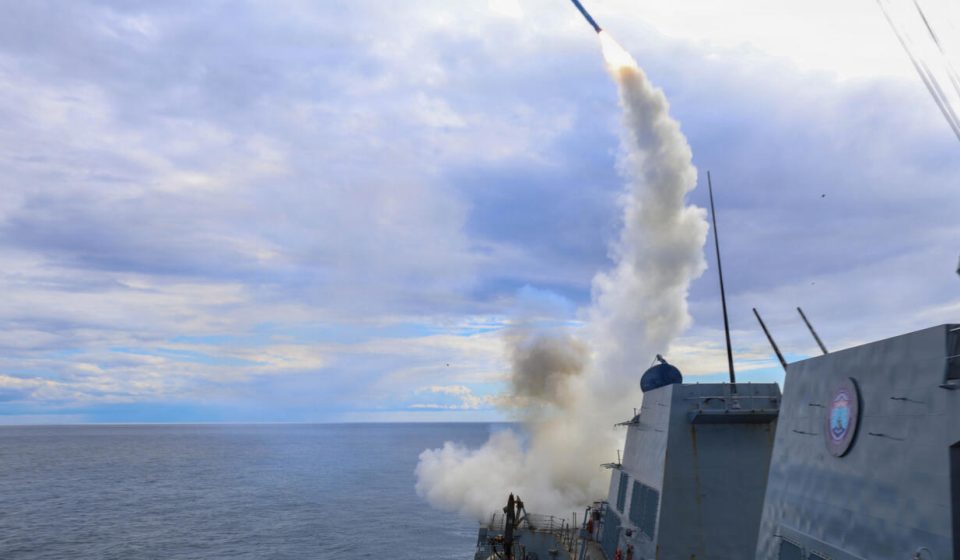
Is the most powerful army on the planet at risk of stock shortages? The question is raised again by several American media. CNN and the New York Times, Monday July 27, established a link between the decrease in stocks of Patriot interceptor missiles and other air defense munitions with the lull in American strikes in Iran. Almost daily for almost two weeks, they stopped on Saturday July 25.
On Monday, Donald Trump brushed aside any concerns about the possibility of a shortage of ammunition for the American army: de-escalation would be favored to leave “room for diplomacy”.
Up to four years to renew stocks
However, on Friday, far from the cameras, General Dan Caine, chairman of the Joint Chiefs of Staff, warned that a resumption of hostilities against Iran would “dangerously deplete available interceptors in the region.” His remarks were relayed by the New York Times.
In detail, the concern relates to two categories. There are offensive munitions, such as Tomahawk cruise missiles, but also defense interceptors, such as the Patriot and THAAD which protect American military installations in the Gulf countries.
An extension in your browser appears to be blocking the loading of the video player. To be able to watch this content, you must disable or uninstall it.

Cover image: © France 24
And “we have a fairly precise idea of the stocks, and the deadlines for replenishing the stocks,” explains Michel Yakovleff, former NATO general and professor at Sciences-Po, during an interview with France 24 on Tuesday July 28.
“The big worry is that in terms of surface-to-air defense missiles, the Americans would have consumed, depending on the type of missile, from a quarter to three quarters of their stocks. As for the renewal rates, it takes – again depending on the missiles – between one year and four years to reconstitute the pre-war stock (…) Hence a very big worry among the American military, and this since the start of the strikes, seeing the rate at which their missiles were leaving.”
What could tomorrow’s America do against China?
A throughput of 850 Tomahawks over the first thirty days of conflict was noted by the Center for Strategic and International Studies (CSIS), a geopolitical think tank based in Washington. By the end of April, the United States had used up a third of those ready for use. That’s a lot, considering the cost of a missile – two million euros – and the manufacturing time: two years.
An extension in your browser appears to be blocking the loading of the video player. To be able to watch this content, you must disable or uninstall it.

Cover image: © France 24
Still according to the think tank, since the start of the “third Gulf War” at the end of February, the United States had already consumed in April almost half of its stock of key munitions, such as the Patriot or the THAAD.
And this reduction in ammunition stocks “poses a short-term risk”, worried the CSIS: “A war against an adversary of the same size as China would result in a much greater consumption of munitions than during the current conflict. Pre-war stocks were already insufficient; their current level will limit American operations in the event of a future conflict.”
American shortages, allies struggling?
By its budget, its production volume and its technologies, the American defense industry dominates the world. It even fuels the war machine of its allies. Like Israel, the first recipient of American military aid in the world. And the Jewish state – despite its significant arms production capacities – could also “be affected”, worries the Israeli news site Ynet.
European NATO members rely on the United States for around 58% of their arms imports, according to benchmark data from the Stockholm International Peace Research Institute (Sipri).
Other customers will have to wait, notes Michel Yakovleff: the Japanese, who ordered 400 Tomahawk cruise missiles for around $2.3 billion, “will perhaps not be delivered until 2030”; likewise Switzerland, which purchased five Patriot surface-to-air missile batteries for an amount of around 2 billion Swiss francs, “at best in 2029”.
“Ukraine no longer counts on America”
“We have a lot of ammunition,” the American president declared to the press on Monday aboard Air Force One, before adding: “I would like to have more, to be honest, but we have given so much to Ukraine.” “The Americans have stopped protecting Ukraine,” objects Michel Yakovleff. Washington delivered a total of 600 Patriot missiles, but they stopped a year ago (…) Ukraine no longer counts on America.”
Can Europe step into the void left by America? Yes, on a technical level, answers Michel Yakovleff: “The Europeans manufacture very good anti-aircraft defense missiles, including anti-missile missiles.” And “the SAMP/T (Franco-Italian medium-range ground-to-air/terrestrial system, editor’s note) intercepts even better than the Patriot PAC-3,” specifies the purist. But Europe certainly remains “behind the United States in terms of production capacity”.
Faced with these expensive weapons, a cheap technology has redefined modern warfare – and escapes the anxieties of American stocks: the drone.
“Discover considerable military power” in Europe
Whether it is sending these devices or intercepting them, “the champions in all categories are the Ukrainians, far ahead of everyone, including the Americans,” notes the former NATO general.
An expertise which has already attracted three countries targeted by Iranian drones: Saudi Arabia, Qatar and the United Arab Emirates. All three sealed an agreement with kyiv opening the export of Ukrainian-designed interception equipment.
“The Pentagon recognizes the considerable American lag behind Ukraine in terms of drone production,” boasts The New Voice of Ukraine.
“The day the Russo-Ukrainian war ends,” the former general promises, “we will discover considerable industrial and military power in Europe” — and “the Ukrainians will flood the drone market.”