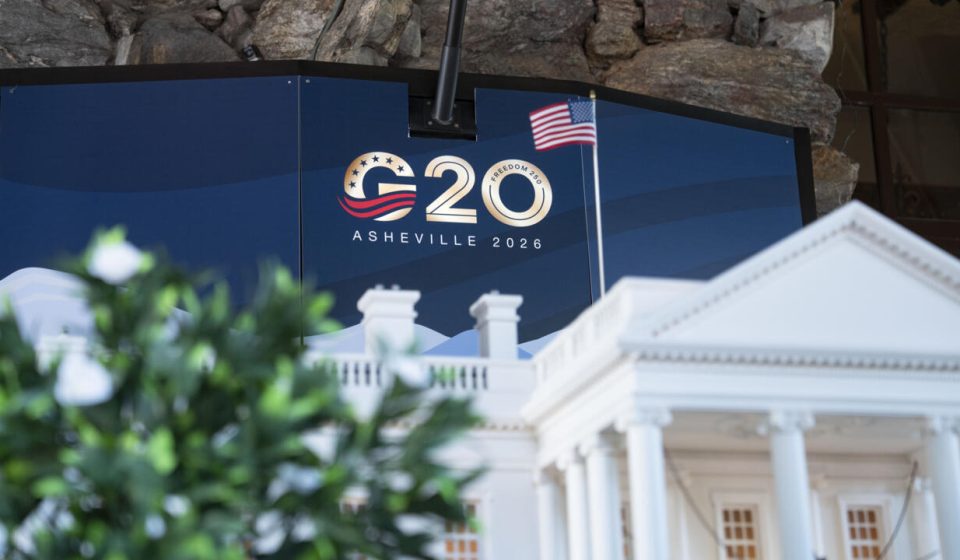

The United States is launching, on Monday, September 14, a series of meetings devoted to “energy abundance” as part of the G20 that it is organizing this year, even as the war launched by Donald Trump against Iran continues to disrupt global hydrocarbon flows.
The discussions will be held until Wednesday in Houston, in the oil state of Texas.
Delegations from the largest economies on the planet (China, India, Japan, Germany, etc.) as well as major producers of black gold, such as Canada and Saudi Arabia, will participate.
Russian diplomacy also indicated on Saturday that Moscow would send certain officials.
The surprise presence of Russian Finance Minister Anton Silouanov at a previous G20 meeting with his counterparts, two weeks ago, caused “unease” among the European allies, who did not appreciate the end to the exclusion of Russia practiced until then due to the war in Ukraine.
The arrival of the Russian delegates comes at a time when Europe is struggling to fill its gas reserves before winter. European countries have chosen to reduce their dependence on Russian gas but are facing a surge in prices caused by the conflict in the Middle East.
Prices at the pump are exploding
One of Washington’s “priorities” for this G20 is to “expand access to affordable, reliable and secure energy.”
But since the strikes carried out in Iran at the end of February by the American army alongside Israel, the flow of hydrocarbons from the Gulf has become rarer.
In the United States, prices paid at the pump have consequently exploded: a gallon (3.78 liters) of diesel now exceeds on average $6.20 according to the American Automobile Association, a record. Ordinary gasoline is 44% more expensive than before the conflict.
Faced with this very unpopular development, which makes Republicans fear a heavy defeat in the November legislative elections, Donald Trump predicted on Wednesday that the war with Iran would stop “immediately” after this deadline.
See alsoWar in the Middle East: “the price of a barrel will be the arbiter of this war”
He also accused Ukrainian President Volodymyr Zelensky on Sunday of causing “a diesel shortage” with his strikes on Russian refineries.
The head of state also announced this summer a “historic” agreement with Venezuela allowing Washington to take control of 17 oil fields. Production potential is estimated at 65 billion barrels.
The American Ministers of Energy, Chris Wright, and of the Interior, Doug Burgum, very involved in the Venezuelan issue, will be present at the Houston meetings.
With AFP