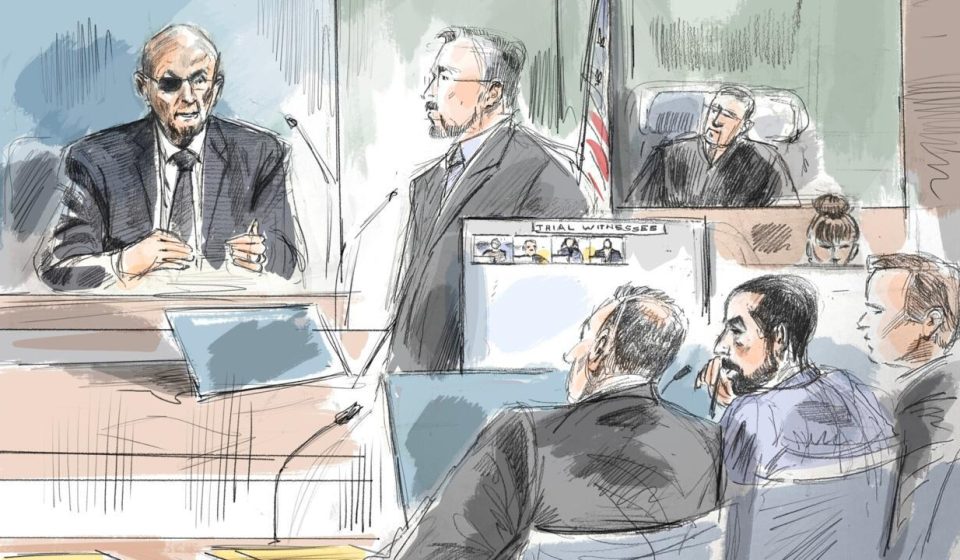

The man who stabbed writer Salman Rushdie in 2022 in the United States was found guilty, Wednesday July 29, of having committed “an act of terrorism” because of his sympathies towards Iran and Lebanese Hezbollah, for which he risks life in prison.
Already sentenced to 25 years of imprisonment by the New York State justice system in May 2025 for this attempted murder of the 79-year-old author, Hadi Matar will receive his sentence on November 3, the US Department of Justice said in a press release.
The 28-year-old was this time convicted at the federal level for “attempting to provide material support to Hezbollah, classified as a foreign terrorist organization, committing an act of terrorism transcending national borders and providing material support to terrorists.”
See alsoSalman Rushdie, the writer who never gives up
In Buffalo, still in New York State, the jury returned its verdict after just two hours of deliberations, reported the New York Times, after a week of trial.
For the prosecution, what guided the attacker was the fatwa launched in 1989 by Ayatollah Khomeini, at the time leader of the Islamic Republic of Iran, against the author of the “Satanic Verses”, a text he considered blasphemous. The American-Lebanese has also been criticized for supporting Hezbollah, a pro-Iranian Lebanese movement classified as a terrorist organization by the United States.
Hadi Matar will appeal
Prosecutors argued that the man had researched and made videos about the fatwa. Photos and material from Hezbollah were also found at the home of Hadi Matar, who was using a false driving license in the name of a figure in the movement.
“Mr. Matar spent more than a year immersing himself in the violent ideology of Hezbollah and preparing to act on this fatwa issued by the Iranian ayatollahs calling for the murder of Mr. Rushdie,” accused the assistant attorney general of the United States, John Eisenberg, quoted in the press release. He “chose to align his values with the terrorist values of Iran’s leaders”, also argued federal prosecutor Michael DiGiacomo.
According to the attacker’s defense, he never acted on behalf of any terrorist organization, even if he was motivated by anger against the writer because of the allegedly blasphemous nature of his book. His lawyer, Nathaniel Barone II, announced his intention to appeal, according to the New York Times.
Iranian fatwa
In court, Salman Rushdie spoke for nearly an hour on Thursday about his attack, which occurred as he was preparing to speak during a conference on freedom of expression in Chautauqua, in New York state (north-east), on August 12, 2022, several media reported.
Asked whether his attacker had attacked him in order to carry out the Iranian fatwa, the writer, who almost lost his life and lost the use of one eye, replied: “I have no certainty. I have my suspicions.”
Born in India but having spent much of his life in the United Kingdom, he was for a long time forced to live in hiding under the protection of the British police. Although the fatwa was never officially repealed, Iran indicated in 1998 that it would no longer seek to implement it. The threat having diminished, Salman Rushdie came out of hiding, settled in New York and obtained American citizenship.
Also readIn his book “The Knife”, Salman Rushdie recounts the attack that almost cost him his life
In 2024, he recounted this attack in “The Knife”, a book in which he imagines long conversations with Hadi Matar, whom he calls “the Imbecile who imagined things about me”, to try to understand his act. “The book, in itself, is about a knife, but it itself is also a bit of a knife. I don’t have any weapons or knives, so that’s the tool I use,” he explained to the American channel ABC. “It became my way of controlling the narrative, so to speak.”
With AFP