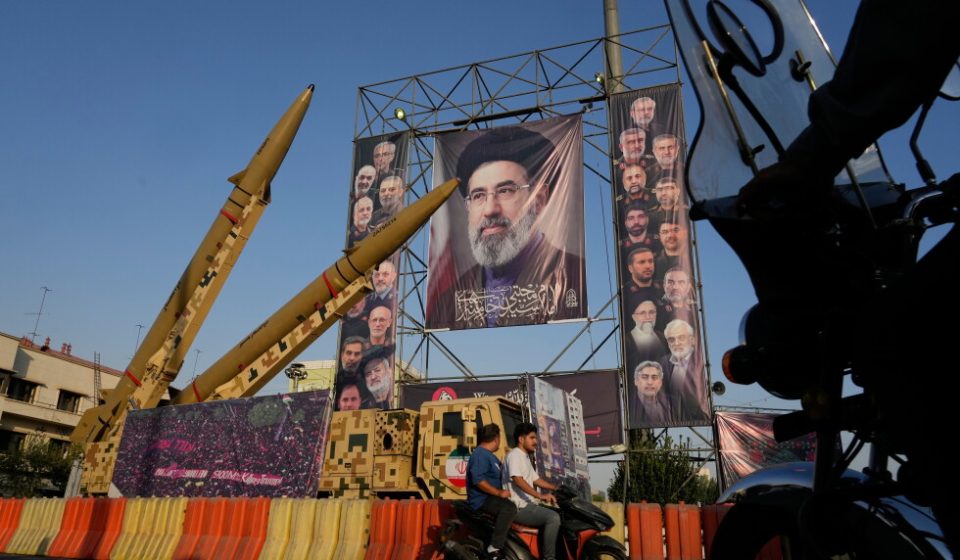
Iranian currency hits record high, Tehran traders exchange 2.5 million rials for the dollar

The Iranian currency fell to a new record low on Tuesday, with traders in Tehran exchanging more than 2.5 million rials for one US dollar, a stark reflection of how the war in the Middle East has gradually intensified. eroded the Iranian economy.
The latest decline came just 27 days after the rial hit its previous record low of 2.2 million per dollar on September 2. The currency has repeatedly reached new lows since the war began in February.
Iran’s economy has been under pressure for years due to international sanctions. But the American naval blockade on Iranian oil and the new sanctions imposed since the start of the war have plunged the country into a tailspin.
At the same time, Iran’s top diplomat said indirect negotiations with the United States were aimed at reopening critical tensions. Strait of Hormuz have become “more serious,” as the chief spokesman of the Iranian Revolutionary Guard Corps, General Hossein Mohebbi, on Tuesday called on Americans to take to the streets and protest the conflict.
Iran’s top diplomat raises prospect of new negotiations
Minister of Foreign Affairs Abbas Araghchi told Iranian media on Monday that “the current focus is only on the Strait of Hormuz,” the chokepoint of the war.
Araghchi made the comments shortly before leaving New York – where he attended last week’s gathering of world leaders at the United Nations General Assembly – and after meeting Pakistani and Qatari mediators.
Araghchi said Qatari intermediaries are expected to engage with the US side soon.
“They should raise the issue again with the American side, after which the final response from the United States will be conveyed to us,” Araghchi said. “If there is a response, the Qataris will convey it to us and a decision will be made in Tehran on that basis.”
Officials, including American ones, confirmed to the Associated Press that mediators work with Iran and the United States to try to negotiate an agreement to end the fighting and open the strait.
Mediation efforts continue even after US President Donald Trump earlier this week rejected an Iranian. proposal reopen the strait in seven days if the United States agreed to lift the blockade of Iranian ports, release frozen Iranian assets and lift sanctions on Iranian oil sales, among other conditions.
Iran sends provocative message to American public
Iran’s Revolutionary Guard Corps on Tuesday appealed to ordinary Americans to push their government to end the U.S. war on Iran, a provocative message that comes just weeks before crucial U.S. midterm elections.
Mohebbi, the Guard spokesman, read a letter at a news conference in Tehran, the Iranian capital, calling on Americans to pressure their government and saying the only way to end the war is for Washington to admit defeat and leave the Middle East.
Mohebbi’s remarks come as Trump’s Republican Party faces fierce headwinds as it seeks to maintain control of Congress. But polls show that the war has darkened the mood of the American electorate in the run-up to the November 3 elections, during which the rise in gasoline prices, a consequence of the conflict, threatens.
Mohebbi also accused the United States of using Iran’s nuclear program as a ruse to “loot Iran’s wealth” and turn the country “into a colony.”
He added that the United States and others did not believe that military and economic action would bring Tehran into submission and that Washington “has no choice but to admit defeat and leave the region.”
“This is how the war will end,” he said.
Trump and his top aides insist that Iran’s economy cannot sustain conflict any longer and have expressed confidence that Tehran will be forced to capitulate.
Shortly after the war broke out, the American president predicted that the conflict would last only a few weeks. Most recently, he said the war would likely end after the US election in November.
U.S. Secretary of State Marco Rubio, during a Monday appearance on Fox News, said Iran was heading toward an economic “cataclysm.” Administration officials say a combination of new sanctions and a U.S. naval blockade aimed at keeping Iranian oil off the market is having the desired effect.
“So when you deny them money through oil sales and sanctions, you’re not just punishing them,” Rubio said. “You are preventing them from having access to money that they will use to try to kill Americans and other people around the world and their own people, to build weapons, to threaten the world and, ultimately, to embark on a nuclear weapons program. »
A major Saudi pipeline is operational again
Separately, a crucial oil pipeline in Saudi Arabia, shut down by the kingdom earlier this month after being attacked, is operational again, according to a Saudi government official.
The official, who was not authorized to comment publicly and spoke on condition of anonymity, said operations were close to pre-attack levels and the pipeline was expected to be operating at full capacity within weeks.
The kingdom relies on the East-West pipeline, which runs throughout the country, to transport its crude from oil processing facilities in the Gulf to ports on the west coast of the Red Sea. From there it can be transported on tankers for export.
Saudi Arabia has blamed an Iran-backed militia in Iraq for the drone attack that forced the temporary closure of the 1,200-kilometer (745-mile) pipeline.
Satellite images indicated that tankers loaded some 12.5 million barrels of oil on Sunday at the Yanbu export terminal, which is supplied by the East-West pipeline, and the neighboring Al Muajjiz terminal, data and analytics firm Kpler said in a report.
—
AP Writer David McHugh in Frankfurt, Germany, contributed to this report.
Gn usa