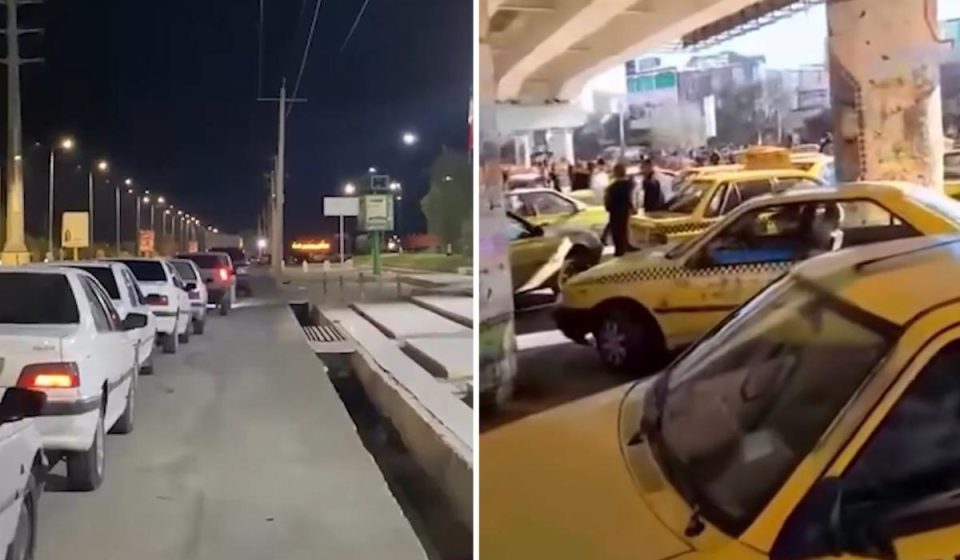
Iran’s fuel rationing system reaches breaking point with hours-long queues and protests on eve of ‘Bloody November’

Across Iran, motorists were stuck in grueling hours-long queues outside gas stations and taxi drivers took to the streets in protest on Saturday, as the state’s fuel rationing system reached breaking point – hours before the infamous anniversary of “Bloody November”.
In a video shared on Telegram, drivers at a gas station in the southern town of Kazeroun can be heard shouting in anger over fuel shortages.
“To those responsible: don’t mess with Kazeroun. This city has repeatedly shown that it does not remain silent in the face of negligence and ignorance of the population’s demands,” commented an Iranian Telegram article on Saturday.
“Nowadays, long queues in front of gas stations in Kazeroun have become one of the main concerns of the population. »
In other videos, lines of cars can be seen stretching for miles in cities across southern Iran, including Kazeroun, Bandar Abbas, Evaz and Lordegan.
In Ardabil in the north, footage shows taxi drivers parking their cars in protest, leaving passengers stranded as they refuse to collect them.
Sunday marks the seventh anniversary of the “Bloody November” that shook Iran.
Shortly after midnight on November 15, 2019, Iran announced a dramatic price hike – from 10,000 to 15,000 rials per liter for the first 60 liters of gasoline per month, then 30,000 rials thereafter – an increase of 50% and 300%, respectively, overnight.
Within hours, nationwide protests erupted, with Iranians blocking highways with their cars, burning banks and destroying images of then-Supreme Leader Ali Khamenei.
After a day of unrest, the iron-fisted Ayatollah asked top commanders to “do whatever it takes to end it,” resulting in one of the deadliest crackdowns in the Islamic Republic’s hard-line history.
An estimated 1,500 Iranians were massacred in less than two weeks.
Fearing a possible repeat, the government has since avoided a further price rise, by rationing gasoline to 160 liters per month per vehicle.
But the collapse of the economy, due to crippling sanctions from Washington, government corruption and now the US blockade on the Strait of Hormuz, has deeply worsened shortages and brought tensions in Iran to the brink.
Until last month, Iranians could refuel with a gas station’s “emergency card” after exhausting their monthly ration, for a higher price of 100,000 rials. This represented almost half of the gasoline sold nationwide.
But since November 1, the regime has abolished emergency cards in more than a third of the country, with plans to eliminate the rest within weeks.
One state official even admitted this week that “we really have a supply problem” – in comments that raised the government’s ire, Iran International reported.
“All the gasoline that the government has, it has given to the people,” said Esmail Sagheb Esfahani, vice president of the National Agency for Energy Efficiency. “Nothing has been held back to provide more.”
Gn world