

Software development job postings in the United States have increased since February 2025, when Anthropic’s Claude Code launched, even as overall job postings have declined, complicating predictions that AI would quickly erase demand for developers.
Concerns about the future of the software development career are valid and have intensified as companies have adopted AI-powered coding tools, especially as these tools continue to improve. As early as 2023, Microsoft’s software development platform GitHub said that on projects where AI was available, it was on track to write half of all code.
Some AI experts say that AI-written code across the entire GitHub platform is now more than halfway done. GitHub hasn’t confirmed this, but reported in October that one in three pull requests – the process by which coders who collaborate on development propose code changes for projects – now involves an AI agent. A year ago, GitHub reported that this figure was less than one in ten. “If this pace continues, in the next two years most of the code submitted to GitHub could be written by an agent. Much of it might never be fully read by a human,” he said.
Labor market researchers say that in this context, the profession is evolving rather than disappearing. Data from Indeed Hiring Lab shows that software development job postings in the United States have increased nearly 15% since February 2025, bucking both the overall job market and coding data.
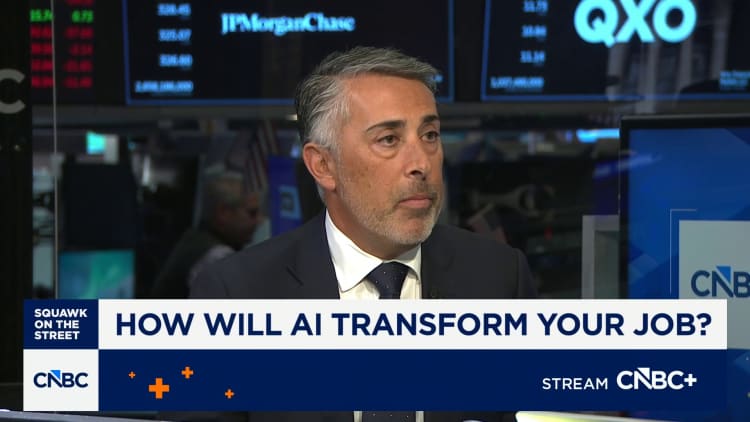
Some economic experts point to the rebound in software job postings as confirmation of a glass-half-full view of AI and the job market. “It wasn’t that long ago that we were reading the headline that we wouldn’t need software developers anymore,” said Eric Kutcher, McKinsey’s North America president, during a recent interview on CNBC’s “Squawk on the Street.” Instead, he said, as companies produce more code than ever, software developers who work with AI remain in high demand. “We’re seeing a lot more growth in places where we thought we’d see the most displacement,” Kutcher said.
Artificial intelligence is increasingly proficient in research, writing, coding, and administrative work – all tasks traditionally assigned to younger employees across industries.
Studio Mtstock | E+ | Getty Images
Recent research on AI and the future of jobs from the McKinsey Global Institute indicates that the earlier decline in the software developer field was not just about AI. While in recent years AI has automated software development tasks, the rebound comes after a sharp decline from the hiring peak of 2022, when tech companies pulled back after a pandemic-era hiring surge.
But even after the recovery, software development job openings remain about 27.5% below their pre-pandemic level, according to data from Indeed Hiring Lab. Importantly, this increase is focused on senior-level and more senior AI-focused roles. Indeed, Hiring Lab found that management positions accounted for 71% of the increase in software development postings between May 2025 and May 2026. Job titles mentioning AI accounted for 37% of the increase.
AI tools could allow companies to produce code faster than developers could do it themselves. GitHub executives have said in the past that at least 80% of code could eventually be written by AI, especially as developers become more comfortable with AI tools. But it could also mean that demand for workers focuses on those who can evaluate AI-generated code or problems and connect new tools to an organization’s broader technology systems.
Sneha Puri, an economist at Indeed Hiring Lab, said companies are realizing that while AI can handle some technical coding tasks, they still need developers to oversee that work, refine products and help customers integrate the technology into their daily operations. One example, she said, is the growing need for workers who can help companies apply AI tools beyond just building them.
Early advances in AI era may not last, young workers remain at risk
Currently, factors like those cited by Puri are helping software developers be among the winners in the early stages of AI’s transformation of the job market. A recent analysis of U.S. Bureau of Labor Statistics data by economist Steve Rattner found that software developers were among the career categories that showed positive growth between May 2023 and May 2025, although that growth was merely in line with the growth of all occupations and well below the pace of growth of traditionally blue-collar jobs associated with AI data center construction.
Anthropic researchers found that even with automation, humans are still needed to oversee that automation and require user participation. But the researchers caution that it is “by no means certain that this trend will continue in the future.”
GitHub said in its pull request report that as AI introduces more code into the world, and with it, more risks in the code, humans must be able to scale with the technology to control the AI’s work. But this may not be possible forever. “As the amount of code increases, we must prevent more exposures and reduce the human effort required by those that remain, otherwise the volume of vulnerabilities introduced will become untenable,” he writes.
For younger workers, prospects in software development remain uncertain. Stanford University’s 2026 AI Index found that employment in AI-exposed fields for people aged 22 to 25 has fallen 16% since the rise of generative AI, with people identified as early-career software developers experiencing a larger decline in employment of 20% as older developer roles expand.
This shift has made it harder for recent graduates to enter software development, even as demand increases for more experienced workers. Puri said students should familiarize themselves with AI tools, but not neglect the skills that remain essential when working with them. “Being able to use AI in your work and improve your efficiency is a great place to start,” Puri said. “But communication, interpersonal skills and leadership are also very important,” she added.
Puri said employers also have a role to play in preserving routes to this area. “Today’s entry-level talents become tomorrow’s senior experts,” she said. “If employers don’t build these pipelines now, they won’t have the top talent they need in 10 years.”
While it is difficult to predict job growth in the AI era, the long-term outlook for software developers remains positive, according to an August report from the U.S. Bureau of Labor Statistics. It projects that employment of software developers will increase 10% between 2025 and 2035, from about 1.72 million to 1.89 million jobs and creating about 174,700 positions.
Gn bussni