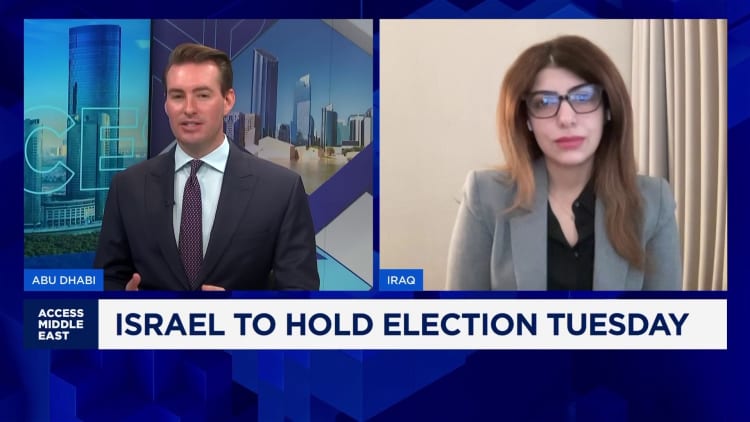

Israeli voters will go to the polls on Tuesday in an election whose implications will extend beyond the country’s borders.
This is Israel’s first election since the Hamas attacks of October 7, 2023, which killed around 1,200 people and saw more than 250 kidnappings. The Palestinian Health Ministry says the Israeli military campaign in Gaza has killed more than 74,500 people. It is also the first vote since the United States and Israel began their joint war against Iran in February.
How elections are held in Israel
Israelis vote for parties rather than directly electing a prime minister, with the Knesset’s 120 seats allocated by proportional representation. Parties must win at least 3.25% of the national vote to enter Parliament.
Since absolute majorities are rare, parties generally form coalitions. The president asks a member of the Knesset – usually the leader best placed to muster a 61-seat majority – to form a government. If repeated attempts fail, new elections may be called.
Israeli Prime Minister Benjamin Netanyahu (center) greets his supporters during a Likud meeting organized as part of the campaign ahead of Israel’s parliamentary elections, at the King Solomon Hotel in Netanya on October 22, 2026. (Photo by JACK GUEZ / AFP via Getty Images)
Jack Guez | Afp | Getty Images
Prime Minister Benjamin Netanyahu, who leads the right-wing Likud party, returned to power in late 2022 with a coalition including far-right and ultra-Orthodox parties. The alliance has since been strained by disputes over a ceasefire in Gaza and the conscription of ultra-Orthodox men.
Recent polls put Netanyahu’s bloc and the main opposition bloc, led by centrist former military leader Gadi Eisenkot, short of the 61 seats needed to govern, making smaller parties potentially decisive.
Arab parties are also in the running, but most major Jewish parties have ruled out any alliance with them. More than 20% of Israel’s population is Arab, but Arab parties have rarely joined government coalitions.
Wartime Priorities
The impending vote is effectively a referendum on Netanyahu, with Hamas attacks having “transformed Israeli society,” according to László Csicsmann, a Middle East expert at Corvinus University in Budapest, Hungary.
“Israel has been at war since October 7, 2023, and the so-called ‘seven-front war’ launched by Netanyahu has undoubtedly exhausted Israeli society,” he told CNBC. “The side that can best convince voters that it can protect the population is likely to win. Other campaign themes include compulsory military service, which is particularly sensitive for Jewish religious parties and Haredi communities.”
Military service is compulsory for most Jewish, Druze and Circassian Israelis over the age of 18, while most other Israeli Arabs are exempt. The conscription of ultra-Orthodox men remains a major legal and political dispute.
The economic toll of the war is also a major problem, Csicsmann said.
“Due to the war and high military spending, economic issues also dominate the political campaign,” he told CNBC, noting that Israel currently spends about 8% of its gross domestic product on military spending. “Additionally, almost every family has a soldier or reservist who was called up and left their job months ago.”

Defense and security are also at the forefront of the election, said Daniel Schatz, a political scientist and former visiting scholar at Harvard, Stanford and Georgetown.
“The challenge for Israel includes restoring trust in the government and deciding how military power will translate into lasting security,” he told CNBC in an email. “For its neighbors and international partners, the question is whether the next government will be able to transform battlefield gains into workable political arrangements.”
Schatz said that while Netanyahu’s supporters see the current prime minister as “an experienced leader facing formidable threats,” his critics see failures in preparation, accountability and strategic direction.
In September, book excerpts published by the Israeli newspaper Haaretz claimed that Netanyahu had been warned that Hamas was preparing a major offensive about a week before the October 7 attacks. Netanyahu called the claims a “complete lie” and reportedly filed a defamation suit against the newspaper.
But Schatz told CNBC that any lingering discontent with Netanyahu should not be confused with support for the left.
“Some voters want different leadership precisely because they believe it would provide more effective security,” he said.
He added that a change in prime minister and governing coalition would likely not produce a radical change in Israel’s position on Palestinian statehood, Iran and other foreign policy issues.
Netanyahu’s right-wing Likud party is running on a manifesto promising “uncompromising security,” as well as pledges to maintain a free economy and financial markets and an attempt to strengthen “Israel as a regional and technological power.”
Eisenkot’s Yashar party says it wants to make Israel a “democratic, powerful, progressive and secure” country, and it also emphasizes national security – including proposing a policy of integrating ultra-Orthodox and Arab communities into compulsory military service.
Palestine, Iran and international relations
Farzan Sabet, senior analyst at the Eurasia Group think tank, told CNBC that the main blocs competing for power are “quite hawkish on security” and would have comparable policies in key areas like confronting Iran and Hezbollah in Lebanon.
But he added that a new coalition government made up mainly of parties from the anti-Netanyahu bloc “would probably prefer to review Israeli strategy towards Tehran” before pursuing any major escalation.
The United States and Israel are reportedly drawing up plans for possible new strikes against Iran after the November 3 midterm elections, while Iran’s military chief has said he is ready for “asymmetric warfare.”
Eurasia’s Sabet added that the anti-Netanyahu bloc could be “more conciliatory on certain issues,” such as military action in Gaza, especially if it improves U.S. relations and Israel’s international standing while meeting the country’s basic security needs.
He said a government made up primarily of the anti-Netanyahu bloc would likely take fewer actions in the West Bank, quell settler violence against Palestinians and avoid annexation of Palestinian land.
The West Bank is Palestinian territory west of the Jordan River where Israeli settlements have been growing for decades. In recent years, settler violence and forced displacement of Palestinians have drawn condemnation from lawmakers in the United States and beyond.
But Sabet told CNBC: “Even if Netanyahu’s opposition has the edge in the latest Israeli election polls, it will be a close race, with several possible outcomes. »
Gn world