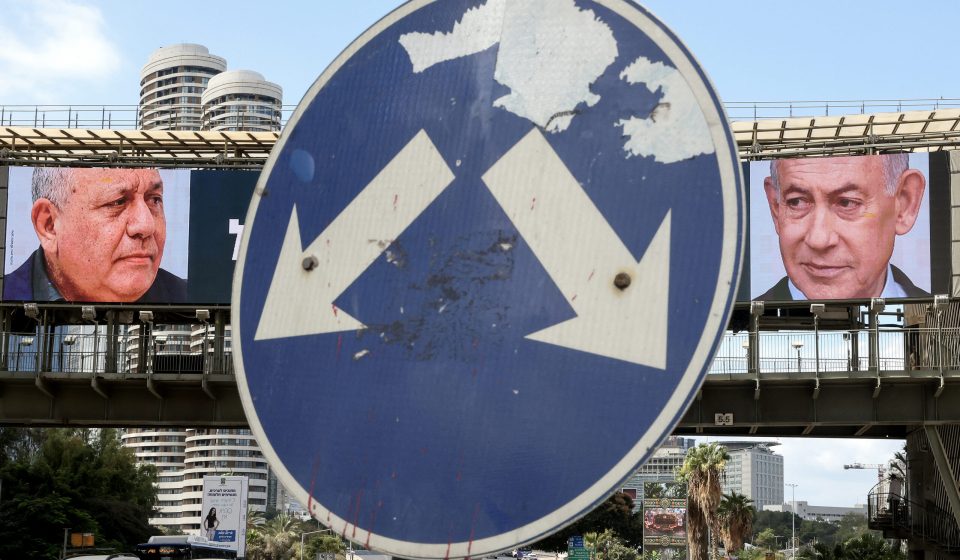

The most likely outcome of Israel’s upcoming elections is a stalemate, with the latest polls ahead of next Tuesday’s election showing neither side – Israeli Prime Minister Benjamin Netanyahu’s bloc and the one opposing him, led by Gadi Eisenkot – is expected to reach a majority in the Knesset.
Israeli law prohibits the publication of new polls from Friday until the October 27 elections.
The overall poll average would put the Netanyahu-led bloc in the lead, with 54 seats, while the opposition would get 50 seats, both short of the necessary majority of 61 seats. Netanyahu’s Likud won 23 seats, compared to 21 for Eizenkot’s Yashar party.
However, the gap between the polls of right-wing media and those of mainstream networks and publications was significant.
In the average of six polls conducted by mainstream television and newspapers, the Eisenkot-led bloc gained more seats than the current coalition. The average of the polls over the last two days gave Eisenkot’s bloc a narrow lead, with 52 seats, compared to 50 for Netanyahu’s bloc.
Meanwhile, an average of polls on Israel’s Channel 14 and i24 News – which rely respectively on Shlomo Filber, a former Netanyahu campaign aide, and Direct Polls, the company Filber founded with former Likud strategist Tzuriel Sharon before leaving last year – finds that Netanyahu’s coalition is expected to secure a majority of 61 seats in the Knesset, while Eisenkot’s bloc would have just 45 seats. These polls have been outliers, but direct polls have been the most accurate in recent elections.
The Arab parties, the Joint List and Raam, are averaging 14 seats in the polls, just below their record 15 seats in 2020, when they ran together. The leaders of the two blocs have pledged not to include Arab parties in their coalition.
Arab voter turnout has hovered around the 50% mark over the past decade. However, Stat-Net, a polling firm specializing in Israel’s Arab population, said that figure could reach 68 to 69 percent this year, which could give parties representing the Arab minority even more seats than expected.
Increased Arab participation would contribute to higher overall turnout, which would increase the number of votes needed to meet the minimum threshold for entry into the Knesset.
Both in the general poll average and in right-wing media polls, neither Amcha Yisrael nor the Reserves and Economy Party, which has been close to the electoral threshold of 3.25% in recent weeks, received enough votes to enter the Knesset. In the most left-wing polls, Reserves and Economy, which has not committed to recommending either Netanyahu or Eisenkot as prime minister, averages three seats.
A poll by the Israel Democracy Institute found that Israelis would rather have new elections than other ways to break a deadlock. More than a third of Israeli Jews (35%) and almost half (46%) of Arabs preferred a new election, while 28% of Jews and 9% chose a unity government with a rotation for the prime minister, and 23% of Jews and 25% chose a minority government.
Gn world