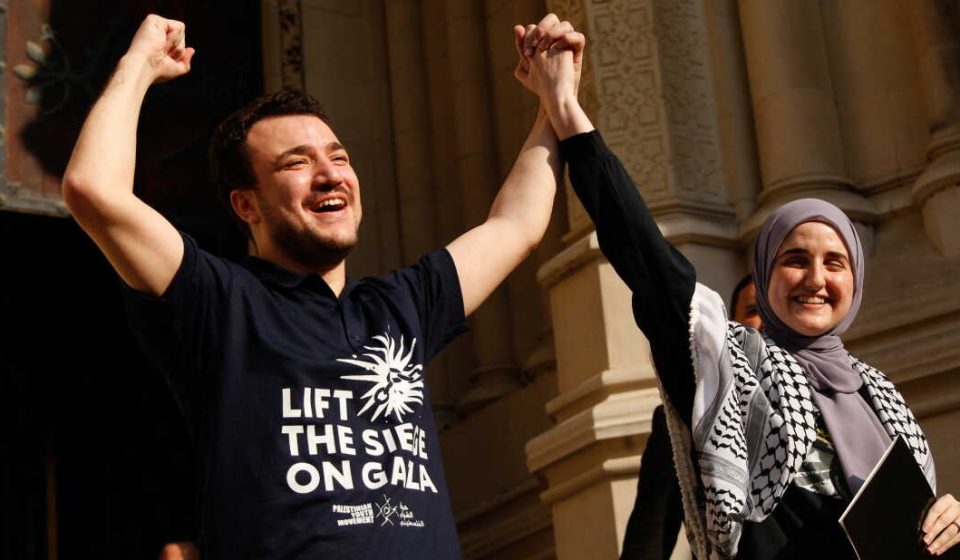


Mahmoud Khalil, accompanied by his wife Noor Abdalla, raises his hands as he arrives for a news conference in New York on June 22, 2025, two days after his release.
Kena Betancur/AFP via Getty Images
hide caption
toggle caption
Kena Betancur/AFP via Getty Images
On the night of March 8, 2025, Mahmoud Khalil was entering the lobby of his Columbia University building with his wife, Noor Abdalla, who was eight months pregnant, when a man in civilian clothes slipped in behind them. Before he knew what was happening, he was arrested by ICE.
Khalil feared for the safety of his pregnant wife. “The last thing I heard before being pushed into the unmarked ICE car was that they were threatening Noor (with) arrest,” he recalls.
Khalil was born in a Palestinian refugee camp in Syria and fled the country at age 18. He held a green card giving him legal status to live and work in the United States. Then a 29-year-old graduate student, he had become one of the most visible faces of the pro-Palestinian protests at Columbia University, where he was a negotiator between protesters and the administration.
Although Khalil has no criminal record and has never been charged with a crime, Secretary of State Marco Rubio nonetheless said he should be deported, invoking a provision rarely used in this way against a permanent resident. After his arrest, Khalil was sent to an immigration detention center in rural Louisiana, more than a thousand miles from home.
“The accusation is that the foreign policy of the United States believes that my presence in the country has harmful consequences,” says Khalil. “A month later, when the government had to present evidence, it had only a short document saying that my otherwise legal activities in the United States had created a hostile environment for Jewish students, and that this ran counter to U.S. efforts to combat anti-Semitism.”
Khalil spent 104 days in detention, during which time Abdalla gave birth to their first child, a son. In June 2025, a federal judge ordered his release. But the government is still trying to deport him and Khalil is preparing to petition the Supreme Court to hear his case.

In September 2026, Khalil filed a lawsuit against Columbia, accusing the university of failing to protect him and other Palestinian students from harassment, and of retaliating against them when they reported it. A Columbia spokesperson said Fresh air: “Creating a campus environment where every member of our community feels welcome, supported and safe is fundamental to who we are as a university and our academic mission. … The University is committed to protecting our community from discrimination and harassment and responding quickly and appropriately when concerns are raised.”

Khalil’s new memoir, No land to stand on, is based in part on the diary he kept while in ICE detention. Despite his experience, he remains a “strong supporter” of the rule of law – and of the United States.
“When I came here just three years ago, this is a place where I discovered that I could have a good life, … (where) I would have potential in my career, but it’s also a place where I want to raise my children,” he said. “This administration is trying to portray me as someone who is violent, someone who hates this country, someone who is working to undermine the principles of this country. In fact, it’s quite the opposite.”
Interview Highlights

On the conditions he experienced while in ICE detention in Louisiana
What happens behind ICE detention doors is horrific. And I believe that is a stain on the American conscience. … There were hundreds of people who were told that their existence was illegal and that none of them could be released or released. I shared an area with over 70 other men. The lights were always on, no privacy. But there was something else, it was the despair in the eyes of these men. They were called criminals, when in reality they were trying to do everything right. Most of them, at least those around me, were picked up at their ICE check-in point, court hearing, or workplace. Once you enter these detention centers, you see a very different reality from this country which is supposed to defend human rights, freedom and justice. But once you walk through these prisons, literally through this door, you see the opposite side of what’s really happening in this country.
Every story was horrible and heartbreaking, and when I went into detention, I thought my case was the most horrible, but… in one day, I (realized) that I was actually lucky; at least I have lawyers who support me, but the vast majority of them would be lucky to have even one lawyer to defend them.
On the location of the detention center in rural Louisiana
It was about an hour from the nearest airport, Alexandria. There are no direct flights or many direct flights to or from major cities. So it was designed to make people feel isolated so they could give up quickly. And that’s also another part of the bad conditions there. They want the inmates to give up very quickly, because if they decide to fight, it would take time. If it’s comfortable, people would fight. But if the situation is so serious, people will say, why should we take up our cause?
On having to listen to his wife give birth on a public telephone while in detention

Every time I try to remember that moment, I am left speechless, because I should have been home free with my newborn son. But instead, I was forced to listen to my wife, Noor, deliver on the phone. It was after midnight, around two or three in the morning. …That’s why I’m really struggling now with all of this, because I can never forgive those who took this moment away from me, a moment that I believe all couples look forward to. … Noor and I tried our best to be together for this moment. I turned down job offers abroad… just (so) we could be together at that time.
On his role as negotiator with Columbia University during the pro-Palestinian protests of spring 2024
During the camp, the students…appointed me to this position for different reasons. One of them (was) my experience working in diplomacy. I spent five years working for the British Embassy in Beirut, for the Foreign Office, doing diplomacy. I have had a very long experience working in such spaces, in the bureaucracy. … Columbia treated us like a PR threat or a brand problem, a PR threat or a problem to deal with rather than as students who were crying about what’s happening in Palestine, students who were actually demanding change.
Whether he witnessed anti-Semitism in the movement at Columbia
I believe that the Palestinian movement, or the Palestinian liberation movement in Colombia, was truly rooted in dignity, security and equality for all. And we are so proud to have built this movement with our Jewish peers, whether they are students, but also teachers. And to me, there was absolutely no anti-Semitism in the movement itself. There was no place for anti-Semitism there. And that’s why I keep repeating against the narrative that Colombia itself helped promote, because we must take anti-Semitism seriously, like all forms of bigotry. We must also recognize when anti-Semitism is used or weaponized to protect Israel from criticism. …

Of course, there were some sporadic anti-Semitic incidents, mostly from people outside of Colombia because they felt Colombia was the hot spot for militancy. But the students were very aware of it, and I remember we had a course at Columbia… like Anti-Semitism 101… to help us understand in the same way that we had a lot (of courses) on anti-blackness. (We had) lessons on Palestinian and black solidarity, Palestinian and Jewish solidarity. So these students were really trying to learn.
Why he keeps fighting and doesn’t expel himself
If I leave and don’t fight, everything this administration says about me will be a record. I could not look my son Deen in the eye and tell him that I have given up the fight at a time when I consider myself one of the privileged Palestinians who knows that Deen will be fed tonight, that my family will not be bombed tonight by an Israeli missile, that I will not be stopped at a checkpoint on the way to my school. So I take this responsibility so carefully that I have to fight. I shouldn’t just walk away because my silence won’t end anything. If I leave this country, I don’t think it would end much of the misery of immigrant families in this country, but also of the Palestinian people.
Anna Bauman and Thea Chaloner produced and edited this interview for broadcast. Bridget Bentz and Molly Seavy-Nesper adapted it for the Web.
Gn headline