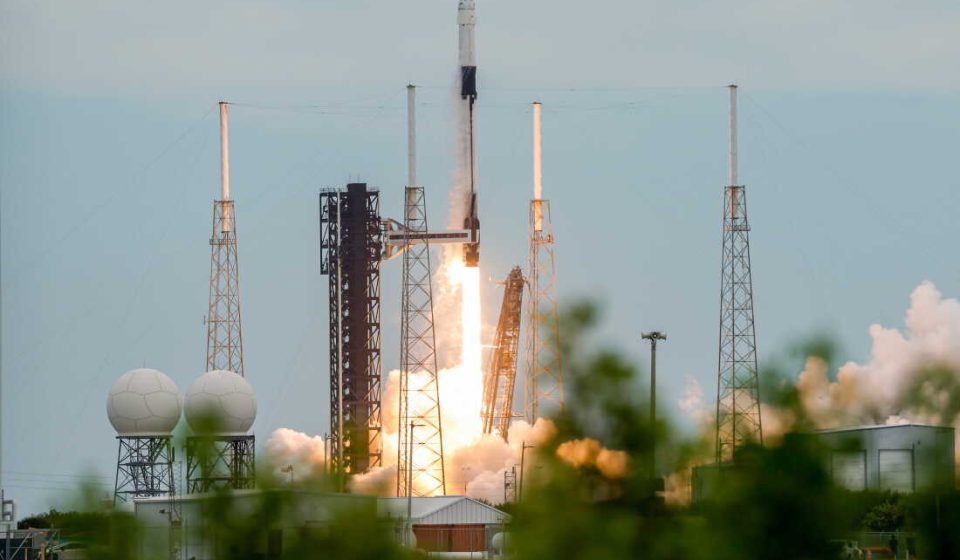


A SpaceX Falcon 9 rocket and Dragon spacecraft carrying NASA’s Crew-13 lift off Thursday from Cape Canaveral, Florida. SpaceX’s Crew Dragon capsule “Grace” will take NASA astronauts Jessica Watkins and Luke Delaney, Canadian Space Agency astronaut Joshua Kutryk and Roscosmos cosmonaut Sergey Teteryatnikov to the International Space Station for approximately six months.
Justin Sullivan/Getty Images
hide caption
Justin Sullivan/Getty Images
KENNEDY SPACE CENTER, Fla. — Despite concerns about thunderstorms and gusty winds, SpaceX launched four people on NASA’s Crew-13 mission to the International Space Station.

The Falcon 9 rocket jumped off the launch pad at the Cape Canaveral space station and flew northeast over the Atlantic Ocean. It will take about eight hours for the capsule to catch up and dock with the space station. The four crew members will spend up to six months living and working aboard the outpost before returning home.
The crew includes two NASA astronauts. Commander Jessica Watkins, a geologist, is making her second trip to space, having launched to the space station on the Crew-4 mission in 2022, and totaling 170 days in space (she was the first Black woman to serve on the space station and spent the most time in space of any Black woman). Pilot Luke Delaney, a naval aviator, makes his first trip to space. He’s from DeBary, Florida, about 50 miles from the Space Coast.
“I grew up pretty close to here,” he said before his flight. “I was able to watch the space shuttle launches, and now I’m going to be able to see them from a little different perspective.”
Deltona High School – where Delaney attended – declared Thursday “Luke Delaney Day” as students gathered outside to watch him take flight.
Mission specialists from Canada and Russia join the crew. Joshua Kutryk of the Canadian Space Agency and Sergey Teteryatnikov of Roscosmos are both making their first trips to space.

NASA SpaceX Crew-13 crew members (from left) Canadian Space Agency astronaut Joshua Kutryk, NASA astronauts Luke Delaney and Jessica Watkins, and Roscosmos cosmonaut Sergey Teteryatnikov before their launch from Cape Canaveral, Florida, on Thursday.
Justin Sullivan/Getty Images
hide caption
Justin Sullivan/Getty Images
Their capsule is called Grace and is the fifth and final Dragon spacecraft built by SpaceX. It made only one trip to the space station, carrying four private astronauts on the Axiom Ax-4 mission.
The mission’s name is similar to a well-known NASA mission in history: Apollo 13. An explosion just 55 hours into that mission in 1970 crippled the Apollo 13 crew’s spacecraft, and NASA scrambled to find a solution to get the crew home safely.
Although not superstitious themselves, the members of Crew-13 incorporated elements of the Apollo 13 mission into their mission patch, remembering the ingenuity and courage that saved that crew.
“I think this really represents what we can do when we’re faced with extremely difficult and dire circumstances,” said NASA’s Dana Weigel. “I give a lot of credit to the crew for greenlighting Apollo 13, for kind of giving credence to that and representing that in the mission patch that they chose.”
Crew 13 members will spend their time on the space station performing maintenance on the orbiting laboratory and conducting scientific experiments – some even within the crew themselves. They will work on a stem cell study that will help researchers better understand the treatment of Parkinson’s disease, study agricultural production in space to prepare for long-duration missions, and test new medical equipment to monitor crew health.
The mission was delayed in August after an oxidizer leak was detected on the Dragon capsule during processing. NASA and SpaceX pushed back the mission from a mid-September launch to find and fix the problem.
“It took a lot of effort, time and many, many hours of determined troubleshooting to get us on track for launch,” said Lori Glaze, NASA’s head of human spaceflight.
Crew-13 will replace members of the Crew-12 mission, launched to the station in February. They will make the return trip to Earth next week and crash land off the coast of Southern California.
This mission is SpaceX’s 13th operational mission for NASA and the 14th overall for the agency. (SpaceX launched a test flight carrying two astronauts to the station in 2020.) The company has also flown other private missions to space, both to the space station and orbital missions. Current NASA Administrator Jared Isaacman funded and flew two of these missions before taking the agency’s top job.
Gn headline