Skip to content
-
Subscribe to our newsletter & never miss our best posts. Subscribe Now!
Today's News. Tomorrow's Perspective. Today's News. Tomorrow's Perspective.

Deliver fast, factual, and easy-to-understand news covering global events, technology, business, science, AI, health, entertainment, and lifestyle.

Today's News. Tomorrow's Perspective. Today's News. Tomorrow's Perspective.

Deliver fast, factual, and easy-to-understand news covering global events, technology, business, science, AI, health, entertainment, and lifestyle.

  • Home
  • Breaking News
  • Business
  • Sports
  • Health
  • Politics
  • Technology & AI
  • World
  • Home
  • Breaking News
  • Business
  • Sports
  • Health
  • Politics
  • Technology & AI
  • World
Close

Search

Subscribe
Neanderthal gene variant in modern human genomes linked to lower risk of schizophrenia, study finds

Health

Neanderthal gene variant in modern human genomes linked to lower risk of schizophrenia, study finds

Stephen Atcheler
By Stephen Atcheler
November 23, 2026 3 Min Read
Comments Off on Neanderthal gene variant in modern human genomes linked to lower risk of schizophrenia, study finds

People who carry a piece of DNA inherited from Neanderthals have a slightly smaller occipital lobe, the brain area at the back of the head. The same goes with a lower risk of schizophrenia. Hugo Zeberg and Svante Pääbo of the Max Planck Institute for Evolutionary Anthropology in Leipzig, Germany, reported the results in PNAS on November 16, 2026.

Humans and Neanderthals interbred 47,000 years ago
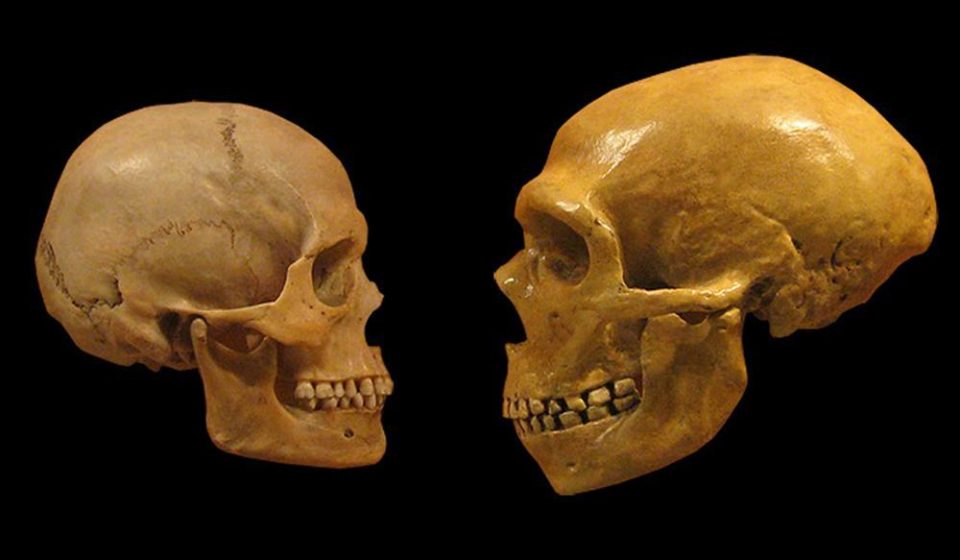
Homo sapiens (left) and Neanderthal (right) skulls from the Cleveland Museum of Natural History. Credit: hairymuseummatt (original photo), DrMikeBaxter (derived work)

The occipital lobe houses the visual cortex, where signals from the eyes receive their first processing. Each copy of the variant has approximately 0.85 cubic centimeters less volume. Two copies means about 1.7 cubic centimeters less. The analysis data was adjusted for head size, so the effect points to that single lobe and not to a smaller brain overall.

The team started with four known variants related to occipital volume. Three also occur in Africa. The fourth, a deletion of four DNA letters on chromosome 14, only appears outside Africa. All five high-coverage Neanderthal genomes carry the deletion, and the two high-coverage Denisovan genomes lack it. The deletion concerns approximately 59,700 letters. A block this long would not have survived since the common ancestor of Neanderthals and modern humans. The probability of such an ancient origin is approximately 1.2 in 100,000.

In brain scan data from the Oxford BIG40 resource, the deletion has the strongest link in the entire genome to the volume of the cuneus, a visual area located on the inner side of the occipital lobe. A separate study ranks the same location second in the genome for cortical surface patterns. The deletion is located 24,300 letters upstream of DAAM1, a gene involved in cellular organization during early brain growth. The change does not affect any protein codes, so the effect most likely works via genetic control. The region generally appears quiet in adult brain tissue, indicating activity during development.
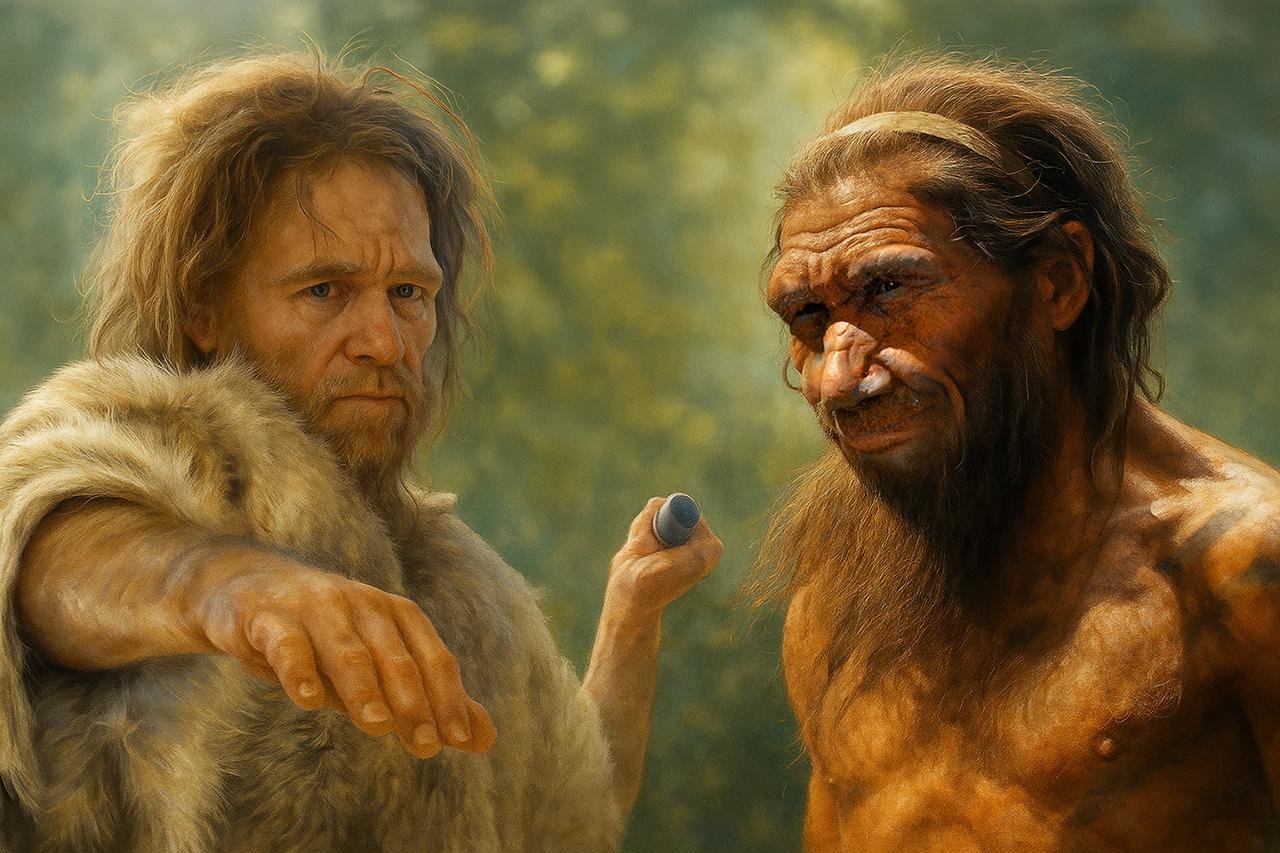
A reconstruction of a Homo sapiens (left) and a Neanderthal (right). Credit: Paul Hudson, Flickr / Wolfgang Sauber, CC BY-SA 4.0. Edited and composited by Archeology News Online Magazine.

Carriers are at lower risk of schizophrenia. The odds ratio is 0.95 per copy and around 0.91 for two copies, or almost 10% less. The result is valid after correction for the 16 characters tested. Bipolar disorder, depression, ADHD, autism and intelligence showed no links. Education level gave a weak signal of correction failure. At most, the effect is equivalent to 13 days of schooling per copy, compared to an average of around 15 years.

Related article: Neanderthal genes linked to rare brain and skull disorder, study finds

The authors also asked whether Neanderthal DNA as a whole reduced the risk of schizophrenia. Among variants in Neanderthal-derived segments, 54.9% of Neanderthal alleles had lower risk, compared to 54.4% elsewhere in the genome. The difference is small and not significant, so the DAAM1 effect seems limited to this location.

A puzzle holds. Skull casts suggest that Neanderthals had relatively larger occipital lobes than modern humans, but this variant is associated with a smaller lobe. The authors say many genes shape brain shape, as well as eye and body size, so the conflict might only be apparent. Weak links to sports clubs and religious groups in the UK Biobank data have not been corrected, and no second group exists to check them.

The authors say the work cautions against equating the size of a brain region with cognitive ability.

Publication: Zeberg, H. and Pääbo, S. (2026). A Neanderthal-derived genetic variant reduces occipital brain volume in modern humans. Proceedings of the National Academy of Sciences, 123(48), e2624837123. doi:10.1073/pnas.2624837123

Gn Health

Views: 4
Stephen Atcheler
Author

Stephen Atcheler

**Stephen** is a staff journalist at **DailyVoxa**, specializing in business, finance, technology, artificial intelligence, and global markets. He is committed to delivering timely, accurate, and insightful reporting that helps readers understand the forces shaping the global economy and the rapidly evolving digital landscape.Drawing on in-depth research and credible sources, Stephen covers breaking developments, industry trends, and emerging innovations with a focus on clarity, balance, and factual accuracy. His reporting is designed to provide readers with reliable information, practical context, and thoughtful analysis without sensationalism.As a member of the DailyVoxa editorial team, Stephen follows the publication's Editorial Policy, Fact-Checking Policy, Corrections Policy, and Ethics Policy. Every article is carefully reviewed to ensure it meets the highest standards of journalistic integrity, transparency, and editorial independence.

Follow Me
Other Articles
Alcaraz puts Zverev in the shade as world's best beats No.1 for first ATP Finals title | ATP Finals
Previous

Alcaraz puts Zverev in the shade as world’s best beats No.1 for first ATP Finals title | ATP Finals

Democrats turn to expensive ICE prison purchases
Next

Democrats turn to expensive ICE prison purchases

Deliver fast, factual, and easy-to-understand news covering global events, technology, business, science, AI, health, entertainment, and lifestyle.
  • About Us
  • Accessibility Statement
  • Advertise With Us
  • AI Usage & Transparency Policy
  • Contact us
  • Cookie Policy
  • Corrections Policy
  • Meet Our Team
  • Privacy Policy
    • Disclaimer
    • DMCA & Copyright Policy
    • Editorial Policy
    • Ethics Policy
    • Fact-Checking Policy
  • Terms and Conditions
Copyright 2026 — Today's News. Tomorrow's Perspective.. All rights reserved.