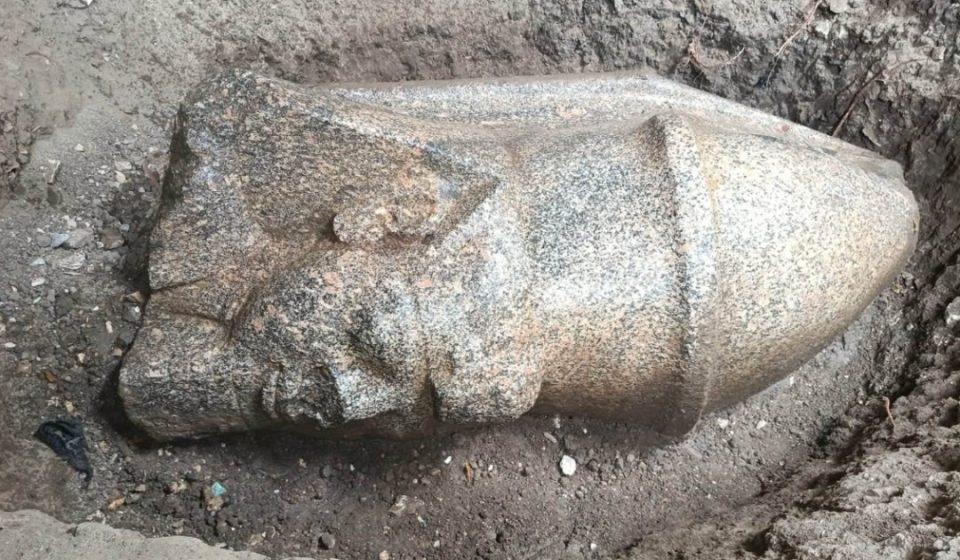

The discovery of an unusual stone in an Egyptian courtyard has led archaeologists to two colossal royal statues, believed to represent Pharaoh Ramesses II, also known as Ramesses the Great. A landowner in the village of Behebat al-Hijara in Gharbia Governorate in Egypt’s Nile Delta was the first to alert archaeologists of an inscribed stone, which turned out to be an ancient artifact, People reports. A major excavation later revealed fragments of two royal statues. The head of one is over 5 feet long and depicts Ramses II with a double crown, symbolizing the unification of Upper and Lower Egypt. Experts say the complete statue would have initially stood around 28 feet tall.
The head and main part of a second statue, stretching nearly 8 feet long without its base or legs, were also discovered, with archaeologists suspecting another depiction of Ramses II, this time seen in a striped royal headdress. The artifacts were found near a pink granite block that bears two of Ramesses II’s royal titles, translating to “King of Upper and Lower Egypt” and “Son of Ra,” according to the Egyptian Ministry of Tourism and Antiquities. Work on site continues. Authorities thanked the owner for quickly alerting authorities of the discovery and granted him and his wife an Umrah pilgrimage to Mecca on Wednesday, according to Anadolu Agency.
Gn world