
Investigators have located the wreckage of a medical transport helicopter that crashed into the Pacific Ocean after leaving Santa Catalina Island Wednesday evening, killing a pilot and a nurse.
One person, a patient transported to the mainland, is still missing and two people survived. Sources close to the investigation said the missing woman is a 45-year-old Avalon resident who suffered a severe allergy attack.
At a news conference Thursday, Los Angeles County Sheriff Robert Luna said it was unlikely the patient survived the crash and noted the wreckage was deep in the water, 200 feet below the surface. Divers from the department’s Special Enforcement Office will work with other agencies and use technology to search the ocean floor.
“This is a tragedy for Catalina and for Los Angeles County,” said County Supervisor Janice Hahn. “The men and women on board have dedicated their careers to responding to crises and saving lives. They are heroes.”
Los Angeles County firefighters received a call at 7:53 p.m. Wednesday requesting a marine rescue to remove three people from the water, agency spokesman Jonathan Torres said.
The department learned the three men were on a helicopter bound for the mainland and that five people were involved, Torres said. The plane was a Eurocopter EC135 P2, the National Transportation Safety Board said. The helicopter was equipped as a medical transport and belonged to REACH Air Medical Services, the U.S. Coast Guard said.
Flight tracking data shows the helicopter left the Pebbly Beach Heliport in Catalina and reached about 175 feet above sea level about eight seconds into its flight before quickly descending.
“We have a helicopter just off the coast of Pebbly Beach,” emergency dispatchers said over the radio, according to an audio recording of the incident. “We need Baywatch Avalon by boat. We have a helicopter with potentially three people on board. … We have people screaming for help.”

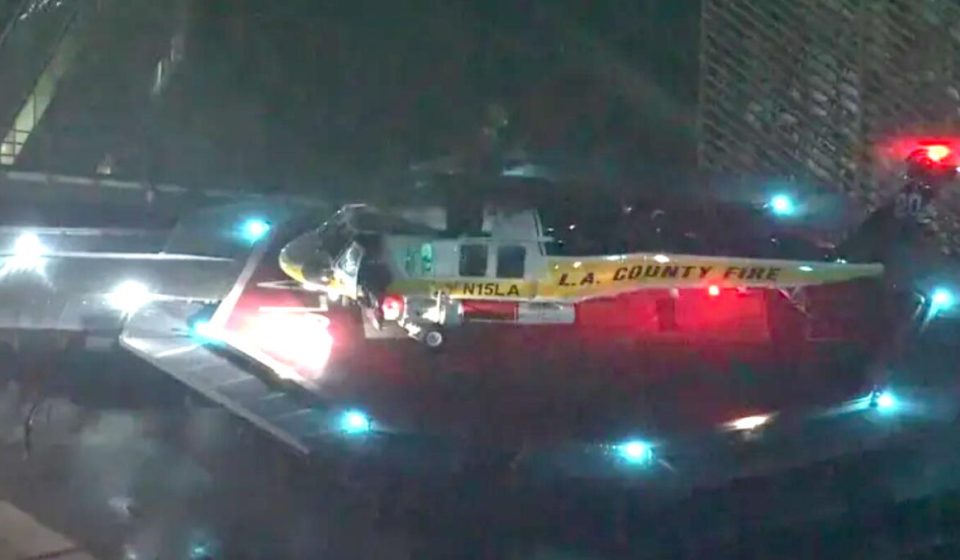
A victim of a Catalina medical transport helicopter crash is taken to Ronald Reagan UCLA Medical Center in Westwood in a Los Angeles County Fire Department helicopter.
(KTLA-TV)
Rescuers found four people in the water. Two of them were pronounced dead and two others were rescued, transported to mainland hospitals and were stable, Torres said. The fifth person was not found, Torres said, although the search continued through the night and into Thursday.
The Coast Guard sent an MH-60 Jayhawk helicopter and crew to the island and deployed a 45-foot response boat to assist with the incident.
Leahy said the helicopter and boat searched several square miles for the missing person and used computer software that predicts where the person might be based on environmental factors such as drift and currents.
The longer the search continues, the larger the search area will need to be, he said. The crash left a large field of debris that ocean currents pushed toward the island, he said, making it easier for the Los Angeles County Sheriff’s Department to recover some of it, Leahy said.
If the missing person is not found, the search will eventually turn into a recovery, in which case the Coast Guard will disengage because the agency does not perform body recovery. It’s unclear exactly when that might happen and depends on a variety of factors, including how quickly the Coast Guard boat and helicopter can cover the search area. As of Thursday morning, conditions were relatively calm and suitable for searching, Leahy said, although currents were stronger than expected.
It’s also difficult to predict whether someone can survive in water, Leahy said, and depends on several factors, including water temperature and whether the person is wearing a flotation device or clinging to debris.
Aviation attorney Mike Slack, based in Austin, Texas, said the missing person most likely went down with the plane because patients were strapped to their stretchers during helicopter transports for safety reasons. This is a “real danger” during medical transport on water, he said.
Although it is too early to say exactly what caused the accident, Slack said that with five people on board, a medical transport helicopter could exceed its maximum weight if it had a full tank of fuel.
Slack said the NTSB would have no difficulty recovering the helicopter and extracting flight data even if the plane was underwater. Many helicopters are equipped with video and audio recording devices that capture everything that happens inside, as well as flight and engine data recorders.
REACH Air Medical Services said in a statement on social media that it was aware of the incident, gathering information and coordinating with authorities.
“Our thoughts are with the families, loved ones and colleagues affected by this tragedy,” the company said in its statement. “We are working to support our team and everyone affected during this incredibly difficult time. »
Federal aircraft records show the helicopter was manufactured by Eurocopter Deutschland GmbH, a German company.
The NTSB will lead the investigation, Torres said.
An NTSB spokesperson said agency investigators arrived on scene around 11:30 a.m. Thursday to document the site and examine the helicopter once it was recovered and transported to a secure facility.
“The investigation is in its early stages and the information available at this time is limited,” the spokesperson wrote.
Catalina Island has a small hospital. About 250 people are transported to the mainland by helicopter for medical treatment each year, the hospital’s general director said previously.
NTSB data shows that of 13 incidents involving EC135 helicopters since 2005, not including Wednesday’s, six resulted in fatalities. The last one occurred in March 2025 in Canton, Mississippi, and involved a medical transport helicopter called AirCare 3. Three people died.
Wednesday’s fatal air disaster was also not the first involving a REACH air medical services helicopter. Last October, a nurse on board another Eurocopter REACH was killed, and the pilot and on-board rescuer were seriously injured.
According to a preliminary NTSB report, “approximately 26 seconds” after the helicopter left the heliport at UC Davis Medical Center in Sacramento, “the flight paramedic reported the power was out and issued a Mayday call as the helicopter autorotated and crashed on U.S. Highway 50.”
An NTSB examination of the accident site found that an outer portion of the main rotor blade had broken off and was found stuck in a detached garage of a nearby home. The helicopter reached approximately 500 feet before an 11-second descent. A final report on the accident is still pending.
In November 2015, firefighters were using a REACH Eurocopter to practice simulating loading and unloading patients at Apple Valley Airport when the pilot felt a chill and immediately landed. An NTSB investigation found that a towel was ingested from an unsecured storage container on the ground, resulting in significant damage to the tail rotor blades.
Gn headline