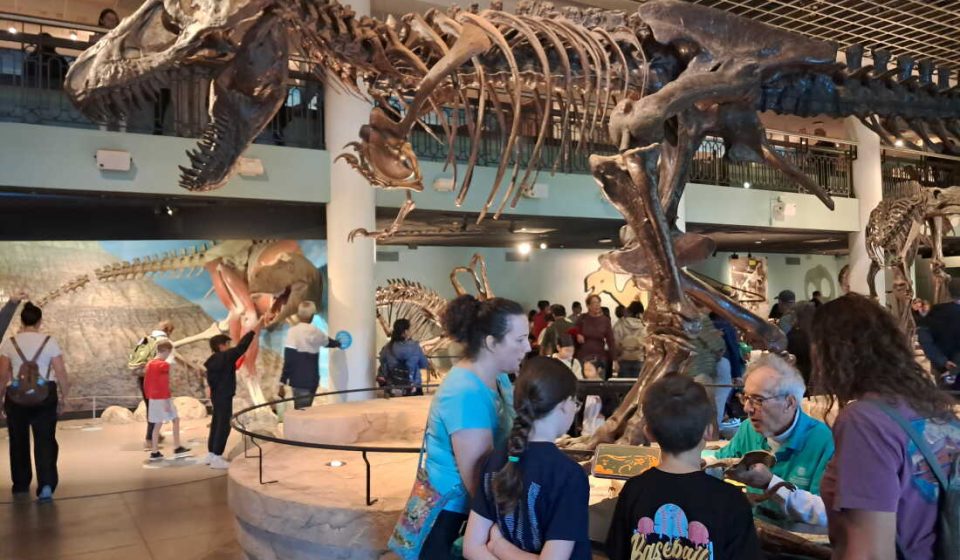


The Museum of the Academy of Natural Sciences’ dinosaur skeleton exhibits have been popular with generations of children since they were first exhibited in 1868.
Andrew Stelzer for NPR
hide caption
Andrew Stelzer for NPR
PHILADELPHIA — Every weekend for the past month, the sidewalk in front of the Natural Academy of Sciences has looked like part festival, part funeral, part science fair.
On the museum’s last Friday, there was a line of visitors waiting to get in; Activists circulate petitions and leaflets to “Save the Academy”; and a museum educator showed off a giant salamander skull and a rare layer of pangolin scales.
For children in the Philadelphia area, visiting this place has been a rite of passage for generations. So when news broke on September 1 that the nearly 200-year-old museum would close at the end of the month, thousands of families began a nostalgic pilgrimage to make one last visit.
“It’s a very special place, for my family and also for me growing up,” said Alexandria McCormick, who was visiting with her husband and six children. She said that when she was a child, her family came several times a year, sparking her love of natural history.
“It makes me really sad to think that my children might not also grow up having these experiences and being inspired to love nature in this way.” she said.
Founded in 1812 and opened to the public in 1828, the Academy of Natural Sciences was the first place in the world to display a dinosaur skeleton, in 1868. There are also mammal dioramas, live animals, and other rotating exhibits.
Its collection of scientific specimens is widely recognized as one of the most important in the world. And its sudden disappearance comes against a backdrop of continued decline in funding for cultural and scientific institutions.
“It’s the oldest natural history museum in the Americas,” says Isa Bétancourtwho worked in the Academy’s entomology department for 10 years, from 2011 to 2021.
Betancourt now lives in Arizona, but hopped on a plane and came back to Philadelphia to help organize the “Let’s save the Academy” campaign, which included a series of rallies, marches and a online petition to keep the museum open, which has more than 114,000 signatures.
“If this museum can disappear like this, what’s stopping other museums from following the same path? We can’t let this set a precedent.” she added.

Academy of Natural Sciences professor Jake Cook shows a beaver skull to museum visitors during one of the museum’s final days of operation.
Andrew Stelzer for NPR
hide caption
Andrew Stelzer for NPR
A sudden closure
Drexel University, which assumed financial responsibility for the Academy in 2011, explained on his website that after the pandemic, costs increased and attendance decreased. However, in recent weeks, museum attendance has skyrocketed and revenues have been more than 20 times higher than last September.
“Maybe if they had announced it last year, they could have attracted as many people as they did today,” said Zoe Abrams, who was visiting with her husband and two children. “It’s busier than Grand Central. That could have saved things.”
Some people working to save it have criticized Drexel for not participating in any effort to stem the closure of museums, nor for providing details on the cost of keeping it open.
“When they announced the one-month notice, it was a surprise to everyone,” Betancourt said. “It’s like the leadership hasn’t even tried to keep it open, and that’s why there’s a lot of frustration with what’s happening. It’s just not right.” she added.
In response to a request for comment, Drexel said in a statement that it “remains deeply committed to protecting the extraordinary legacy of the Academy of Natural Sciences.”
Less than a week before the September 30 closing date, the William Penn Foundation offered one-year bridge funding; to buy time to explore more permanent solutions. Drexel said it was exploring the possibility of working with the foundation, but would need a long-term sustainability plan before considering reopening the museum.
Difficult times for scientific institutions
The Academy houses a massive and irreplaceable library of more than 19 million specimens. It includes Thomas Jefferson’s fossil collection and plant samples collected by Lewis and Clark. It also has an archive of 73,000 holotype specimens, carefully preserved samples that scientists use as a reference to define and name species.
Drexel said it would preserve access to this collection for students and researchers. But it’s unclear exactly what this means for the general public. And all this uncertainty comes at a time when government support for cultural institutions is in sharp decline. “It’s certainly a challenging time for the museum sector.” said Natanya Kashan, a spokeswoman for the American Alliance of Museums. A 2025 survey of AAM members found that a third of them have had government grants and contracts canceled, and more than two-thirds have been affected in some way by executive orders. “Financial pressures aren’t just about federal funding, they’re also about philanthropy, corporate giving and individual giving,” she said.
The Academy tied its financial fate to that of Drexel when, in 2011, the two institutions announcement an “affiliation”. The Academy became a subsidiary of Drexel, but retained its own board of directors and 501c3 organizational status. In a statement announcing the partnership, the Academy president boasted of a “rock-solid balance sheet, with an endowment of $51 million.”
But, like many universities, Drexel has financial difficulties, partly because of decline in registrations. In 2024, the school reported that it faced a budget deficit.
And as attendance declined, in 2025, the museum laid off staff, and reduced hours. It’s soon canceled its 2026 summer camp program. Earlier this year, The Philadelphia Inquirer reported that the university and the Academy were renegotiate the relationship with the heir; Drexel wanted a complete merger, which would grant it the building, endowment and collections.
Amid speculation that Drexel plans to sell At the 150-year-old building housing the Academy, the Philadelphia City Council has proposed changing local zoning to make it more difficult to sell the building or convert it to other uses. The council also plans to hold special sessions public hearingsto find out how the Academy got to the point of closure and what possible solutions might be. The legislation calling for the hearing also gives the board the power to subpoena Drexel.
“We need to know how this happened. What were the levers that created this decision, and how can we undo this decision?” said city council member Dr. Nina Ahmad.
“We haven’t found any campaign in the recent past to encourage or say to the city of Philadelphia, ‘We may close if you don’t come and use our museum.’ None of that.”
Philadelphia has a history of rescuing financially troubled cultural institutions, including the famed Barnes Foundation art collection and the Please touch the children’s museum. But these campaigns took place before the closure of their respective museums. Reopening an already closed institution could be much more difficult.
Gn usa