Philadelphia-area cancer vaccine trials show new promise after decades of setbacks in the field

After completing treatment for stage 3 colon cancer in 2022, Colby Johnson was ready to try anything that could prevent her cancer from coming back.
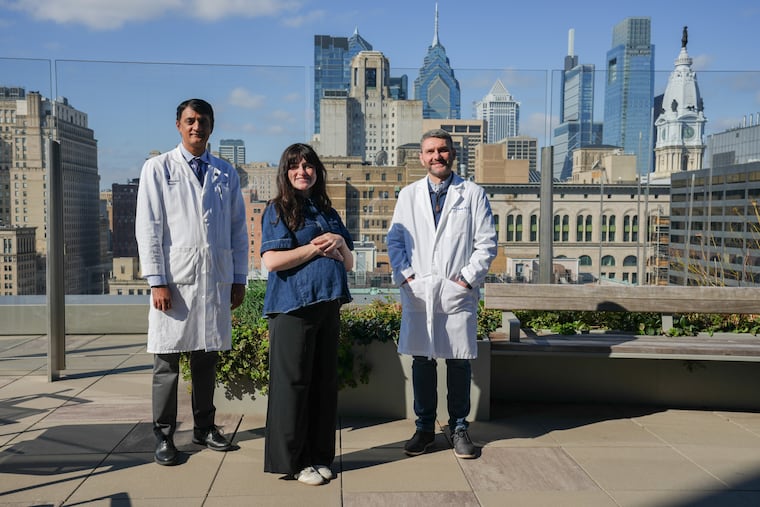
The then 26-year-old signed up for a small, early trial of a new vaccine at Jefferson Health. Designed to train the immune system to recognize and attack cancer cells, the treatment gave him hope that if the cancer returned, his body would know how to eliminate it.
That’s the idea behind so-called cancer vaccines, a rapidly evolving field that is seeing progress in several clinical trials this year after decades of setbacks.
The first successful late-stage trial for an mRNA cancer vaccine came in August for a melanoma vaccine developed by pharmaceutical giants Merck and Moderna. And this month, New York-based SELLAS Life Sciences announced positive results in an advanced cancer vaccine trial involving 126 leukemia patients.
» LEARN MORE: Penn helped test a promising mRNA cancer vaccine. Here’s what the test means for the field.
Experts say the technology may be most effective when cancer is detected early or after other treatments have already eliminated tumors.
Some early trials of cancer vaccines failed when tested as standalone treatments in patients with advanced cancer, who tend to have significant disease and weakened immune systems. Other candidates have used targets that are also present on healthy tissues, thus weakening the body’s ability to generate an immune response.
“I think there is potential for vaccines against virtually any type of cancer – the key being the ability to give these vaccines to patients when their immune systems are still robust,” said Ben Stanger, director of the Penn Pancreatic Cancer Research Center.
The Jefferson trial is just one example of a locally developed and tested cancer vaccine. Susan Domchek of the University of Pennsylvania is leading trials to determine whether vaccines can prevent cancer in people with BRCA gene mutations, which increase their risk of developing certain cancers.
» LEARN MORE: Penn’s BRCA cancer vaccine trial aims to prevent disease in healthy people
Many of these efforts are in their early stages, meaning it will still take years to prove their safety and effectiveness. Most new treatments do not get to the point where they are approved and become widely available to patients.
In 46 patients in the Jefferson trial whose gastrointestinal cancers had previously been surgically removed, the vaccine was found to be safe, according to an abstract presented at the American Society of Clinical Oncology (ASCO) annual meeting in late May.
The results are preliminary and have not yet undergone the rigorous peer review process usually required for publication in an academic journal.
The tested vaccine also induced robust immune responses in patients given the highest dose, suggesting it could provoke and hopefully train the immune system. However, its effect on cancer remains to be proven.
Because the trial was not randomized and controlled – the gold standard for establishing causation – it cannot be used to assess effectiveness.
“This requires a larger, more powerful study with a control group,” said Stanger, who was not involved in the trial.
Jefferson’s team said it was too early to determine the cost of the vaccine.
Johnson doesn’t know if the vaccine helped her. But she was happy to have received the higher dose, believing it would give her the best chance of benefiting.
The 30-year-old Manayunk resident remains cancer-free and is expected to give birth to her first child next month.
“We live a very happy, healthy, lucky life, with lots of friends and family around us,” she said of her life after cancer.
The potential
When people think of a vaccine, they usually imagine flu or COVID-19 vaccines.
These train the immune system to recognize and fight a virus if it is exposed. Cancer vaccines are pretty much the same. By teaching the body to recognize a particular target on cancer cells, the technology helps prepare the immune system to fend off threats.
Think of it like arming the immune system with wanted posters for suspected criminals.
“When it comes to vaccines, the immune system is the medicine,” Stanger said.
However, cancer vaccines in trials are more often deployed after the cancer has already been diagnosed.
For example, the new melanoma vaccine has been used to prevent cancer from coming back in people after initial treatment. The same goes for the leukemia trial.
“We traditionally think of vaccines as something you give before you get a disease,” Domchek said. “And suddenly we’re using the word vaccine for things that are considered treatments.”
The Penn researcher questioned whether the label “immune therapy” should be used instead to avoid confusion. In contrast, its BRCA cancer vaccine approach attempts to prevent the development of cancer in the first place.
Approaches range from personalized therapies to commercially available products. which are predefined and standardized.
In the melanoma trial, individual patient tumors were sequenced to identify targets for personalized vaccines.
Meanwhile, Domchek’s trial focuses on patients whose BRCA mutations increase their risk but who don’t yet have cancer. A personalized approach won’t work “because they don’t have something to sequence,” Domchek said.
The Jefferson vaccine uses a target shared by all patients with gastrointestinal tumors.
The advantages of an off-the-shelf therapy are its scalability, ready availability, and potentially lower manufacturing costs. A personalized approach offers greater adaptability, precision and specificity.
“There will be a role for both, for sure,” Eileen O’Reilly, a medical oncologist at Memorial Sloan Kettering Cancer Center in New York who is not involved in either local effort, said of both approaches.
Cancer vaccines can be administered in a variety of ways, from mRNA technology based on Nobel Prize-winning research at Penn to virus-based platforms.
If successful, cancer vaccines could provide a lasting advantage over other treatments.
“When responses occur, they have the potential for sustainability,” O’Reilly said.
Penn’s efforts continue
BRCA carriers are at high risk of developing cancers affecting the breasts, ovaries, pancreas, prostate and skin.
This creates a unique challenge for scientists searching for a shared target across tumor types and patients. A universal vaccine for all cancers is considered unlikely because cancer encompasses many different diseases.
The approach tested at Penn vaccinates patients against three common hallmarks of cancers.
One is a subunit of an enzyme called telomerase that appears in larger amounts than usual in 95% of human cancers. The others are WT1, a protein found in various cancers, and PSMA, a protein widely found in prostate cancer.
Multi-target vaccines could prove more robust given that cancers are very complex and adaptive, said O’Reilly, who is developing a new pancreatic cancer vaccine at Memorial Sloan Kettering that targets several common genetic drivers of cancer.
However, researchers will need to determine whether having multiple targets dilutes the overall quality of the immune response.
“If you have several different targets, are you limiting what the immune response can do? » said O’Reilly.
Domchek’s phase 1b trial is testing the vaccine in 44 participants: 28 who are healthy and have no history of cancer and 16 who do not have cancer but have a history of disease. The first results reported in 2025 at the ASCO annual meeting showed that the vaccine was safe.
The technology uses pieces of DNA introduced into cells via an electrical jolt.
His team then examines whether the vaccine generated an adequate immune response before moving on to trials testing its effectiveness against cancer.
“We still have a way to go because we need to prove that it lowers the risk of cancer,” she said.
Jefferson’s vaccine trial
Drew Weissman, one of the Nobel Prize-winning mRNA scientists at Penn, doesn’t think cancer vaccines would work well in someone whose advanced cancer can’t be eliminated. The immune system has trouble killing large tumors, he told The Inquirer in a September article.
That’s partly why Jefferson’s approach targets patients whose tumors have already been surgically removed.
The vaccine, delivered using a virus, targets a protein called GUCY2C that is commonly found on cancer cells from gastrointestinal tumors.
Forty-six patients all received the treatment, with most reporting flu-like side effects. For Johnson, that meant a high fever and symptoms that lasted about two to three days.
Among the 21 colorectal cancer patients included in the analysis, higher vaccine doses were associated with lower rates of cancer recurrence at two years.
“We see an earlier indication of preventing recurrence in high-risk patients, and our next step is to prove that,” said Babar Bashir, the Jefferson oncologist who led the trial alongside Adam Snook, the Jefferson scientist who developed the technology.
Stanger said it’s difficult to say whether the reported decrease in relapses is significant, since there was no control group and the study was small.
O’Reilly agrees, pointing out that without randomization, there can be “huge selection bias” in how patients are chosen.
Jefferson’s team is preparing for a follow-up Phase 2b trial, funded by an approximately $2 million grant from the Pennsylvania Department of Health.
Gn Health