In February 2025, US President Donald Trump marked his return to power by launching a trade war with China.
New tariffs, amid accusations that China was failing to stop the flow of drugs to the United States, have set the stage for a growing economic confrontation between the world’s two largest economies that could reshape global trade.
As Trump’s new tariff regime hit allies and rivals alike, China took the fight head on.
Washington first imposed 10% tariffs on Chinese goods, citing fentanyl and immigration concerns, and Beijing responded by limiting exports of five rare earth metals critical to defense, clean energy and technology products.
Then there was a confrontation with Trump’s “Liberation Day” tariffs in April, including 34% on Chinese goods. A retaliatory exchange ensued as US tariffs on China climbed to 145 percent, while US goods entering China were hit with tariffs of 125 percent, alongside restrictions on exports of rare earths.
The tariff war oscillated for much of that year before the two leaders sat down at a table in October, on the sidelines of the 2025 Asia-Pacific Economic Cooperation (APEC) summit in South Korea, to call a truce.
The pause in hostilities, of limited duration, opened the way to a diplomatic thaw.
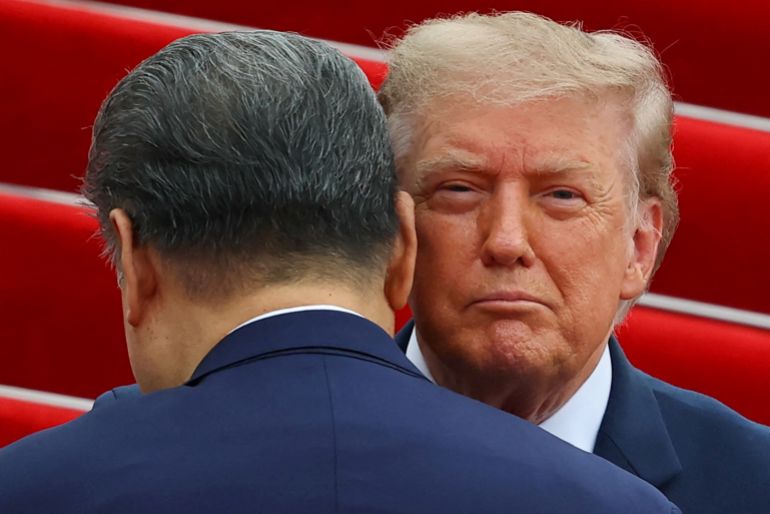
Trump then traveled to Beijing last May for talks with Xi, who then visited Washington in September for the first time in more than a decade. Trump embraced the Chinese president when he arrived in Shenzhen, China’s technology hub, earlier this month for this year’s APEC summit.
But then Trump returned to Washington and, within a week, his administration announced a new tariff regime – his second attempt to reshape his trade war after the Supreme Court declared last year’s April Liberation Day tariffs illegal.
“The practical goal is simple: rebuild (the) tariff leverage that the Supreme Court removed and force Beijing to the table before the next summit,” said Alicia Garcia-Herrero, chief Asia-Pacific economist at investment bank Natixis.

“The goal has changed somewhat”
This time, the Trump administration announced plans to impose new tariffs on 14 of its major trading partners, including China, the European Union and India, accusing them of flooding global markets with cheap goods through unfair government subsidies, policies and wage suppression.
China is subject to the highest rates – a new 20 percent levy that remains within the trade truce set to expire in January. Washington has, however, threatened to impose a 40 percent tax if trade negotiations fail.
Instead of the emergency powers it used the first time — and which the Supreme Court struck down — the Trump administration is using Section 301 of the Trade Act of 1974, alleging that targeted countries are using “excess structural capacity.” The organization identified these 14 specific economies in a survey launched in March, but considers China the main offender, particularly in the steel, aluminum, electric cars, appliances and solar panel sectors.
Deborah Elms, head of trade policy at the Hinrich Foundation, a trade policy think tank in Singapore, said the “original intent” of the survey “was to provide a more sustainable path back to the tariff levels” announced on Liberation Day.
“Over this period, I think the focus has changed somewhat,” she told Al Jazeera.
“Originally a means of implementing tariffs, it seems clear that the White House wants broader use of Section 301, which allows a wide range of activities to be subject to possible negotiations and future sanctions like tariffs,” she added.
Elms argued that Trump’s announcement “is pretty interesting now,” given that he is scheduled to meet with Xi next month in Miami at the G20 leaders’ summit. “This announcement adds another layer of possible tensions,” she said.

“Right to retaliate”
Just before Trump landed in Shenzhen, where he was greeted by Xi on the tarmac, earlier this month, the Chinese leader opened the Asia-Pacific Economic Cooperation (APEC) leaders’ meeting by calling for “reducing barriers to trade and investment.”
Xi also presented Beijing as a stable trading partner, unlike the United States, where Trump’s tariff war had already shaken global economic equations.
In response to the latest round of tariffs this week, Beijing warned that it “reserves the right” to retaliate with higher tariffs.
“China urges the United States to correct its bad practices and return to the right track to resolve issues through dialogue and consultation,” a Commerce Ministry spokesperson said, adding that Beijing “will resolutely safeguard its legitimate rights and interests.”
Referring to the eight-month investigation into “structural overcapacity” practices undertaken by Jamieson Greer, Trump’s trade representative, China said it was “a typical act of unilateralism that seriously disrupts the international economic order and seriously violates WTO rules.”
With the latest measures, Washington seeks to expand its economic confrontation with Beijing beyond bilateral trade, targeting the industrial policies of countries emerging as alternative production centers but whose supply chains remain closely linked to those of China.
Elms, of the Hinrich Foundation, told Al Jazeera that while Beijing “is probably OK with a 20% tariff, it is arguably less comfortable with trying to hold all other trading partners accountable to the United States for their engagement with China.”

“China can mitigate this”
Herrero, of investment bank Natixis, said Trump’s latest tariffs “are less a grand strategy than a familiar negotiating ploy: keeping the pressure on after a friendly photo op,” referring to the Shenzhen meeting.
“The justification given is Chinese overcapacity,” she said, adding that the goal, however, is to “rebuild tariff leverage” and “force Beijing to the table before the next summit.”
Chen Bo, a senior research fellow at the National University of Singapore (NUS), said the new measures replace the removed reciprocal tariffs, with “the same kind of inherent reasons or motivations”.
Bo argued that the U.S. government “must raise funds to continue its many activities, including the war against Iran.” Additionally, “they can’t rely on the bond market due to high interest rates – and consumer inflation has already hit them hard in the midterm election results.”
“Tariff money is one of the easiest ways to finance yourself, rather than asking Congress for more,” Bo told Al Jazeera.
Despite nearly a decade of lingering trade tensions between the United States and China, Beijing’s global trade surplus hit a record $1.19 trillion last year, underscoring the scale of its export dominance. For comparison, the United States had a goods trade deficit of $1.24 trillion during the same period.
“Nothing has changed substantially over the years,” he said, adding that “no new tariff will be effective in reducing Chinese overcapacity, not significantly.”
Bo said he believed China and the United States were “working hard on trade negotiations to de-escalate or mitigate” before the two leaders meet again next month, where they want to discuss issues including AI, nuclear weapons and the wars in Iran and Ukraine. “It’s a much bigger vision for them than a business relationship,” Bo said.
On the Beijing side, Herrero declared that “China can still blunt” these new American measures.
“Rare earths remain its most effective tool,” she added.
“The risk for Trump is the same as always: Higher prices pass through to American consumers and the entire trade system crumbles even further,” Herrero said. “Whether this counts as a feature or a bug depends on how much pain Washington is willing to absorb.”
Gn world