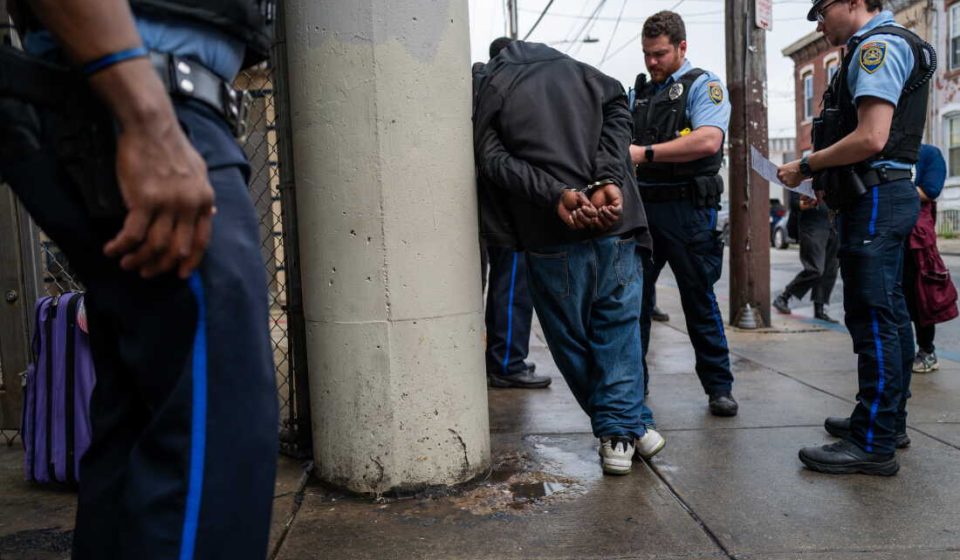


Police arrest a man as the City of Philadelphia begins clearing a drug encampment in the Kensington neighborhood of Philadelphia, May 8, 2024.
Spencer Platt/Getty Images/Getty Images North America
hide caption
Spencer Platt/Getty Images/Getty Images North America
Arrests for minor crimes, including vagrancy and drug possession, increased in the United States between 2024 and 2025, even as rates of violent crime, including homicide, fell to historic lows, according to a new analysis of federal data from the criminal justice and immigration reform advocacy group FWD.us.
Zoë Towns, executive director of FWD.us, spoke with NPR ahead of the report’s release Wednesday.
“This increase signals a really worrying return to some of the extreme law-and-order policies that defined America’s criminal justice system in the ’80s and ’90s,” Towns said, referring to the tough-on-crime policies of the era, including mandatory minimum prison sentences, that led to massive increases in U.S. incarceration for decades.
The report analyzes publicly available arrest data from the FBI and immigration authorities and does not indicate whether charges were dropped or whether people served jail or prison time.
Still, Towns said, “An arrest has life-changing consequences for the person involved and their family. This could mean days or months in prison.
An FBI representative did not immediately respond to a request for comment on this analysis.
The findings
Four states, California, Hawaii, Nevada and Arizona, accounted for more than half of the increase in vagrancy arrests, according to the report. The legal definition of vagrancy is “roaming from one place to another without permanent employment, a home or material resources.” In practice, it is applied disproportionately to homeless people.
FWD.us found that vagrancy arrests increased by 44% (22,769 in 2024 to 32,728 in 2025).
Two demographic groups made up the majority of arrests: Asian Americans, as well as Native Hawaiians and other Pacific Islanders. Although AANHPI members represent only about 7 percent of the U.S. population, they are responsible for 17 percent of the increase in vagrancy arrests, largely in Hawaii, according to FWD.us.
Arrests for marijuana possession increased 6%, mostly in Southern states that have not yet legalized the drug. The report shows there were 190,182 arrests in 2024 and 201,273 a year later.
There was a stark racial disparity in people arrested for marijuana possession: Black people accounted for 83% of the national increase in marijuana arrests in 2025, and nearly half of all cannabis arrests were of Black people (45%).
Arrests for possession of drugs other than marijuana increased slightly between 2024 and 2025. The report found a 3% national increase in arrests, to 508,087 in 2024 and 523,520 in 2025.
This increase appears to be linked to the collapse of policies decriminalizing drug possession in some states.
Voters in California (which saw the largest increase in drug possession arrests) voted in 2024 to overturn a measure that had reclassified drug possession from a felony to a misdemeanor. Voter-approved Proposition 36 increases criminal penalties for repeat thieves and drug users. FWD.us claims that arrests for drug possession increased by more than 14,000 in a single year after its passage.
That same year, Oregon also reinstated a policy that made simple drug possession a criminal offense again. This resulted in a 39% (2,205) increase in arrests for possession of drugs other than marijuana.
The report also highlights the sharp increase (188%) in arrests for immigration violations during this period – a trend already covered by NPR. In 2024, 109,936 arrests for immigration violations were reported. A year later, in 2025, those arrests totaled 316,304.
Why is this happening now?
FWD.us ties the increases, in part, to changes at the federal level.
The data reviewed by FWD.us covers the first full year of President Trump’s second term. At that time, the administration relied on a tough-on-crime message.
He stepped up his deportation efforts, arresting hundreds of thousands of people nationwide, many of whom had no criminal convictions. Millions of federal dollars have also been sent to local police through the 287(g) program, which allows local police to make immigration-related arrests.
FWD believes that federal deployments of immigration agents and the National Guard may also have led to increased police surveillance and, therefore, more arrests.
In the summer of 2025, Trump claimed that U.S. cities including Washington, D.C., were suffering from a “crime emergency” — despite data showing violent crime in the city was at an all-time high in 2024. He sent hundreds of National Guard troops to the city.
FWD.us found that arrests in Washington for marijuana possession “more than doubled” following the Trump administration’s deployment of the National Guard to the city.
Vagrancy arrests may also be linked to the Supreme Court’s actions, according to the FWD report. Two years ago, judges ruled that cities could ban people from sleeping and camping in public places. The ruling allowed Oregon and dozens of other Western localities to limit where people living in cars, parks and other encampments can stay.
Insha Rahman, president and director of the nonprofit Vera Institute for Criminal Justice Reform, says there are still “incredibly positive trends” showing crime is down across the board.
Adult arrests for drug crimes peaked in 2006 at about 1.7 million, more than 2.5 times the number recorded in 1980.
And continued a downward trend.
Rahman says the decline “is a testament to the resilience of states and localities that have continued to step up and invest in what works.” Vera was not involved in the FWD.us report.
This includes investing in treatment and diversion programs that provide assistance to people struggling with addiction, community violence intervention programs, youth services, counseling and alternative response programs.
Gn headline