
Stay informed with free updates
Simply register at Artificial intelligence myFT Digest – delivered straight to your inbox.
Pope Leo
Huang, along with U.S. President Donald Trump, rejected calls from artificial intelligence labs OpenAI and Anthropic to coordinate and slow model development and introduce more regulations following a series of high-profile hacking incidents and public warnings about the technology’s existential risks.
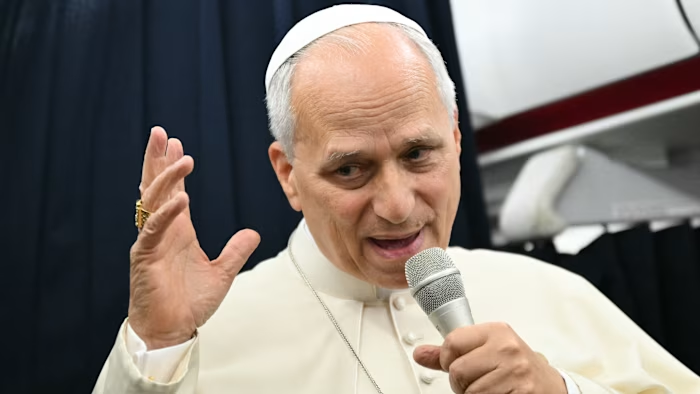
Leo told reporters that he had read reports on Monday that Nvidia had launched new security tools for modelers, but he questioned Huang’s commitment to security in light of his recent comments.
“But he’s the same one who says there should be no limits or government regulations,” Leo said on the flight back to Rome after a visit to France.
“I think the concerns raised by many experts, specialists in AI, must be taken seriously,” he added.
The pope’s blow against the head of the world’s most valuable company speaks to the extraordinary level of concern over AI security issues, which have become a top priority for leaders around the world.
OpenAI’s Sam Altman and Anthropic’s Dario Amodei appeared at the UN Security Council last week to address the issue and advocate for greater global cooperation.
But pressure for international action on AI safeguards was blocked by Trump, who called warnings that the technology could threaten humanity a “hoax” and rejected any “globalist plans to control superintelligence.”
Leo, who has clashed with Trump on several occasions, said AI anxiety was not “fake news, as some have said.”
“If someone asked me, ‘Am I in panic mode?’ No, I’m not. I sleep at night,” Leo said. “It’s an issue that I think we need to sit down and talk about.”
The pontiff’s comment on Nvidia comes after the $5.5 trillion chipmaker unveiled a new set of security tools aimed at controlling the activity of AI agents — robots that can operate autonomously — including a system called “Sentry” that tracks agent behavior using Nvidia’s “data processing unit” chips.
An Nvidia executive told reporters that these tools would have prevented a high-profile hack of Hugging Face in July by OpenAI agents, sparking a new debate about the risks posed by AI.
“Interestingly, just today I read that the boss of Nvidia claims to have found a way to put some guardrails into AI,” Leo said.
Since assuming the papacy last year, Chicago-born Pope Leo has shown great interest in AI. In May, he released an official letter known as an “encyclical” in which he asserted that AI is not morally neutral and must be “disarmed” through robust regulation to ensure it serves humanity rather than undermining it.
Last week, it emerged that OpenAI’s models had hacked dozens of websites, including an Australian health department website, during routine training.
The Nvidia chief has spent recent weeks joining forces with Trump to oppose the need for additional regulation or oversight, emphasizing that the responsibility for ensuring security lies with each company.
“The market forces are already there. We don’t need new laws. We don’t need new regulations,” Huang said earlier this month.
Huang, who has become one of Trump’s closest tech executives, responded to a call from the president on stage at an event in which he acknowledged the concerns were a hoax.
Leo’s intervention comes as AI executives are scheduled to meet with Trump and US lawmakers at the White House on Tuesday.
Trump had dinner with Amodei on Sunday evening, in a gesture of detente with the company after the Pentagon banned its products when Anthropic tried to restrict their use in warfare.
Nvidia declined to comment.
Gn usa