
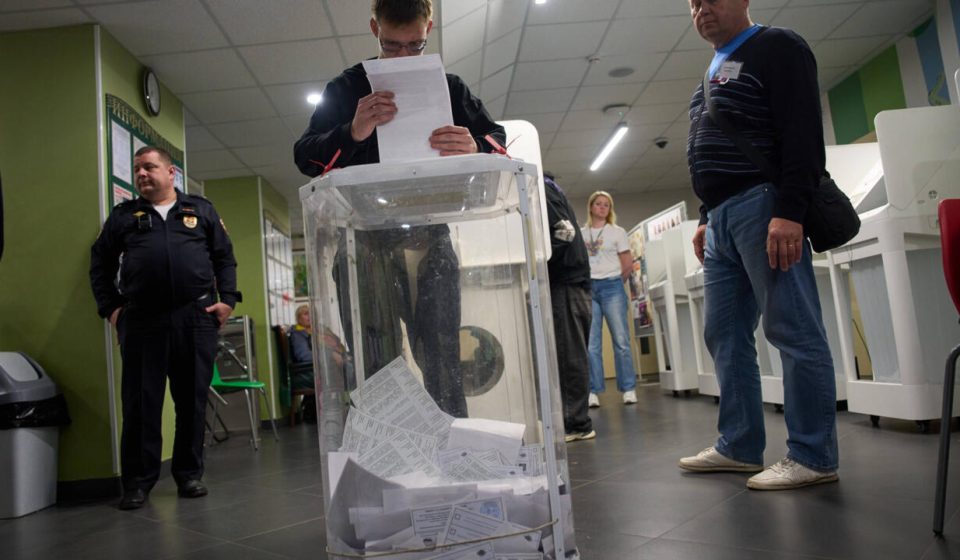

Unsurprisingly, Vladimir Putin’s party won the legislative elections on Sunday September 20, a vote marked by computer hacking and Ukrainian drone attacks to which Moscow promised a response.
According to an exit poll carried out by the Russian Center for the Study of Public Opinion (VCIOM), a state institute, United Russia won 49.4% of the vote, approximately the same score as in 2021, after three days of voting in the midst of the war in Ukraine.
Dmitry Medvedev, the former Russian president and current head of the Kremlin United Russia party, “thanked the citizens who took part in the vote”.
See alsoMarie Jégo: “Putin wants to make these legislative elections the emblem of public support for his war”
The vote took place without suspense in a country where the expression of dissent is severely repressed by the authorities and where the only party directly opposed to the war, Yabloko, was sidelined.
Facing the Kremlin party, only groups supporting to varying degrees Vladimir Putin and the continuation of the conflict in Ukraine – the communists of the KPRF, the nationalists of the LDPR, the conservatives of Fair Russia and the liberals of the New People party – were allowed to compete.
The Communist Party and the nationalist LDPR party are respectively credited with 14.2% and 10.7%.
The head of the Electoral Commission, Ella Pamfilova, indicated that the preliminary results would be announced on Monday at 11:00 a.m. (8:00 GMT).
These legislative elections, the first since the start of the large-scale offensive against Ukraine in 2022, aim to renew the 450 seats in the Duma, the lower house of the Russian Parliament. They also took place in the territories of Ukraine occupied and annexed by Russia.
“Very significant impact in the Moscow region”
Recalling the reality of a conflict marked in recent months by an intensification of strikes on both sides of the front, the last day of voting was marked early Sunday by a Ukrainian attack which involved more than a thousand drones, hitting a refinery and residential areas, causing fires.
At least two people were killed and around twenty others injured, according to Russian authorities.
A Ukrainian drone also struck a bus in the Kherson region, in southern Ukraine controlled by Russia, killing two people including an employee of the Election Commission, the Commission announced.
See alsoLegislative elections in Russia: Moscow accuses kyiv of disrupting the vote
In Moscow itself, a major refinery was damaged, according to Mayor Sergei Sobyanin, who denounced an attack “unprecedented” and “obviously planned with the aim of disrupting the elections”. He spoke of more than 1,600 drones shot down by Russian air defense, of which “450 were heading towards Moscow.”
In the evening, the Russian Defense Ministry assured that Moscow would “continue and intensify” its strikes using “high-precision weapons against military targets in kyiv”, in response to these attacks.
Ukrainian President Volodymyr Zelensky assured that Ukraine’s strikes “had a very significant impact in the Moscow region”, affirming that around ten different weapons were used.
“Powerful cyberattack”
At the same time, the Election Commission announced that it had observed “more than a thousand” waves of attacks intended to saturate the electronic voting system with requests, as well as attacks against “Russia’s telecommunications infrastructure as a whole”.
“The attacks were carried out by highly professional and well-coordinated groups, using artificial intelligence tools,” said Ella Pamfilova, referring to attempts showing “signs of Ukrainian interference”.
Ms. Pamfilova had already reported a “powerful cyberattack” which took place on Saturday without bringing down the systems.
This election took place in a tense social context, with Russia facing Western economic sanctions, regular Ukrainian strikes, gasoline shortages and limitations in the functioning of the internet in several regions.
See alsoLegislative elections in Russia: “The result is a foregone conclusion” for a Putin victory
Vitali Ivanov, 63, retired from the Moscow metro, told AFP on Sunday that he had voted “for the communists”. “I have a small pension, it’s not enough to live on,” he explains.
The EU denounces a climate of “systematic and institutionalized repression”
In Moscow, Igor Safronov, a 30-year-old programmer, told AFP that he had voted for the New People party because he “did not want to vote for United Russia.”
In Berlin, which hosts one of the largest diasporas of Russians who have fled their country, a few dozen supporters of the opposition in exile protested with cries of “Russia will be free!” and “No to war!”, noted an AFP journalist.
In London, around a hundred people gathered in front of the Russian embassy, some waving Ukrainian flags, others holding signs reading “Say no to Putin”.
The European Union, for its part, denounced elections taking place in a climate of “systematic and institutionalized repression”.
With AFP